BLANK the money and BLANK

Uncategorized

I.

It’s funny that the less money artists have the less we’re willing to take. Running alongside the dismantling of the welfare state in the UK is the dismantling of its system of arts funding. There is less state money available, and it’s less widely distributed, and arts organisations are being carrot-and-sticked into pursuing the corporate buck. But increasingly the response to this isn’t to scrape and scrounge and take whatever money we can get, but to question where the money’s coming from and what the money can do.

The most high profile campaign on corporate funding is the attack on oil sponsorship of the arts. A coalition of organisations like Liberate Tate, Art Not Oil, and Platform are regularly raising hell by making great art about the oil industry’s artwash of its murderous and racist expansions. The targets are both major British institutions like the Tate, the Royal Shakespeare Company, and the British Museum, and the general public, in a campaign to remove the oil industry’s social license to operate. The work is in solidarity with indigenous activists and climate campaigners as part of a broad attack on big energy.

And as these questions are being asked, arts organisations are being pushed further into corporate sponsorship. ACE’s Catalyst fund supports and trains organisations in seeking funding from beyond state sources, and is also funding exploratory work about the question of funding itself. Catalyst money was involved in the recent funding ethics debate at Artsadmin, Take the money and run, and is also indirectly funding me to write this blogpost, as an artist commissioned to work with Artsadmin as a critical contributor to its Catalyst training and research.

The Take the money and run event was packed with artists and arts workers full of angry questions about how the arts is, will be and should be funded. There was wide opposition to the corporatisation of the sector, support for anti-oil action, questions about how to have an ethical fundraising policy, and demands to camapign for better state funding. In a way, it’s not surprising that this is the response of artists to cuts in funding: with money tight, everyone is thinking about money more, is more aware of where money comes from and what it means, is present to the politics of the issue. Artists have an inconvenient habit of searching out painful ideas, and an tricky inability to let go of them, even when they make art work more difficult.

This is a contribution to the conversation, asking (and trying to answer): What are artists supposed to do about money?

II.

There seems to be a widespread misunderstanding of what a boycott is. A boycott is not a private personal action: it is an organised political campaign. It’s named after a British land agent whose evictions of tenant farmers led to social ostracism and an economic blockade. It succeeded because it was organised to the point of being total.

A personal boycott that’s not part of a broader political campaign is that absurdity, ethical consumerism. Ethical consumerism is the most ineffective political movement I’ve ever heard of. The idea that you can end corporate exploitation and abuse by encouraging people to buy different stuff has no basis in economics: all you’re doing is creating a new market for capitalism to expand into. Supermarkets don’t stop selling coffee grown in the worst possible conditions, they just sell the organic version as well. Sometimes consumer choice can be deployed as part of a broader movement, and sometimes the purchase can be part of building alternative economic structures – as is the case with Fairtrade’s support for co-operatives – but mostly, treated as politics, it’s a con.

Nevertheless, I myself mostly buy organic and Fairtrade goods. I’m even a vegan, albeit a very relaxed one. I can’t bring myself to wear sweatshop clothes or eat megacorp bananas, for the same reason as if I eat meat I can’t get the image of a factory-farmed pig out of my head and feel a personal complicity in the planet burning up. I do most of the ethical consumer things out a vague sense of moral duty and the ongoing construction of who I want to be; I just don’t kid myself that it’s politics.

This pursuit of moral purity defines a lot of this sort of bad politics. Ethical consumerism is an attempt to detach oneself from complicity in genocide and ecocide, an attempt to be a good and separate person in a bad and messy world. To me it feels like it belongs to certain religious traditions, in which sins and good works are totted up on a cosmic balance sheet. I prefer to try and accept that we – the we that I represent, the we of the globally privileged in wealthy countries – are unavoidably complicit in horror, inevitably hypocrites. Worrying about which smartphone is ethically better (spoiler: none of them) and whether or not quinoa is OK to buy since that Guardian article is more about your sense of self-worth than it is about changing the world.

In the arts, there’s now a growing trend of working to institute ethical fundraising policies, rules to make sure organisations aren’t complicit in corporate or state criminality. To me, there’s a risk here that this becomes like ethical consumerism – an attempt to buy a clean moral record, rather than a recognition that funding is politics. A good example is the Tricycle’s failed boycott of Israeli state funding. The Tricycle attempted to claim ethical neutrality – it just wasn’t accepting money from either political actor in a controversial conflict – but opponents easily pointed out the hypocrisy of the position. There was an honourable political approach – joining the major international Boycott, Divestment and Sanctions campaign called for by and in solidarity with Palestinian activists – but by claiming unmaintainable ethical neutrality rather than political commitment, the Tricycle’s attempt failed.

Ethics in arts funding isn’t about you. It isn’t about your personal values. It’s about leveraging cultural power to change something. I join a campaign against oil sponsorship of arts institutions I love not because I feel dirty being associated with oil (I need to accept that I’m morally complicit), but because I think that campaign might be a major wound to an industry that’s killing us. We each come to our own compromise the the world, our own ethical lines that help us to live in a terrifyingly oppressive system – but beyond that, we can campaign, and boycott is one of the tools available to us. When that boycott is called for by those constituencies most affected by the target, it truly isn’t about you: your moral sense is outraged, but your political self must act.

III.

Something which came up repeatedly at Take the money and run was how special art is. How art liberates us, how art takes us to a better place, how art helps us imagine different worlds. These are all things I’d love to be true, and I think that they succeed in being true sometimes, but I’m sceptical about how the argument is often used: that art is special, and we can’t allow commerce to debase it.

Only recently has art become anything other than a plaything of the ruling classes. The culture that the majority of people enjoyed – folk music, say, or street games, or storytelling, or craft – were considered mere entertainment, or mere artisanry, while the arts – opera, ballet, literature – were bought and paid for as ways for the powerful to feel special. Artists were special creatures too, paid for by patrons, while artisans and entertainers had a lower status as workers or, in worse cases, drop-outs. Art as we understand it is a ruling class creation. What’s happened now is that we’ve opened up the category of art in terms of both participants – we want more people to be artists – and audiences – we want access to great art for everyone.

The result is an arts industry that has contradictions at its heart, that combines vaguely liberal ideologies of mass participation with elitist historical roots. Its artists want to be paid properly as workers, but also want to feel like they float about the drudgery of employment. It tries to make art accessible, but remains vaguely attached to the idea that artworks are a special sort of thing and not what everyone enjoys. It wants funding, but doesn’t want to lower itself into the mire of commerce.

We need to avoid assuming that commerce is an inherently bad thing to let into art, and instead ask about the power relations that are involved in different forms of funding. When a sponsor, patron, trust or funding body gives us money, what power are they giving and what power are they taking? What do they get from us, and what do we forget we are giving them? What creative control are they asking for? What social license do they walk away with? How does the art they fund reinforce their power? How might the art they fund undermine their power without them realising it?

A corporate sponsor might artwash, gaining social acceptability through its sponsorship of major institutions, as is the case with BP. A corporate sponsor might ask for creative input on the artwork, turning the art itself into a large scale advert. An arts culture built entirely on corporate sponsorship means that the only art that will get paid for is the art preferred by the rich. But a corporate sponsor might, just sometimes, might be a hands-off source of money, and a corporate sponsor might, just sometimes, not be paying enough attention to what you’re actually doing with their cash.

The goal of seeking funding is to get more great art made; ethical arts funding needs to be about making sure that art doesn’t end up giving more power to those who would destroy us. But there are also some deeper questions that considering where our money comes from gets us to: if we have ambitions for art to be something other than rich people’s toys, how might we make it differently? And what kind of funding might that need to make it happen? Sometimes I think we might be better off destroying the category of art entirely.

IV.

Despite the speed with which artists criticise corporate funding, we’re oddly at ease with state funding. And I’m writing in the British context, about a state built on empire, genocide and slavery, a state which continues to be complicit in financial colonialism and aggressively exploitative globalisation. In terms of the ethical record of funders, you can’t get much worse than the British state: every pound I take from it is a deeply compromised pound.

One difference between state and corporate funding is the chimera of democracy: the idea that when we take money from the state, we’re taking money from an instution we’re supposed to have some kind of democratic control of. The idea, the ideal, is that state funding makes great art happen that couldn’t happen otherwise, ensures that art gets made for and with diverse populations rather than just to the preferences of the rich, and is distributed in some way according to popular will. This ideal bears very little relationship to reality.

As an example, the Arts Council of England spends 15 times as much money per head on London organisations as it does outside the capital, and invests disproportionately huge sums in particular in national opera, ballet and literary theatre. Arts funding, even as it is being cut, shores up the institutions of power. Meanwhile, as the UK’s apathy vote rises, its major parties refuse to adopt the most popular possible policies in favour of cronyism, and its two party system begins to collapse, it’s hardly possible to say that the British state feels particularly good at offering democratic control of resources.

Just as corporate funding has obvious risks, state funding needs to be criticised and problematised. It’s not just in totalitarian regimes that state-funded art props up power: we have to ask to what degree the ruling classes decide where the money is spent, and how much control arts councils give them over distribution. In the UK, as the more independent arts councils are cut, government culture department funding increasingly supports national ideologies – it won’t be long, I’m sure, before DCMS requires funded organisations to disseminate “British values”. Campaigns for ethical funding need to also be campaigns for better state funding – not just more money, but money better distributed, with more democratic control over the distribution.

But then again, these campaigns for ethical funding both tend to imagine that states and corporations can be reformed into perfection; that with enough political pressure, we’ll get a state capitalist system we can all be happy with. Personally, I think that’s nonsense. Personally, I think that the ruling classes can only support ethical funding campaigns as long as the foundation of their power is threatened, and that such campaigns are worth very little, and that more powerful and honest campaigns will bring us into conflicts with the very systems of power we seek to reform. But that said, I’m happy for now to form liberal alliances for transitional reforms – if nothing else, because I refuse to fetishise poverty, and I need to get paid too.

V.

So what can you do? If all money is dirty, if all artists are hypocrites, and if all funding is ethically compromised, what actions are available to you? I’d argue that accepting the brokenness of everything is a great place to start from if you want to make real and radical changes. I’d also argue that refusing the cling to the purity of any given action opens up a wide portfolio of strategies: rather than trying to hold our ethical ground, we can fight a guerilla war, adopting different tactics as needed to win the world we want. Here are four possibilities:

Take the Money and Run. Artists need to get paid, and the system we need to get paid by is inherently oppressive, exploitative and abusive. You’re going to have to accept you’re complicit, and you’re going to have to learn to hold your nose. Or rather, you’re going to have to learn when, for what and for whom it’s worth holding your nose, right to hold your nose. Remember that you’re own survival is important, and that the work you’re doing is important, and decide to make the kind of compromises you can live with. Accept that you’re a hypocrite, and make art that matters. Make your life strong so that you can fight back.

Steal the Money and Smash. Sometimes, they’re not paying attention, and sometimes taking money from a dubious organisation is an excellent way in to cause them some damage. I heard a story once about an artist who took some money from Vodafone’s World of Difference fund at a time when the mobile giant was the target of a major pay-your-tax campaign. The artist used the money to work for a local radical social centre, and leaked passwords to the Vodafone Foundations’ blogging platform to activists, enabling some troublemakers to plaster the company’s website with propaganda for a couple of days and grab some headlines. This story makes it seem possible to cause more damage to a funder than the benefit they gain by artwashing you. Stay alert for opportunities to use their money against them!

Hate the Money and Shout. But sometimes we need the boycott tactic. Sometimes we need to be able to state clearly that a given funder is not acceptable, and make a paraiah of the national institutions lending their reputation to corporate abusers. This is especially the case when the campaign is called for and organised with those on the receiving end of oppression: boycott must always be more about solidarity with those struggling than individual moral worth. When you boycott, organise with others, and turn it into an extraordinary event. You’ll always need to have arguments ready to turn away the easy charge of hypocrisy, but boycott can be one of the biggest ways to shift public perception.

Fuck the Money and Build. The only people who we can really trust, who really need to be able to trust, are each other. Artists, activists and all the people struggling in oppressive systems need to be able to build their own systems of support and mutual aid. A sector of atomised artists each struggling over numbing funding applications and neurotic sponsorship bids is no good for anyone, or for art. We need independently-funded arts and social centres. We need workers co-ops. We need to be honest with each other about money. We need more radical unions. We need to make money off cheap tickets, cheap drinks, cheap food and use it to pay each other. We need to learn how to build autonomous systems of support. We need to look after each other.

*

This article was written as part of a commission with Artsadmin to explore arts funding through attending events, critical thought, writing and a new artwork. All opinions, however, are purely my own and not necessarily those of anyone in the organisation. It was originally published at http://www.artsadmin.co.uk/artsonline/

Images: “where are we now / no money no art”, from Flickr user aestheticsofcrisis, “money is destroying art and culture”, from Flickr user acb, both licensed under Creative Commons Attribution-NonCommercial-ShareAlike 2.0 Generic license, and still from “The K-Foundation Burn a Million Quid” from http://en.wikipedia.org/wiki/File:The_K-Foundation_Burn_a_Million_Quid.jpg for licensing.
Readan List

orkney, Poetry

2015-04-22 18.54.15

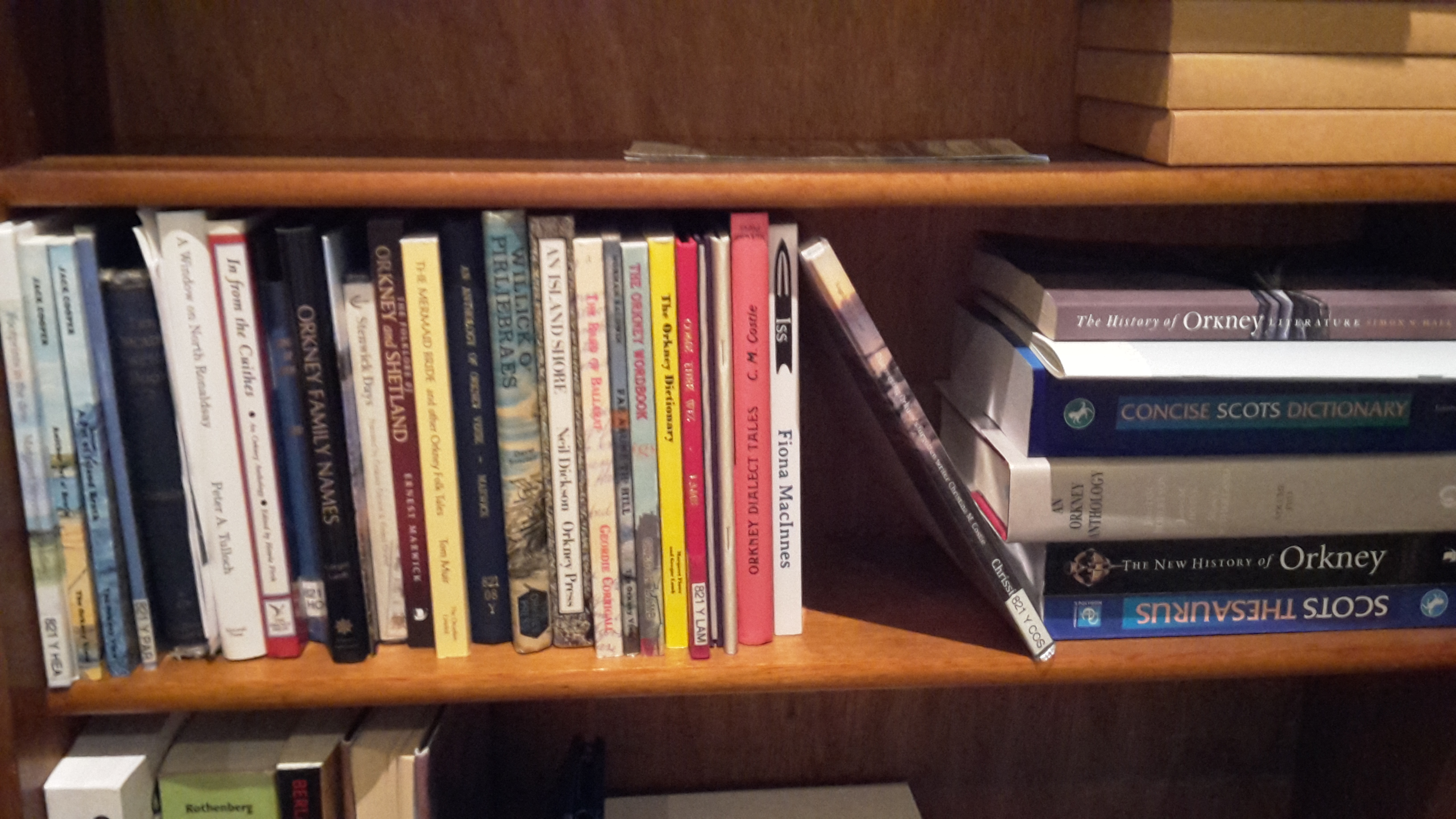
In the first twa week in Orkney A’m spent maist o me oors bletheran wi local writers an scooran the shelfs o the Orkney Library & Archive – a piece at yet feels lik a haem fae haem, een a decade eftir flittan sooth. (Hid’s uncan whan yir teenage hingoot is Big On Twitter.) A’m tryan tae pit thegither a readan list o aathing A cin find at’s wrote in Orkney language / dialect

Orkney haes a grand writan and publeeshan culture. The Orcadian Bookshop‘s shelves are haevan wi Orkney beuks – local history, memoirs, novels, poetry, bairns’ beuks, photography, archaeology an a haep mair – an the Orkney Room at the Archive is fill o inspiration. Thare’s plenty o fock writan fae here an aboot here. Bit hid’s remerkable tae me at so little o hid, past an present, is wrote in the local language, especially whan the clossest comparator, Shetland, haes that rich a Shetlandic literatur, led bi Shetland ForWirds an the New Shetlander. Hou that is will hae tae bide fer anither time, bit A’d walcome yir thowts.

Christina Costie an Robert Rendall are weel-kent fir thir early mid-20th century Orkney dialect poetry, an cheust recently we’ve haed twatree publeecations o contemporary poetry at cid herald a new floueran. In the years in atween, maist o the use o Orkney dialect haes been in the dialogue in local stories an reminiscences, maist affens publeeshed in the 1980s, but blydely publeeshed yet. Thare’s a peedie bit consistent an culturally-important tradeetion o comic verse forbye, wi o coorse an overlap wi the formal poetry.

This is a stairtan readan list, an A’m likely left oot a haep o whit thare is. Hid’s aathing A’m foond so far at’s wrote in or aboot Orkney language or haes a peedie bit o dialect material. If yi ken o things A’m missed, A’d love tae hear aboot hid.

(Bi the wey, A’m yet feeguran oot hou A want tae spell an use dialect, bit A’m got tae haad tae experimentan tae dae hid, sae thank yi fer yir beirance an feel free tae point oot the mistaks.)

Poetry

Andersson Burnett, Linda (ed): Archipelagos: Poems from Writing the North (2014): Original contemporary poetry respondan tae the literatur o Orkney an Shetland. Includes some o the peedie bit thare is o publeeshed contemporary dialect poetry.

Corrigal, G: Bard of Ballarat (1997, written early 20th C): humorous verse, mixan Orcadian and English gey fluidly. Tape recordan avaelable.

Costie, CM: Wullie O’ Skippigoe: collects dialect poems previously publeeshed in Collected Poems (1974) an But-End Ballans (1949) wi new material. Gey rich an complex use o dialect.

Horne, D: Songs of Orkney (early 20th C). Maistly English, some Orcadian but as a mixter-maxter wi cheneral Scots.

Lamb, G: Come Thee Wiz / Nivver Spaek! (late 20th C). Humorous dialect verse. Tape recordan avaelable.

MacInnes, M: Alias Isobel (2008): Contemporary dialect poetry – the only example o a fill pamphlet A ken o.

Orkney Heritage Society: Orkney Dialect Poetry Competition (2010): Contemporary dialect poetry o ivry kin.

Parkins, HS: Seven year o Yule days (2002) / The long, long night (2005): Humorous dialect verse.

Rendall, Robert: Collected Poems (1940-1966). Orcadian an English, maistly formal verse. His arteecle ‘The Literary Uses of Dialect’ (avaelable in An Island Shore) is an interestan entry intae the language debates o the Scots Renaissance.

Novels

A’m no fully dellit intae Orkney novels tae leuk at the uses o dialect, bit A’m foond at hid’s affen no used e’en whan Orkney folk are takkin in hitoreecal novels, or cheust a wird or twa is used. A’m only foond wan geud exemple yet. As far’s A ken hid’s cheust been used in the dialogue an naebdy’s attemptit an Orcadian narration – yet. So suchestions wid be parteecularly walcome here.

MacInnes, F: Iss (2014). Novel o class an identity. Muckle o the dialogue is dialect, rendered phonetically in a free-flowan non-standardised wey, an gey interestan fer hids attenteeveness tae dialect differs atween pareeshes an classes.

Short Stories

A doot A’m missan a fair few exemples o the genre o reminiscences an stories o local life, maist usan dialect in the dialogue, an maistly publeeshed in the local paper(s) afore anthologisation.

Baldwin, N: Fae Abune th’ Hill (1987). Record o local life fae a serviceman’s perspective, includan muckle dialect dialogue. Wrote pairtly wi an interest in recordan an preservan dialect, but wi ootside lugs.

Campbell, H: Island Notes in War Time (1919) /nJean’s Garden and How It Grew (1927): Muckle dialect dialogue.

Cooper, J: A Pot of Island Broth (1988) / Anither Pot o’ Broth (1989): Stories, reminiscences an poems, wi some dialect dialogue.

Costie, CM: Collected Orkney Dialect Tales (1976): Dialect no cheust in the dialogue bit in the narration, an the richest an maist complex use o dialect A ken o.

Johnson, RT: Stenwick Days (1984) / Orcadian Nights. Humorous stories o local life includan dialect dialogue. Audiobook wi dialect spaekers avaelable.

Nicol, T: Tales from Eynhallow (1992). Stories an reminiscences wi some dialect dialogue.

Sinclair, D: Willick O’ Pirliebraes (1981) / Willick and the Black, Black Oil (1994). Humorous stories o local life wi muckle dialect dialogue.

Stevenson Headley, M: The Voldro’s Nest (1986) / Mixter-Maxter (2006) / Footprints in the Dew (2011). Stories, reminiscences an poems, wi some dialect dialogue.

Anthologies

Firth, H: In from the Cuithes (1995). Some dialect in the dialogue in narratives an stories.

Marwick, E: An Anthology of Orkney Verse (1949). Maitly English, but wi some dialect poetry o the time an some fock poetry rendered in dialect.

Marwick, E: An Orkney Anthology Vol II (2012). pp289-352 collect wird-lists an essays on dialect.

Traill Dennison, W: The Orcadian Sketchbook (1880). Stories, poems an miscellany: a fouondational text o dialect literatur.

Resources an Analysis

Flaws, M an Lamb, G: The Orkney Dictionary (2005): Word-lists fae the Orkney Wordbook, bit includes English-tae-Orcadian section, an suchestions on grammar, spellan an pronunciation – the beginnans o a standardised Orcadian orthography.

Hall, S: The History of Orkney Literature (2010): Sterkly estableeshes an analyses a canon o Orkney literatur reutit in historical an literary contexts.

Lamb, G: The Orkney Wordbook (2012): Extensive word-lists wi etymolochies an usaches.

Lamb, G: Orkney Family Names (2003) / Testimony of the Orkneyingar: the placenames of Orkney (1993): Extensive etymolochies fer the proper noun aspects o the language.

Ljosland, Ragnhild: Chrissie’s Bodle (2011). Biography an analysis o Christina Costie, includan commentary on uses o dialect.

Rendall, T: Voices Aroond the Flow (2013): Analysis o cheenging dialect in the 20th Century in the areas aroond Scapa Flow.

A’m maistly left oot academic an linguistic analysis, fer thare’s that muckle o hid an thare’ll be better bibliographies than A cin pit thegeiher. Hid is vital tae understandan dialect writan, tho. Northern Lights, Northern Words: Vol. 2 of The Languages of Scotland and Ulster is a geud broad survey o the field.

From the Archive

A’m cheust staritit tae dell intae whit’s avaelable here. The papers o J.S. Clouston, S. Cursiter, E.W. Marwick an J. Mooney aa hae dialect stories an poems, some unpubleeshed.

The wallie soond archive is the best resource fer cheust listenan tae spokken dialect. Radio Orkney’s ootput is affens digitised an totally brilliant. Stairt here:

What I mean when I say I’m working as an artist (Part 2)

Uncategorized

After work

Two years ago I wrote a post called What I mean when I say I’m working as an artist. It was an attempt to explain my life to my friends and family (and to myself); a way to take stock of my finances and understand what I needed to do; and a small and early entry into a growing debate about paying artists — a debate that I’m glad to say has since got a much bigger profile. I’ve just done my tax return for 2014-15 disgustingly early in the hopes of arranging a rebate for overpaid tax, so I thought it was time for an update. I feel like a lot has changed in my life — in September 2014 I became a “full-time” artist — but reading the first post I’m surprised by how much still rings true. My understanding has advanced, and my commitment to my work has deepened and become more serious, and I get some better commissions, but my finances and work hours are remarkably similar. I am, however, a lot more obsessed by money. This version uses some of the same text, but is less about explaining what an artist’s life is like and more about looking at where my work comes from and how much money I make.

I’m writing this now for all the same reasons: to explain myself to myself and to the world, and to advocate for better pay. But I’m also sharing it in the interests of transparency. Since I wrote the original post, Bryony Kimmings instigated a project called I’ll Show You Mine, which for a while organised discussions and encouraged transparency about fees and wages. The idea is that if more of us share our finances, more of us understand what we’re worth, how hard it is, and what it takes to live off our art. This post is for other artists, in the hope that they might share things too. But most of all, this is a post for the producers and programmers I work with: Hi! Thank you for all your support and encouragement. Thank you for the opportunities. This is what my finances are like. This is what I live off. I am a moderately successful early-career artist, and I earn vastly below a living wage. Now pay me.

My Work

I make poems and shows and games. I also co-curate the performance night ANATOMY (on hiatus while we try to get the funding to pay ourselves and our acts properly), and occasionally programme or produce other events. Mostly I work in what’s recognisable as the professional poetry and theatre sectors, but I cross over into the performance art end of visual art sometimes, and I increasingly do things adjacent to digital art and digital games development as well.

I finished full-time education just under five years ago. This means that for most purposes I’m an “early career” artist, and in many cases I’m still “emerging”, though some opportunities for those categories cut off after five years, so I hope to have fully “emerged” at some point soon. (I wrote more about what these categories mean last time.) I do get bookings and commissions targeted at early career artist development, but increasingly I put myself into a broader pool of professional artists. My profile is, I think, a little bit higher than peers at a similar stage, mostly because I’m a loud-mouth on social media. Occasionally this leads to work. Occasionally — but, I hope, less occasionally — I suspect that it makes getting work harder.

I’m fully freelance, which on the one hand means I get to write off a lot of things against expenses (a portion of my rent as my home office, my artistic interests as research), and on the other hand means I have a lot more expenses: my office and all supplies, lots of travel, liability insurance, all my NICs, and so on. I also have no job security, no job-related benefits, and no-one’s paying into a work pension for me.

My income is all over the place. A chunk of my money comes from fees from venues and programmers who book or commission me, a chunk comes from paid residencies, a bit comes from my own national funding body grant applications, and a bit comes from box office splits. I don’t have a strong idea of where most of my money should be coming from for it to look sustainable. So far, commissions and residencies have mostly paid my way, but I’m experimenting with building up my ability to tour shows and give workshops, hoping to strengthen my income. It’s still a mess, for now.

I work a six-day week, around seven hours a day. I’m trying to cut it down. To be an artist, I have to plan the art, make the art, organise places to put the art, and find ways to finance the art. These things can happen in any order, and which order they happen in largely depends on whether or not someone’s going to pay me and how much control they want over the product. On average, each month (counting a month as 4 weeks, and a day as 7 hours), I spend roughly

  • 4 days writing
  • 5 days performing or preparing for performances;
  • 4 days writing and answering emails, or doing general admin;
  • 4 days in meetings and interviews
  • 3 days writing proposals and funding bids;
  • 2 days planning and running workshops.
  • 2 days writing texts like this

This is a fairly conservative estimate of how much time I spend on the “hard work” bit of being an artist. You will note that of the 24 days of hard work each month, only just under half is spent on what you might think of as the fun bit – or at least the creatively satisfying bit – of making art. Before I was full-time, it was around a third of my “being an artist” time, because everything had to be crammed in; now I’m able to give things a little longer to develop.

I used to have a long-term part-time non-artistic contract, which gave me enough to live off while I developed my practice. At that time, I worked well over the UK’s legal maximum working week (48 hours, or six eight-hour days a week). I do work less now, because anything else is completely unsustainable and results in more weeks of not being able to get out of bed. But I’m still using conservative numbers above, and I’ve only included the “hard work”. Making art also involves a lot of “soft work”. To make good art, or at least to make successful art (by mainstream standards of success), you’ve got to be constantly actively engaged with the world and the art other people are making. (Action Hero have a lovely, empowering blogpost on this subject, among other great advice on living as an artist.) That means that I spend a lot of time

  • reading poetry;
  • watching performances;
  • reading / watching / listening / participating in texts and events about art;
  • pissing about on the internet;
  • participating in social media.

I didn’t include this stuff because most non-artists (and probably most artists) are likely to sniff at the idea of it being called work. But I mention it because it is part of what I do, and because if work is, at least in part, the stuff we are obliged to do rather than the stuff we enjoy doing, then the work-attitude, the feeling-of-being-at-work, does infect me when I’m reading poetry and watching performances and tweeting and all of that. The flipside of that is that the feeling-of-being-at-play, when I’m lucky, infects the enjoyable bit of my “hard work”.

All of which is to say, this is why many artists will consider themselves over-committed over-workers.

Going “Full-Time”

Back in September I left the regular half-week non-artistic contract to work as an artist “full-time”. I was proud and I was scared. I wasn’t yet making anything close to a living wage, or even the minimum wage, from my artistic work — but I also felt that I’d probably hit an income and career-development ceiling. There’s only so much you can make on half a week, even an overworked week, and a lot of opportunities are closed to you when you’re locked to a particular city for three days in the week. Knowing this, I’d spent time living very frugally and building up a savings buffer so that I could support myself for the first year or two of working as a full-time artist.

I’ve started putting inverted commas around “full-time” for three reasons. The first is that I’ve taken 20-30 days of non-artistic work on temporary contracts since I took the leap: I was in a January slump, had received a lot of rejections with no major pay-offs coming, and was offered good work. I expect this will happen from time to time, and I’m happy with that. The other reason is connected, but runs deeper, and that’s that I regret contributing to the idea that you have to be “professional” and “full-time” to really “be” an artist. You don’t. I’ve chosen to support my art by writing lots of funding applications and commission proposals, but that’s no more legitimate than choosing to support it by working in a bar. Neither is particularly enjoyable labour, and you may find yourself better suited to something like the latter. You also don’t always have to be able to get out of bed. Sometimes you can’t. And that’s OK, even when it doesn’t feel OK: you’re not failing. If you make art, you are an artist. You are already an artist.

The third reason is best put by Alex Swift here. We shouldn’t over-valorise selling our labour. It is an inherently exploitative and alienating social relationship. Work is not the ultimate good of life. We all have the right (and possibly the need) to make meaning in our lives, but to funnel all that into the financial relation of wage labour is foul, for all that I recognise that the right to have work and be paid is an economic necessity. We all deserve rich lives whether or not we can (or want to) work. I would like to live a life without work. I probably never will. But I don’t want to hold “full-time work” as the ambition of my life, because it’s not, and it’s generally not a great ambition if what you want is to have meaning and be well.

Since I went “full-time”, I’ve been able to work a bit less and give myself something like a human scale of time off. I’ve also been able to spend more time on each project, which I hope means I’m making better art, and I’ve been able to apply for bigger and stranger long-term things. I’m currently writing this on down-time from a four-month residency that I’ve organised for myself and got funding for, the kind of thing that’s impossible without having the time free. But it’s not all good. I’ve found myself having to justify myself to myself more: the pressure to make art is greater, and the pressure to make it successful is greater. I am more anxious about my work, which I hadn’t thought was possible. I am more attuned to my status, my reputation, and my need to make the most of every opportunity. I decided I was going to be a professional, but I hate having to act like a professional. I think “professional” is a horrible word to put next to “artist”. “Artist” itself is a pretty crummy word. Both of those terms, like “full-time”, are labels that I still deploy, at arms length, to try and convince people to pay me.

My Income

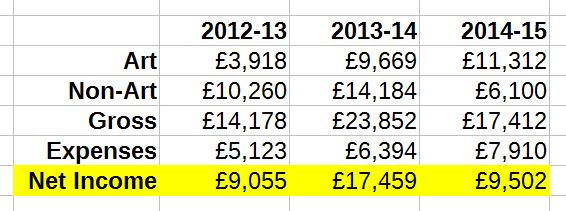
Here’s the tasty bit, then. Here’s what I’ve made for the past three years.

Income Table

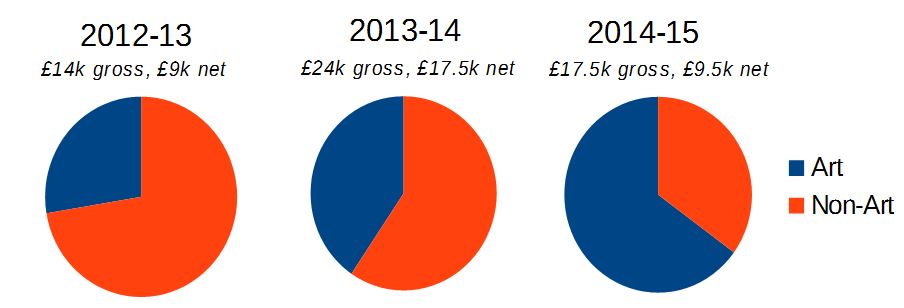
Or, in visual form:

income pies

The Scottish Living Wage is £16,300 per year.

The mean income for my age bracket is £22,700 per year.

Some explanatory notes:

  • I have a very small student loan for my undergrad (in Scotland, so paid no tuition fees), which I began paying back in my 2013-14 tax return. I had a bank loan for my Masters, but I paid it off.
  • I have no dependents, and no allowance.
  • I rent, in Edinburgh, sharing with a partner (though for half of 2013-14 and half of 2014-15 I lives alone). My parents now own their house outright.
  • Expenses includes a small portion of my rent and energy bills, half my phone and internet bills, and most of my artistic purchases, along with show materials, office supplies, travel and so on. So if you were to compare me to a PAYE worker, you might want to imagine something like an income a little under halfway between gross and net.
  • I’m very frugal, but I’d prefer not to be and don’t think there’s any honour in it. I’m still living beyond my income, as I have very gradually built up savings from my non-artistic work for this purpose.

What It Means

This is what I wrote two and a half years ago, and it’s all still true:

I work, and I work hard, for vastly more hours than I’m paid for. For the very little public money I get for my art, I give a lot back: I organise a big performance platform, I give around 10 hours a month as trustee of Forest, a local arts centre, and whenever I do get funding I make jobs for other people. I’m not trying to big myself up – I’m just trying to explain.

I am not doing art because it is easy, nor because it is easy money. I can only be doing it because I love it and because I think it is important.

I, along with many other artists, get furious at the kind of people who comment on articles about arts funding calling us “lazy” and “scroungers”. They have no idea. No idea at all. And I suspect one of the reasons that artists and the industry are really a bit rubbish at explaining what it is their work involves and why it deserves funding is that we’re too damn overworked to take on a major communications campaign.

My finances should look pretty awful to anyone outside the industry. But I do think that my artistic peers mostly have similar balance sheets. I don’t have the feeling that I’m anything unusual. If anything, I suspect I’ve had a little more success than others with my level of experience, though I, like most artists, am constantly berating myself for my failures and for not succeeding faster. In short: I do not feel like my level of work and pay is anything unusual for an emerging artist. I don’t have a good sense from older artists and others in the industry about whether this is a big shift from past decades. I would like to hear from others whether my finances look appalling to them, or whether you too shrug and think that’s just how it is.

It should also be clear that I grab the work when I can, and that I have to be able to manage a lot of projects at once, shift flexibly between them, and be prepared to work strange days and strange hours. I do not have a weekend. This is called “precarious labour” or “cellurisation” or sometimes something else. Artists, or, more horribly, the “creative industries”, have been particular drivers of this economic shift in labour practices. There’s a lot of socioeconomic theory about what it means and I could talk about it for hours, but not here. Bifo’s After the Future and Fibreculture’s Issue 5: Precrious Labour are good places to start reading, and the Precarious Workers’ Brigade is good place to start doing.

I could say that I am only able to do art because I am frugal. But my privilege (class, gender, race) comes into it: it has helped me to get the education which got me the day job; it meant that while I was a student so I didn’t have to do much bar work, which meant could spend my time practising art and learning a lot of organising skills; it provides a support structure so that I can afford to be financially precarious, or at least so that I can feel like I can. I have much lower barriers to being an artist than the majority of the population.

I am very modestly successful in terms of my profile and bookings, for my career stage, and yet this is how hard I have to work for this little actual paid employment. This is the basic reality of trying to be a professional artist. We cannot have a healthy arts culture, or a diverse arts culture, or high quality art, without  funding. Without more public funding.  There are more precise, more subtle, and more wide-ranging arguments to be made. But I hope that outlining the basics of my reality adds to them.

Demanding Pay

When I first wrote one of these posts, I barely understood my finances. Since then, I’ve run an art project about obsessively tracking them, and though that’s finished I still use YNAB to track all my income and expenditure. I used to think, when I was younger and more foolish, that there was cred in not really understanding how money works and refusing to let it rule me; now I think it’s a vital survival tool and a platform for political advocacy. Money runs the world, and even though it hurts, I want to understand how it flows through me, how it rules me.

I value my time much higher than I did two and a half years ago, and not just because my art is better: it’s also because I’ve gained confidence in quoting what I believe my art is worth. I quote high and expect to be negotiated down. I also believe that to work for free is, in many contexts, to be a scab: that I cannot allow venues, especially publicly-funded venues, to have my time for free, because to do so is to lower the expectations for all other artists. I still work for free in the early stages of project development, but I’d prefer not to, and I still work for box office splits, but increasingly won’t accept it from a publicly-funded venue with paid staff.

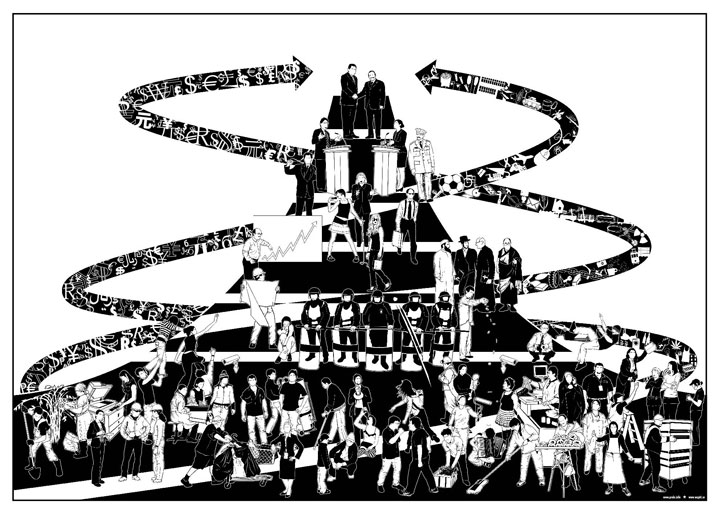
I have much less patience now for venues and programmers that don’t pay me. I have never written a shirty email, but I’ve come close, and I do turn things down. Here is something I think about often: that the venues that I work with have paid staff with something approaching job security, but that the artists they programme do not. The people labouring to make the product see much less of the value of that product (not just box office take, but security and pensions and benefits) than the managers of the places the product is made, and this is a 200-year-old economic relationship. When I work for a venue for free, I am almost always generating financial value for them, so why aren’t they paying me? Why are they preferencing the managers of art over artists? Why do we accept this situation? But here is something else I think about often: managers of art are, by and large, on my side. You share my politics, or something reasonably close to it. You are suffering from the same funding cuts as me. In the pyramid of capitalism, you are above me, but we’re both near the bottom. The difference between us is not belief, but power. If you have that power, please do not accept this situation, and be honest about when you are exploiting artists.

I don’t need any more development opportunities. I need to get paid. And so do you.

Image by Frank Vervial, licensed under Creative Commons BY-NC-ND 2.0