Gamepoems: A Primer

Uncategorized

2773318215_7b5c8acf74_o

We’ll Meet Again

Meet a friend, chat about whatever you like until you reach a question that you can’t answer. Say “Give me some time to think,” turn back to back. Walk.

Travel in opposite directions until you have circumnavigated the globe and are back at this point. If you meet each other halfway you gain a point. If you both get back to the starting location you gain a point. If you can now answer the question you gain a point. Agree never to play this game again.

– Adam Dixon

What happens when game and poem meet?

Last month I gave a talk at Feral Vector on crossover art between games, poems and theatre, and ran a workshop exploring one of these intersections, writing absurd, exciting and wistful gamey poemy vignettes with a mix of game developers working in many different platforms. And for a good few months now some friends and I have been writing and sharing things we’re calling “gamepoems”. But I’m still not entirely sure what a gamepoem is! – so this is a primer for me as much as for you, looking at the different ways “game” and “poem” have been put together, and inviting you to join in what happens next.

A group of gamepoems might not all share any characteristics other than the name itself: they’re related to each other (and to “games”, and to “poems”) by family resemblances, which means that they can look weirdly and gloriously different. A gamepoem might describe an absurd scenario that’s fun to imagine; it might awkwardly gamify an everyday experience in a way that’s meaningful; it might be a parodic set of instructions; it might give rules to follow that result in revelatory experiences; it might be contained within a moment or a lifetime. I thought it was time to talk about what we’re doing, where it came from, and where it might go.

I: Naming

The Sleeper Wakes

If you’re in bed with someone who’s sleeping, get a point for each time you manage to make them rotate ninety degrees. You lose if they wake up

– Holly Gramazio

We’re certainly not the first folk to use the term “gamepoem”; others have taken it in different directions.

Our main antecedent comes from the roleplaying community – the group of gamers whose work is closest to something like theatre already, playing games where the players tell, out loud, the story of what the characters they’re playing are doing, only sometimes with dice and figurines and golins and winzards. Within this community, folk gathered variously under “alternative roleplaying” or “indie roleplaying” or “Nordic LARP” have most regularly been exploring these mechanics for artistic, social and political purposes – and within that community there are folk writing what they call “roleplaying poems” or “gamepoems”. In this usage, gamepoems are short, evocative rules for telling a story or having an experience together in a gamelike way. A particularly wonderful example is Gizmet’s “Insomnia”, which begins: “This is a game for one player who wishes to sleep, and six other players who are the voices who keep them awake.” Like many gamepoems, it’s pleasurable just to read and imagine – as with some gamepoems, it’s not certain whether it’s truly playable, but you have the sense that playing it might change something fundamentally. Sometimes the result is practically indistinguishable from what might happen in actors’ improvisation sessions, or at an awkward murder mystery party, and is only recognisably part of the roleplaying world because that’s the world which it comes from and which shapes its meaning. Alongside Gizmet’s work Norwegian Style stands out, and two community portals that use the term and have archives of examples are UK Roleplayers and Story-Games.com.

A completely different route to mashing game and poem together comes from videogames: Ian Bogost calls his piece A Slow Year a “game poem” as well. He says, “A Slow Year is a collection of four games, one for each season, about the experience of observing things. These games are neither action nor strategy: each of them requires a different kind of sedate observation and methodical input. The game attempts to embrace maximum expressive constraint and representational condensation. I want to call them game poems.” Philip Scott has run workshops on gamepoems on similar lines asking “How can we capture the structure, pace, and flexibility of poetry in games? How can contemporary game making tools transform, analyze, and re-interpret the familiar form of poetry?” The results are “small, focused experiences, each only a few minutes long”. Here, the medium and aesthetic trappings of videogames are being made poem-like through smallness, focussedness, evocativeness.

Another approach comes from writers of text games. Porpentine calls some of her shorter pieces written in the game-maker programme Twine, such as Under the Skin, “twinepoems” – I don’t know if she’s the originator of the term, but it’s definitely taken off. Here, the gameiness of the Twine format (you click to progress through an imagined textual space, sometimes there are challenges to overcome) bangs into aspects of poetry: sometimes a twinepoem might be shaped like a poem on the page, sometimes it might just be small in size (opposing “twinepoem” to “twine novella”, perhaps), sometimes the poeminess might be that it is abstract and evocative rather than literal or narrative. It is to twinepoems that Lana Polansky turns when discussing theories of the poetics of play itself – how play can be like a poem, and how poetry can be like play, and what structures both approaches. Meanwhile, in a different form of text games, the interactive fiction community – which continued the use of the medium used by the earliest computer games after the commercial sector moved on – used to hold a semi-regular “art show” which created “text sculptures”. It’s fascinating to me that twine-makers, when looking for an analogue for their more singular and evocative works, settled on “poem” as the right analogue, whereas parser-based IF-makers used “sculpture”. There’s something here about how the different media conceive of virtual space: as something to read, or something to look at? As something to imagine, or something to move around?

A final example to mention comes from Sidekick Books: they have now produced two anthologies of poems about games, which I’ve also seen called “game poems”. Here the ruling medium is clearly poetry rather than games, and most of the published pieces are only about games, rather than trying to be games. However, in Coin Opera 2, there are several “Boss Fights”, where the editors set two poets a gamelike challenge: poets played a game with each other, and the writing of the poem was the output of that process. The resulting poem might not be a game, but the instructions that led to writing it could definitely be a gamepoem, where game and poem are equal halves of the experience. How can the writing of a poetic text itself be achieved through play and interactivity? This is discussed in the first half of Lana Polansky’s essay; for me, the Oulipian approach to poetry, making authorship about the writing of rules and constraints rather than the writing of poems themselves, is at the foundation of poetic play – and gamepoems. A game, whatever its scale or complexity, is a system of rules designed to imply a set of experiences, and sometimes I wonder whether that description could apply to “poem” as well.

II: Remembering

Hide-and-Seek Piece

Hide until everybody goes home.
Hide until everybody forgets about you.
Hide until everybody dies.

– Yoko Ono

There are many things that aren’t called gamepoems that look a bit like them, because every artform has many histories.

I like thinking about Victorian parlour games as an early form of something gamepoemish. While most of them are much more game than poem, occasionally you happen across one that crosses into new territory. Take Bullet Pudding as Fanny Austen describes it: “You must have a large pewter dish filled with flour which you must pile up into a sort of pudding with a peek at top. You must then lay a bullet at top and everybody cuts a slice of it, and the person that is cutting it when it falls must poke about with their noses and chins till they find it and then take it out with their mouths of which makes them strange figures all covered with flour but the worst is that you must not laugh for fear of the flour getting up your nose and mouth and choking you.” What’s going on here is not just the competition, not just the playfulness, but deliberately creating through instructions an absurd situation that carries more meaning than it ought.

Bullet Pudding reminds me most of all of the “event scores” produced by Fluxus and similar artists from the 60s on. Also sometimes called “instructional poems” and “fluxgames”, these provided concise instructions for interactions or experiences which carried meaning (or didn’t). For a comparison with Bullet Pudding, here’s Milan Knizak’s Flour Game: “At the same time very day, using the same words, in the same store, for 100 days, you purchase 10dkg. of flour (approximately 1/4 pound). On 101st day, you buy 1 q. (200 pounds) of flour. For the next 100 days, but 10 dkg. (1/4 pounds) again. On the 202nd say, buy 1q. (200 pounds). And again, and again, and again. With the flour, mold a big cone. The one who makes the biggest cone is the winner.” There are aspects of the game here, and aspects of the performance, and it’s written as a poem – a blur of genres, like many of the best gamepoems. Yoko Ono’s book Grapefruit is a seminal text, which puts something gamepoemish at the foundation of conceptual art.

Much of this work – surrealism, conceptualism, situationism – has as much to do with theatre as with those other genres, and it’s contributed to how theatre has evolved in the same way that it’s contributed to poetry (or, for that matter, games?) And this brings us to the world of theatre games. As they’re usually played, theatre games are training exercises: they teach forms of movement, or attention, or performance skills. Clive Barker’s book Theatre Games deploys games as an actor-training method, but occasionally the games are played for their own sake, and the book is as much an exploration of what games are as a training manual. In their form as improv theatre, these games can turn into a performance for an audience: the performers are playing with each other, but they’re also putting on a show. The result of all of these approaches is a group of people following a set of rules in a way that is interesting or meaningful. Sometimes, reading a theatre game is like reading a gamepoem, and a knowledge of theatre games definitely influences the gamepoem trend. Take Disc, for example: “The stage is a disc, only in its very centre. The disc must be balanced at all times. Any time a player moves, or a new player enters, the others must rebalance the disc, and every move must be justified by the unfolding story.” Playing this game could train actors to be quick-thinking, attentive and responsive, but the experience of playing it is also a reflection in interpersonal dynamics and the way humans take up space: a gamepoem.

Lastly, let’s think about something which blends into improv games quite closely: folk games, games which have no author, and which are passed from person to person. (Games For People is a great compilation.) Tag and Broken Telephone and Ring-A-Ring-A-Roses are all folk games. Sometimes, when you pay attention to a folk game, you find a gamepoem lurking in there, some surprisingly deep reflection on life and play. But my favourite folk game to mention when talking about gamepoems is The Game. The one you all just lost. The version I learned was, “Once you have learned of the game, you never stop playing. Whenever you think about the game, you lose.” I love its concision, its balance, its absurdity. It is the ur-game; that’s why it’s called The Game. I love that it smashes apart our ideas of what a game is, what thinking is; I love that it is unbounded in time and space and by the very way it’s written becomes a supervirus. It’s the gamepoem I try to emulate in complexity and simplicity whenever I write a gamepoem.

III: Playing

Icebreaker

You are playing a team of foley artists creating the sound effects for someone walking across a frozen lake. First, decide together who your someone is. Second, decide together how thick the ice is. Play begins when a team member makes the sound of the first footstep onto the lake. No player is allowed to make the sound of two footsteps in succession. The breaking of the ice must be gradual. No player may go straight from “sound of a careful footstep” to “ice shatters and person falls in lake”. When the ice begins to break, players may begin to overlap their turns. It is not permitted to create the sound effects of the drowning person. The game ends when the surface of the water is still again.

– HJ Giles

So, what are gamepoems? What holds all of these different approaches together, apart from the name? What I’m seeing are lots of different artists from different backgrounds colliding the ideas of “game” and “poem” together. What happens when you apply the systemic interactivity of games to the textuality of poetry? What happens when you apply the observational discipline of poetry to the playfulness of games? I’m not keen on fixed definitions, but when we try to describe some aspect of a game – competitiveness, for example – and some aspect of a poem – evocativeness, for example – and mix them together, that’s when you’ve got a gamepoem, in whatever medium.

Gamepoems are the collision of:
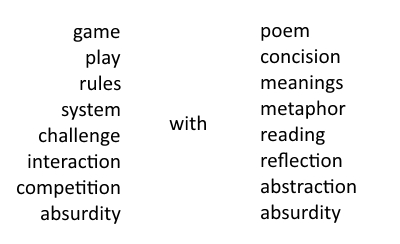
gamepoems
No one of these pairs is necessary or sufficient to make a gamepoem, but they all might be. These columns can be extended, disputed, and swapped, and this definition is descriptive and not prescriptive. Gamepoems are indeterminate. Gamepoems are about playing with and making poetic interpretations of what we think games and poems are. They’re about writing concise sets of rules that summon impossible worlds.  They’re about crafting tiny experiences that mean a lot to people. They’re about laughing at the way we act, and acting in ways that make us laugh. Here are some of the gamepoems we’ve been making. They’re all different:

George Buckenham: Monogamy, a game for lovers
George Buckenham: a game for walking home
Adam Dixon: Long Games for Two Players
Adam Dixon: Games for Grimsby
Adam Dixon: Games for Inanimate Objects
HJ Giles: I’ll Check My Diary
HJ Giles: Trashmonsters
Holly Gramazio: 21 Games
Holly Gramazio: A Beekeeper’s Guide to Game Design
Hannah Nicklin: The Ashes Game
Jonathan Whiting: Burn While Reading
Jonathan Whiting: My Dream Game

Now make your own. Now change what the words mean.
image by Louis Vest,  licensed under Creative Commons BY-NC 2.0

Orcadian Irthogrifee Irthografee Orthografee Orthography

orkney, Poetry

2015-05-04 14.15.54

When you’re writing in minor languages, how you write matters as much as what you write.

Right now, I’m writing in Standard Formal English. I’ve told myself that that’s because I’m doing a post on Orcadian orthography, and to make clear the distinctions between different approaches I need to write the analysis in a different language. That’s partly true. But it’s also true that Standard Formal English comes more easily to me, because I’m more experienced in writing in it, and because a Standard Formal Orcadian doesn’t exist. Yet.

It’s also true that Standard Formal English is attractive because it gets to pretend to be neutral. Like all unmarked things, its surface familiarity lets it pass unseen. When I write in this language you might not quite notice that I’m writing in it, and so all the political currents flowing through it might also go unnoticed. You might not notice that this language, the language that I’m using right now, is the language of the most extensively genocidal settler-colonial imperialism the world has ever seen, is the primary international language of neoliberal capitalist globalisation, is the language most responsible for the erosion of international linguistic diversity, is the primary international language of authoritarian academia, is an established and extensive language of poetry, religion, theatre, and beauty. And that all of these things are built into the words I use, the grammar that forms them into sense, and the orthography that underpins how they appear.

I write in minor languages and experimental forms because the thriving of diverse languages is the thriving of diverse ways of thinking. I think that writing in minor languages is poetically exciting, and that doing so helps to support linguistic diversity in thriving, and that writing against English helps to expose the strange and disturbing politics of that global language. I am learning how to write in Orcadian because it is the language of my home, and I care about my home’s culture, and I don’t want us to lose the ways of thinking and being that are tangled in our tongues, and I think that learning how to do new things with old words is learning how to be new things in an old world.

But what system of orthography best achieves these goals? How should we spell Orcadian?

* * *

Here’s a passage of Christina Costie, from her Collected Short Stories. Her prose is a shining literary experiment and vital work of language preservation: it stands as both a modernist remaking of literary language and the strongest and most aurally accurate body of published dialect work Orkney has ever had. She deserved to be better recognised and better supported, and I’m glad that Ragnhild Ljosland’s Chrissie’s Bodle has begun the work of fully acknowledging the work.

“A’ll deu that,” he said. “Tell thee boy A’m coman ower the morn for the len’ o’ fish heuks.” He moved aff tae the door, an’ Jeanic wha hid saesed the cup o’ life wae baith haan’s an druken ‘id tae hids bitterest dregs, wis a’ at eence cowld sober an’ silent i’ the face o’ Daith. The weeman sat quiet a peerie while, every ane wae her ain thowts. Than Jeanic said, “Lasses, Wattic’s deean.” “Aye,” said ‘Lizbeth, lukkin doon at her haan’s falded i’ her lap, “an’ t’ree peerie bairns’ll be fetherless afore lang comes short.”
(Waa’s Folk)

The orthography here serves to mark out the key pronunciations of spoken Orcadian. It creates a language for both dialogue and narration that accurately reflects the way that Orcadians speak, and it does so carefully and consistently. Moreover, it preserves a remarkable specificity of place: it is not a standardised Orcadian, but one specific to the Walls/Waas region of Orkney the story is set in. Often small differences in orthography reflect cultural differences between speakers, and code-switching from the same speaker in different circumstances. Thus we have “peerie” rather than the “peedie” of other parts of Orkney, and (in other passages) a more Scots “aald” rather than a North Orcadian “owld”. Similarly, what would be translated as “it” into Standard English is both “hid” and “’id” depending on sentence position. This approach enables a flexible, subtle orthography that can convey important social and emotional effects.

However, this approach is also in debt to English, and submits itself to English superiority. The most obvious aspect of this is the apologetic apostrophe, showing letters that are “missing” from the “proper” English version. Thus the Orcadian for “and” is rendered as “an’”, despite that D never having existed in Orcadian to be marked as missing.

Even were we to remove all the apologetic apostrophes from this orthography, as in Lamb, Flaws et al’s work, there are other English dependencies: spelling in this orthography is used not so much to accurately render Orcadian but to mark Orcadian’s difference from English. Thus the English “hand” is in this Orcadian “haan”, and the English “off” is in this Orcadian “aff”, but the A sound is the same in both Orcadian words. The double A in “haan” is used because to use the single A would not alter the spelling from English, and therefore not indicate that the A sound here is different than the A sound in the English “hand”.

Costie’s Orcadian also thus inherits many of the bizarre spelling inconsistencies of English, one of the most difficult languages in the world to learn how to pronounce because of its many fossilised anomalies. The “ae” of “saesed” and the “ai” of “baith” are (or can be, dependening on the region of Orkney) pronounced the same way, but there’s no way of knowing this unless you’ve already heard it; similarly, the “ee” and “ie” of “peerie” are the same sound. Unless you’ve heard them already, or apply some of the rules of thumb of English, themselves always inconsistent, you wouldn’t know that the “ie” of “quiet” is different than “peerie”, or that the “i” in “quiet” is the same as in “silent”, but different from the “i” of “hid” and “bitterest”. All this means that while Orcadians can read Costie’s Orcadian accurately out loud, non-Orcadians are lost.

This also means that a dependency on English is built into the very bones of Costie’s Orcadian, which risks perpetuating the idea that Orcadian is in someway inferior to English, or derived from English, rather than an individual language that has evolved autonomously from but in dialogue with English. This in turn risks perpetuating some of the ideas which have held back Orkney language literature and which were often reinforced by the Orkney literati of the 20th century: that Orcadian is suited only to comic material or Orkney subjects, that Orcadian lacks the full expressiveness of English, that Orcadian cannot be used to write about intellectual matters. Costie’s work stands against those ideas, but the orthography holds the seed of them.

There’s also a logical problem: if the spelling is only accessible to Orkney speakers, wouldn’t Orkney speakers do just as well with English spellings for all but the unique words? I don’t agree with this argument, but there is a logical consistency to its orthography. It takes a dependence on English to its extreme conclusion:

“I’ll do that,” he said. “Tell thee boy I’m coming over the morn for the lend of fish hooks.” He moved off to the door, and Jeanic, who had seized the cup of life with both hands and drunk it to its bitterest dregs, was all at once cold sober and silent in the face of Death. The women sat quiet a peerie while, every one with her own thoughts. Then Jeanic said, “Lasses, Wattic’s dying.” “Aye,” said Lizbeth, looking down at her hands folded in her lap, “and three peerie bairns’ll be fatherless before long comes short.”

This approach – preserving local speech-forms while using English orthography – is used by Lewis Grassic Gibbon is his novels, and is also frequently used for the dialogue in contemporary novels set in Orkney. I particularly dislike this approach in the latter case, because those novels’ authors have a tendency to inaccurately render or completely lose local speech forms: you’ll see “Aye” and “peedie” and “lass”, but you are much more likely to find “before too long” than “before long comes short”, and you’ll certainly see “to borrow” rather than the correct Orcadian grammar “for the lend of”.

With a very attentive and careful ear like Grassic Gibbon’s the effect of this orthography can be powerful, but I am still suspicious of the approach, which I think tends to erode local pronunciations, and I am also sad that the expressive power of local pronunciations is not recognised. Some grammatical forms are also inevitably lost: Orcadian preserves a case distinction between verbal nouns and present continuous tense, so that the English “I’m knitting my knitting” is translated into Costie’s Orcadian as “A’m knittan me knitteen”.

The only advantage of this approach is that it makes accessible to an English-reading public the unique words and (if properly used) speech forms of a minor language. A strong-willed Orcadian would read aloud both examples above in the same way, but I suspect that as Orkney language is eroded by a dominant English-language culture this will become less and less likely.

A third approach would be to for Orcadian to fully join forces with the Scots language movement, and use the standardised orthography of the Scots dictionaries while contributing its own words and speech-forms. The same passage would thus become:

“A’ll dae that,” he said. “Tell thee/yer boy A’m comin ower the morn for the lend o fish hooks.” He muived aff tae the door, an Jeanic, wha haed seized the cup o life wi baith haunds an drunken it tae its stroungest dregs, was aw at ance cauld sober and seelent in the face o Daith. The weemen sat quate a peerie/wee while, ilka wi her awn thochts. Than Jeanic said, “Lasses, Wattic’s deein.” “Aye,” said Lizbeth, leukin doun at her haunds fauldit in her lap, “an three peerie/wee bairns’ll be faitherless afore lang cams short.”

I mainly do this to set it up as a straw man: to me it seems like the worst option so far. Because Scots is also a minor language, it is marked to our eyes and ears: it does not have English’s ability to vanish behind unmarked privilege. That is to say, while an Orcadian might read aloud the English-spelled passage in Orcadian, they would almost certainly read the Scots-spelled passage in lowlands Scots. While Scots spelling is designed to encompass as wide a range of Scottish dialects as possible, it just can’t cope with the major vowel shifts north of John o’ Groats: the Scots “cauld” is as distant from our “cowld” as is the English “cold”, and in the reading “cauld” would displace “cowld”.

The motivation behind this approach would be to contribute towards the broad Scots language project: to continue the work of the Scots Renaissance of creating a national language for Scotland separate from English. I do not believe in this project. I do not use a minor language because I want to create a new state, but because I am interested in political possibilities beyond the state. Moreover, I think few if any Orkney writers would get behind that project, because Scotland and Scots is seen as as much of a colonising force in Orkney as English. Orkney Norn was largely eroded/displaced/incorporated by Scots long before Scots was in turn eroded/displaced/incorporated by English.

However, there are two points of interest for me here. The first is the choice of words. Access to the full lexicon of Scots does expand the possibilities for a literary Orcadian: it’s nice to have “stroungest” as a potential alternative to “bitterest”, and that hugely expanded lexicon is what gives syncretist Scots poetry its overwhelming power. Such a choice would be inauthentic to spoken Orcadian, but what is authenticity? The second is that Scots is increasingly incoporated into Orcadian, and so an authentic contemporary Orcadian vernacular should reflect that. An Orcadian of my age is more likely to say the Scots “yer” than the Orcadian “thee”, and some are as likely to say “wee” as “peedie/peerie”. To write accurate contemporary Orcadian dialogue in prose would have to use some aspects of Scots.

Because I hit all of these problems in each of the options currently available to me, in my last blogpost I experimented with creating a draft of a new orthography. My approach was to stay consistent with the orthography used by Costie, Rendall, Lamb, Flaws et. al., but to standardise it and to build it as far as possible from first principles. It always uses the same symbols for the same sounds, and has no inherent reliance on English spelling. Here is the same passage rewritten in my experimental orthography:

“A’l deu that,” he saed. “Tel thee beuy A’m koman ower the morn fir the len o fish heuks.” He meuvd af tae the dor, an Jeanic wha hid saesd the kup o laif wae baeth hans an druken hid tae hids bitirest dregs, wis a at eence kould sobir an sailent i the faes o Daith. The weeman sat quaiët a peeree whail, iveree aen wae hir aen thouts. Than Jeanic saed, “Lases, Wattic’s deeän.” “Ai,” saed Lizbeth, lukan doon at hir hans falded i hir lap, “an tree peeree berns’l be fethirles afor lang kams short.”

This approach achieves a few things well, I think. Although there is the obstacle of learning a new way of deducing sounds from spellings, it can be sounded as well by a non-Orcadian as an Orcadian. Personally, as a mixed Orcadian/Scots/English speaker, I find it easier to read consistently in this Orcadian than Costie’s Orcadian, because I am never misled into Scots or English pronunciations by commonality of spelling.

This orthography also helps to make more apparent Orcadian’s connection with Nordic languages. Because the distraction of English is more removed, we can more easily see the words that come directly from Old Norse, and the influence of Norse on the languages of the British Isles. More than one Scandinavian reader told me they could see reflections of their own language clearly in my last post, which didn’t happen to any of the previous ones, written in a more Costie-like Orcadian. Politically and culturally, this may be significant – though not as significant as the decisive minor language break from English, which pleasingly satisfies my aims.

There are, however, major and perhaps fatal disadvantages. The first is that it is hard to learn, and has to be learned. Minor concessions to similarity with English (restoring double-consonants, say, or use of “y” for “ai” and “ee” sounds when used that way in English) might help, but would detract from the purity of the approach which is its sole purpose.

The second is that it looks like a child wrote it, and so it risks being read as a naive language. I have little patience with this idea, because I like how children think, because no language is naive, and because children’s spelling is much more intuitive than so-called proper spelling. “Peeree” is more intuitive than “peerie”, “dor” than “door”.

The second is that, by standardising Orcadian, this approach erases local differences. One Orcadian writer pointed out a few things that jarred to her ears in my last post, because I’ve biased this orthography to North Isles (specifically Westray) Orcadian. In other words, a standard Orcadian suffers from the same faults as a standard Scots.

The third, and perhaps most important, is that this approach breaks not only with English but with both all the language-preservation work done so far and with popular understanding. The Orkney Wordbook, The Orkney Dictionary and contemporary Orcadian writers all use a variant of the literary Orcadian established by Rendall and Costie. Everyone here spells it “peedie” and not “peedee”, and that’s fair enough; to insist on “peeree” over “peerie” and “ai” over “aye” and “wei” over “wey” is hubristic, detached from local tradition, and risks being so obfuscatory as to find no readers. It’s an Orcadian that’s an interesting literary exercise, but does not to me feel like it belongs to a running thread of Orkney literature. If my political interest is not just to write in a powerful Orcadian myself but to support Orcadian writing, I certainly wouldn’t want to enforce (or even necessarily encourage) this orthography, interested as I am in it.

Thinking about that standardised/traditional/accepted Orcadian as it has grown in the last century or so, here is one final way of writing Costie’s passage. I’d not advocate editing the original for publication, but it’s interesting to think about how it might be written if it were written now: with no apologetic apostrophes and a few more standardised spellings. Consistent, powerful, flexible, rooted in the way folk speak, and enabling more folk to write in their tongue:

“A’ll deu that,” heu said. “Tell thee boy A’m coman ower the morn for the len o fish heuks.” Heu moved aff tae the door, an Jeanic wha hid saesed the cup o life wae baith haans an druken id tae hids bitterest dregs, wis aa at eence cowld sober an silent i the face o Daith. The weeman sat quiet a peerie while, every aen wae her ain thowts. Than Jeanic said, “Lasses, Wattic’s deean.” “Aye,” said Lizbeth, lukkan doon at her haans falded i her lap, “an tree peerie bairns’ll be fetherless afore lang comes short.”

* * *

So, how should we spell Orcadian? How should I spell Orcadian? How should you spell Orcadian?

I don’t think there’s a single answer to that question. I think different approaches to Orcadian orthography have different effects, different audiences, and achieve different political and literary results. I’ve explored five orthographies here not in order to come up with an answer but to think about what different ways of writing might achieve: not to close down posssibilities but to open them up.

There is power in standardised languages, and especially in the standardising work of dictionaries and grammars for minor languages: they support people in writing, they preseve words and speech-forms, they provide a locus for organisation. But at the same time I think we need to be free to bend and break rules for different aesthetic results and social meanings – in minor languages, but in English too.

I’m interested in minor languages in general and Orcadian in particular because I want to proliferate ways of speaking and thinking, to spread diverse ideas, tongues, and people. I’ll likely keep shifting and changing the way that I speak and write, and I think you can as well.

Slipan, Sweechan

orkney, Poetry

The English used to the right is an accepted orthography that’s congealed over time: development seems to have stalled. It’s completely inconsistent, but accurate to Standard English speech. There is no guiding principle but convention. I’ll write about different ways of doing Orcadian orthography, and the successes and failures of Standard English, next time.

Slipan, Sweechan

The mor at fok meuv aroon, the mor fok at meuv aroon, the mor tungs we a spaek wi.

*

.
A grod up immersd in twa sindree weis o spaekan: the Standard English o mee femlee, an the Orkney langwach o mee komyoonitee. A nivir fillee adoptid wan or the tither, pikan up vools an konsonants fae both, mee aksent orbitan aroon an unplaesabl sentir, sumtaims slippan north, sumtaims skaitan sooth. A tak on aspekts o the spaekan at’s aboot mee, wharivir A’m at: sumtaims A sweech swithlee, sumtaims slolee. A kin spaek pasabil RP, bit haer an thir a slippid vool will lat on mee reuts; A hae all the unkin nordik vools o Orcadian in mee tung’s raech, bit A kannae baid thir staeblee.

Mee sistir, fouïr an a haf aers ouldir as mee, chaenchis that bit mor dramateeklee. Thir a bit o slipach in hir aksent, bit hid tends tae baid firmlee whariver sheu’s baidan. Sheu kam tae Orkney a cockney, queeklee got Westray, got Edinburgh whan sheu gaed tae yooniversitee, an noo soonds naeraboot totalee Brighton.

A lot o fok fae lang-taim Orcadian femlees sweech a geud bit teu. The most comin sweech is tae baid in an Orkney aksent bit tae drap a the daiälekt wirds an adopt Standard English vool firmaeshins. This is komin enof tae hae a daiälekt wird: “chantan”. Fok affens yeus hid tae anser the fon, tae taech a kless, tae mak a spaech. This daes, thir affens mor sithrin Scots’ idyims an vools in Orcadians’ cheneril spaech, een ithoot chantan, as maigraeshin sofans daiälekts.

Wan set o academik modils at kin eksplaen (or at laest descraib) this is “code-switching” (kod-sweechan), an at’s the term a lot o the fok A’m spokin tae hae yeusd tae tak aboot thir aen daiälekt yeus. Fok deu hid, konshislee an unkonshislee, atween langwachis an daiälekts an registirs (whitiver the unkan, bliree distinkshins atween them terms is). Hid saems gei affens, haer, mibee apees, tae be aboot beelongan, an atheen at entaels: kles, inteemasee, aidentitee, praid, desair…

*

.
Fiona MacInnes’s novil “Iss” – in Engleesh, the taitl maens both “us” an “this”, dependan on the novil’s spaekir – deskraibs most o hids karaktirs kod-sweechan, delibritlee an no. The soshalist postmestir o Gaelic orichins spaeks an aksentid Standard Engleesh most o the taim, bit swichis tae brod Orcadian whan spaekan tae lokals askan fir a hand fae him; his lass fairs oot a the Orcadian fae hir tung whan sheu flits tae Edinburgh fir ert skeul, an than trais tae rekiver hid whan retirnan haem. The novil’s spaekirs ken snellee hoo hoo thei spaek cheenchis ithers’ persepshins, both haem an sooth, an the cheenchis ir rekordid in fonetik daiälog. Bit haer an thir thei kach thirsels oot.

This faels gei treu tae ekspeereeïns, fir mee – the renyee thir is in sweechan sumtaims. The parteeklir Orcadian ekspeereeïns haes its aen parteeklir paens: enkoontirs wi fok wha patronais or patronaisinlee fetishais, amost refleksivlee, rooral aksents; the dos o dekaeds o Orkney langwach beeän eksplisitlee band fae the skeul; the konekshin atween dwainan langwach an 20th sentiree eekonomik deklain; yung fok flitan sooth an diskiveran whit weis thir aksent merks them oot; kles, ai. A o this shoogs ir, A doot, at the seurs o chantan.

Wan raitir A spok tae deskraibd at faelan in the nanosekind afore ye spaek whan ye reealais a the soshil implikaeshuns o the wird-firm yir aboot tae yeus. Hid’s laik verteego. Sumtaims hid kin fraes ye. A rekognais whit sheu wis deskraiban imeedyitlee, an twa-three sentensis laetir foond meesel fraesan, unaebl tae utir ithir “old” or “ald” or “ould”, onee o whit A’d mibee itherweis komfirtablee yeus at difer taims. Sum sweechan hapens unkonshislee, an hid’s that mukl aesyir at wei, fir tae be konshis o the sweechis an slips ye mak is tae git afil ankshis.

*

.
Fok want tae beelong, an fok want tae fael athentik. Afens, getan the cod rang maks ye nithir.

Ernest Marwick rot a skript fir a spot on Radio Orkney kad “The Crime of Speaking Proper”, whar he deskraibs chantan as no an ankshis respons tae poor bit a pretens: “to chant is to try to put one over on our friends and neighbours by pretending to a more refined use of language than they possess”. Heu’s eequalee hersh on inkomirs spaekan (or traiän tae spaek) Orcadian, atakan a traveleen saelsmin fir afektan the langwach fir tae sel theens. His konkleuzhin – in a pees fir spaekan at’s rot in firmil Engleesh – is at “We must speak as naturally as we can in any given situation”.

Is thir sik a theen as an athentik vais, tho? A’m nivir haed een meesel; A cidna. A’m afens been konfyeusd bi the wei poiïts tak aboot “findan yir vais” whan ritan poiïtree, fir A’m nivir haed een tae find: mee poiïtree swichis mods, swichis rechistirs, swichis langwachis, swichis firms. A’m skepteecal o Marwick’s aideeal o athentisitee, seeän hid as a ferlee disipleenaree wei tae merk oot an infors beelongeen (an no beelongeen). Hid risks teu fetishaisan langwachis laik Orcadian as ai beud in a taind reuril past: A’m as skepteecal o Robert Rendall’s eedikt at daiälekt poiïtree kin onlee be geud gin hid is “sincerely wrought and faithfully reflects local life”. Fir mee, the fek o a langwach is in hids reench an adaptabilitee: gin a langwach is livan, hid kin be plaefil, inventiv, unkin, distriblan, fremitan, insinseer. An, fir mee, whit raelee merks oot a langwach is at it kin be laernd.

Most o the fok A’m spokin tae, both ritirs an langwach activists, saed thit “abdee sweeches”. Orkney haes ai been a stopeen paint fir travlirs: afor creus ships hid wis Briteesh impeeryal eksplorirs; afore them, hid wis spulyan an colonaisan Vaikeens; afore them, hid’s fikl tae sei, bit the walee sais o wir sentral neeölithik templ compleks maks mee imachin at fok kam haer fae a weis awei een then. An at maens wir spaekan haes ai been inflooïnsd bi ither spaekan, an monee o us wil ai haed differ fok wir spokan tae wi differ tungs.

Morag MacInnes’s poiïm sequins “Alias Isobel” is rot in the richist an most compleks Orkney langwach A’m seen in contemprir poiïtree, but hid’s calerlee leus in hids cods teu. Speleens (an sicweis, mibee, pronunseeaeshins teu) o the saem wird cin differ fae poiïm tae poiïm, or een inooth poiïms, bit the wark as a hol haes a kaindlee vernaclir flo. Isobel Gunn hersel, a maigrant, sumbdee wha flit Orkney in men’s klaes an rechistird as a mael laebrir, wid laikan o slippid an sweechd as at: the myeusik o the poiïtree rings o treuth. (Mor, A doot, as mee aen ritan haer, whit haes preeöritaisd speleen ouïr kaindleenes as A figir oot whit A’m traiän tae deu.)

A that bai, A’m met fok teu wha dinnae cod-sweech, an sum A’m spokin tae disagree on gin abdee daes hid. Thir brod Orcadians wha had sterklee tae the langwach thei spaek in – whit, firnent skeuleen an skorn an ordnir inflooïns, taks gei mukl fek. Bit ir thir onee mor athentik in thir laifs or thir tungs as the rest o us, an whas spaekan mon we lisen tae whan we rait?

*

.
Thir at laest faiv weis o ritan Orkney langwach A cin theenk o:

The first is tae tak Christina Costie’s aproch, whit rendirs the brodist o Orcadian vernaklir spaekan wi a ferlee konsistint fonetik speleen: the naraetirs o hir storees ir spaekan, no ritan, an thir spaekan a strang an abaidan Orkney langwach. This is vaital tae langwach presirvaeshin, bit hid’s gei fikl tae deu, an taks a gei talentid an treezhird lug fir langwach.

The secind is tae tak Fiona an Morag MacInnes’s aproch (tho thei mak oot the efekt in difer weis), whit is tae rendir contemprir vernaklir spaekan fonetiklee, no fashin aboot speleen bit paintitlee recordan hoo the spaekir spaeks noo, sweechis an a. This is mibee the most acsesibl aproch, an hid’s espeshlee yeusfil fir langfirm naraeshun, makan monee differ entreeweis fir differ levils o intrest. Hid most paintitlee rendirs teu hoo most contemprir Orcadians akchilee spaek.

The third, whit A’m foond in novils rot bi both Orcadians an viseetirs, is tae rait daiälog mostlee in Engleesh, onlee yeusin Orkney wirds an speleens fir spesific merkir wirds at sha the spaeker’s Orcadian. This, fir mee, is the most unsatisfaiän: hid fetishaisis the langwach ithoot rilee contreebyeutan tae hids thraivan. Bit hid cin introdyeus wirds an the thot o ritan Orkney langwach tae beeginirs.

The fouïrd wid bees a modrenist, MacDiarmidait aproch, makan a consistint irthografee an yeusan a thrang o Orcadian wirds an idyims, whethir or no hid reflekts the vernaklir. This is an unpoplir aproch in poiïtree this daes, but A hae a fondniss fir the unkin poor o hids myeusikl an ekspereementl efekts.

The fifd is whit A’m deuan noo, whit is foond teu in Simon Hall’s blog Brisk Northerly (tho wi a differ irthografee), makan a “firmil Orcadian” tae mach firmil rot Engleesh: Orkney speleens, Orkney wirds (bit no that thrangan), but in rot (insteed o spokan) firms. This is, as wi the second aproch, yeusfil fir langwach presirvaeshin an thraivan, an hid’s mor apropreeït tae diskirsiv pros. Hid deus, tho, chans at tainan Orcadian sentins firms tae thir Engleesh or Scots equivilint.

Thir problee ithir weis. An thir sheurlee a saksd, whit is tae meuv gliblee atween this mods dependan on whit’s needid. Fir mee, thir nae athentik corekt ansir on hoo tae rait: hid depends on whit ye want tae deu, whit ye want tae mak oot. We kin be conshis o hoo we spaek, an meuv gliblee ithoot fashin aboot hid that mukl – an mibee insteed o findan beelongan in an inacsesibl athenticitee, we kin find hid in shaerd pleuralitee, the shaerd slippan o monee-myeusikl tungs.

.
*

The orthography used here is based on that used in the Orkney Dictionary, but takes it to its extreme conclusion. (That doesn’t necessarily mean it should be used: this is an experiment.)

Single vowels all represent short vowel sounds. Double vowels all represent long vowel sounds or dipthongs. All the comparisons with SE words below are approximate guides only: in an Orcadian accent, most of the vowels sound slightly differently to their Standard English equivalent.

  • a: very short a as in Standard English “black” and “gather”.
  • e: short e as in SE “red”, “tent”.
  • i: short i as in SE “pit” and “twin”
  • o: short o as in SE “not” and “blot”.
  • u: short u as in SE “dunk” and “but” (except in combination with q; see below).
  • ae: can be the a/ai of SE “place”/“plaice”, the “ea” of “meat”, or something in between, depending on the speaker and region of Orkney. Compare to the same variable sound in “encyclopaedia” and “paediatrician”.
  • ai: as in SE imports “haiku” and “gaia”.
  • ee: as in SE “feet” and “teen”.
  • ei: no SE equivalent. Halfway between the “ay” of “way” and the “y” of “why”.
  • eu: no SE equivalent. In Norwegian, it is represented by ø; it is close to the French “eu” of “bleu”.
  • oi: as in SE “point” and “foil”.
  • oo: as in SE “moot” an “boot”. Not the shorter oo as in SE “book”.
  • ou: as in the SE “about” and “proud”.y and w function with vowels as in SE.

When a vowel appears with a diaresis, it does not change the pronunciation of the vowels itself, but indicates that it is a separate sound, as in SE “Chloë”. Thus “daiälekt” is pronounced similarly to the SE “dialect”. Where four vowels are in sequence, it indicates two separate dipthongs, as in “pronunseeaeshin”, pronounced similarly to the SE “pronunciation”.

All consonants and consonant pairs are as in SE, but note:

  • r: always rotic.
  • ch: as in SE “chair” and “chore”; it never becomes the soft terminal “dge” sound some SE speakers use in “sandwich”.
  • kh: used for the Scots “ch” of “loch” and “nicht”.
  • zh: used for the SE “s” as in “treasure” and “pleasure”.

Depending on the speaker and region of Orkney:

  • qu can also be pronounced as an aspirant “wh” as in SE “what” and “which”. In old Scots this is written as “quh”.
  • wh can also be pronounced as an “f” as in SE “foot” and “fall”, though with more aspiration than in SE English, which is also found in contemporary northeast Scots. (N.B.: this does not mean that the Orcadian “qu” ever becomes an SE “f”.)
  • th can also be pronounced as a “t” as in SE “trouble” and “wit”, especially at word beginnings and endings.
  • k can also be pronounced as “ty” as in SE “boatyard”, especially at word beginnings.
  • d can also be silent, especially in confunction with “l”.

Finally, the SE spelling of most proper nouns has been kept. “Orkney” world otherwise be written as “Orknee” and “Orcadian” as “Orkaedyin”.

I may have made spelling mistakes.

The Orcadian yeusd tae the left is an ekspereemint in irthografee: hid’s still in deevelopmint, bit A think hid’s filly consistint, gin no yet filly pyntit. The prinseepl is at ivree letir or letir paer aywis merks the sam soond, as notid in the gyd beelo. A’ll ryt aboot differ weis o deuan Orcadian irthografee, an the suksesis an faelyirs o this ekspereemint, nekst tym.

Slipping, Switching

The more that folk move around, the more folk that move around, the more tongues we all speak with.

*

I grew up immersed in two distinct ways of speaking: the standard English of my family, and the rich Orkney language of my community. I never fully adopted one or the other, picking up vowels and consonants from both, my accent orbiting around an unplaceable centre, sometimes slipping north, sometimes sliding south. I take on aspects of the speech immediately around me, wherever I am: sometimes I switch rapidly, sometimes slowly. I can speak passabl RP, but occasionally a slipped vowel will betray me; I have all the unusual nordic vowels of Orcadian within my tongue’s reach, but I can’t stay stably there.

My sister switches, four and a half years older than me, changes much more dramatically. There is some slippage in her accent, but it tends to stay firmly wherever she’s living. She arrived in Orkney all cockney, quickly became Westray, turned Edinburgh when she went to university, and now sounds almost entirely Brighton.

A lot of folk from long-time Orcadian families switch a lot too. The most common switch is to stay in an Orkney accent but to drop all the dialect words and adopt standard English vowel formations. This is common enough to have a dialect word: “chantan”. Folk often use it to answer the phone, to teach a class, to make a speech. These days, there’s often also more southern Scots’ idioms and vowels in Orcadians’ general speech, even without chanting, as migration softens dialects.

One set of academic models that can explain (or at least describe) this is “code-switching”, and that’s the term a lot of the folk I’ve spoken to have used to talk about their own dialect use. Folk do it, consciously and unconsciously, between languages and dialects and registers (whatever the strange, fuzzy distinctions between those terms might be). It seems very often, here, maybe everywhere, to be about belonging, and everything that entails: class, intimacy, identity, pride, desire…

*

Fiona MacInnes’s novel Iss – in English, the title means both “us” and “this”, depending on the novel’s speaker – describes most of its characters code-switching, deliberately or otherwise. The socialist postmaster of Highland origins speaks an accented Standard English most of the time, but switches to broad Orcadian when speaking to locals seeking his help; his daughter pushes all the Orcadian from her tongue when she moves to Edinburgh for art school, and then tries to recover it when returning home. The novel’s speakers are acutely aware of how the way they speak affects others’ perceptions, both at home and south, and the changes are recorded in phonetic dialogue. But occasionally they catch themselves out.

This feels very true to experience, for me – the painfulness of switching sometimes. The particular Orcadian experience has its own particular pains: encounters with folk who patronise or patronisingly fetishise, almost reflexively, rural accents; many decades of Orkney language being explicitly forbidden in schools; the connection between dissipating language and 20th century economic decline; young folk moving south and finding how much their accent marks them out; class, always. All of these shocks are, I think, at the source of chantan.

One writer I spoke to described that feeling in the nanosecond before you speak when you realise all the social implications of the word-form you’re about to use. It’s like vertigo. Sometimes it can freeze you. I recognised what she was describing immediately, and a few sentences later found myself freezing, unable to say either “old” or “aald” or “owld”, each of which I might otherwise comfortably use at different times. Some switching happens unconsciously, and it’s so much easier that way, because to be conscious of the switches and slips you make is to be made very anxious indeed.

*

Folk want to belong, and folk want to feel authentic. Often, getting the code wrong makes you neither.

Ernest Marwick wrote a script for a spot on Radio Orkney called “The Crime of Speaking Proper”, where he describes chantan as not an anxious response to power but a pretence: “to chant is to try to put one over on our friends and neighbours by pretending to a more refined use of language than they possess”. He’s equally harsh on incomers speaking (or trying to speak) Orcadian, attacking a travelling salesman for affecting the language in order to sell things. His conclusion – in a piece for speaking that’s written in formal English – is that “We must speak as naturally as we can in any given situation”.

Is there such a thing as an authentic voice, though? I’ve never had one myself; I couldn’t. I’ve often been confused by the way poets talk about “finding your voice” when writing poetry, because I’ve never had one to find: my poetry switches modes, switches registers, switches languages, switches forms. I’m sceptical of Marwick’s ideal of authenticity, seeing it as quite a disciplinary way to mark out and enforce belonging (and not belonging). It also risks fetishising languages like Orcadian as forever penned in a lost rural past: I’m as sceptical of Robert Rendall’s edict that dialect poetry can only be good if it is “sincerely wrought and faithfully reflects local life”. For me, the strength of a language is in its range and adaptability: if a language is alive, it can be playful, inventive, weird, disturbing, alienating, insincere. And, for me, what really marks out a language is that it can be learned.

Most of the people I’ve spoken to, both writers and language activists, said that “everybody switches”. Orkney has always been a stopping point for travellers: before the cruise ships, it was British imperial explorers; before them, it was marauding and colonising Vikings; before them, it’s hard to say, but the vast size of our central neolithic temple complex makes me imagine that folk came here from a long way away even then. And that means our speech has always been influenced by other speech, and many of us will have always had different folk we spoke to with different tongues.

Morag MacInnes’s poem sequence “Alias Isobel”, is written in the richest and most complex Orkney language I’ve seen in contemporary poetry, but it’s also refreshingly loose in its codes. Spellings (and thus potentially pronunciations) of the same word might differ from poem to poem, or even within poems, but the work as a whole has a natural vernacular flow. Isobel Gunn herself, a migrant, someone who left Orkney in men’s clothes and registered as a male labourer, would likely have slipped and switched in this way: the music of the poetry has the ring of truth. (More, I think, than my own writing here, which has prioritised spelling over naturalness while I learn what I’m trying to do.)

All that said, I’ve also met folk who don’t code-switch, and some I’ve spoken to disagree on whether everyone does it. There are broad Orcadians who hold strongly to the language they speak in – which, in the face of schooling and put-downs and ordinary influence, takes a great deal of strength. But are they any more authentic in their lives or their tongues than the rest of us, and whose speech should we listen to when we write?

*

There’s at least five ways of writing Orkney language I can think of:

The first is to take Christina Costie’s approach, which renders the broadest of Orcadian vernacular speech with a fairly consistent phonetic spelling: the narrators of her stories are speaking, not writing, and they’re speaking a strong and abiding Orkney language. This is vital to language preservation, but it’s very difficult to do, and takes a highly talented and treasured ear for language.

The second is to take Fiona and Morag MacInnes’s approach (though they achieve the effect differently), which is to render contemporary vernacular speech phonetically, worrying less about spelling and more about accurately recording how the speaker speaks now, switches and all. This is perhaps the most accessible approach, and is particularly useful for longform narration, allowing many different entry points for different levels of interest. It also most accurately renders how most contemporary Orcadians actually speak.

The third, which I’ve found in novels written by both Orcadians and visitors, is to write dialogue on the whole in English, only using Orkney words and spellings for specific marker words that show the speaker is Orcadian. This, for me, is the most unsatisfying: it fetishises the language without really contributing to its thriving. It can, though, introduce words and the idea of writing Orkney language to beginners.

The fourth would be a modernist, MacDiarmidite approach, creating a consistent orthography and using a density of Orcadian words and idioms, regardless of whether it reflects the vernacular. This is an unpopular approach in poetry these days, but I have a fondness for the strange power of its musical and experimental effects.

The fifth is what I’m doing now, also found in Simon Hall’s blog Brisk Northerly (though with a different orthography), creating a “formal Orcadian” to match formal written English: Orkney spellings, Orkney words (but not too densely packed), but in written (rather than spoken) sentence forms. This is, like the second approach, useful for language preservation and thriving, and it’s more appropriate to disursive prose. It does, though, risk losing Orcadian sentence forms to their English or Scots equivalent.

There are probably other ways. And there is certainly a sixth, which is to move fluidly between these modes depending on what’s needed. For me, there is no authentic right answer on how to write: it depends on what you want to do, what you want to achieve. We can be conscious of how we speak, and move fluidly without worrying about it too much – and maybe instead of finding belonging in an inaccessible authenticity, we can find it in shared plurality, the shared slipping of many-musical tongues.

*