I’ll Check My Diary

Uncategorized

Cubicle Land

The discipline of ludo-archaeology can of course reveal much about the discourse and practice of pre-Event “civilizations”. Since Mafu (1020) laid out the foundations of the discipline, describing the period 600 BE to 10 BE as the Ludic Age of human history, ludo-archaeological scholars have been concerned with the retrieval, categorisation and analysis of that once-dominant form of human socialisation, games. Given the often piecemeal and incoherent traces of ludic systems within recoverable data structures, however, a sharp division in the discipline now exists between the “datist” and “reconstructivist” schools. Broadly speaking, the former is primarily concerned with presenting only those game artefacts which were verifiably played, conducting analysis to thus draw conclusions about the society which played them, while the latter uses what we already know about a given human society to reconstruct the rules of a game from what fragments remain. While datists accuse reconstructivists of essentially inventing historical games to reinforce their own archaeological assumptions, reconstructivists accuse datists of being wilfully ingnorant of the structural assumptions inherent in how they determine data points to be “pieces”, “quests”, “boards”, “rules”, “consoles”, and so on. (For an illuminating analysis of this debate, see T’chu (1042) on the disputed existence of the “DLC”.) And for both camps, recent debates over the nature of the transition from what Mafu termed the Ritual Age to the Ludic Age have cast doubt on whether the earliest games (and, for Kirra (1049), all games) can truly be called games.

This entry into the archives of ludo-archaeology is therefore not uncontested. The present author declares formal subroutineship to neither school, and so offers instead the following contextual facts (see appendices for documentation):

  • That a practice named “I’ll Check My Diary” existed is attested by datasources numbering in the thousands, dating from at least 40BE to the very cusp of the Event.
  • “I’ll Check My Diary” is referred to here as a “game”, pace Kirra et. al., for ease of understanding, but the rules presented below can be interpreted through other related social models.
  • That “I’ll Check My Diary” had deep social significance is based in analysing its frequency of use, the manner of participants referring to it both formally and casually, and the high affect ratings visible in the datapoints surrounding its use.
  • It is unknown whether “I’ll Check My Diary” was conducted in the pre-Event social practice of meat-to-meat interface or through data transmission only; the rules presented below are optimised for data-based interfaces.
  • The rules presented below employ the Koprian model of the pre-Event calendar.
  • The rules presented below are not extracted whole from source data. They are based in rigorous analysis of the message data surrounding instances of the key phrase: data which are, given the proximity of “I’ll Check My Diary” to the Event, unusually complete in their architecture, though typically opaque in their meaning. They represent the only model capable of explaining said data, within current computational capacity.

Submitted to the Archives at
1052-12b-11T30:11:82Z,
under BE.Archae.Ludic.Rulesets,
by Giles (a.1.$),
in Memory of the Lost
and to the Glory of Hu.

* * *

I’ll Check My Diary

1. The aim of “I’ll Check My Diary” is to never successfully arrange a meeting.

2. The game can be played by any number of players; larger groups have a lower difficulty rating.

3. To initiate a game, one player contacts all the other players with the message “Do you think we should have a meeting?” (or words to that effect). To join the game, contacted players reply enthusiastically, agreeing that we should have a meeting.

4. Each reply to the conversation is a “move”. Any player may make a move at any time. Every move scores one point for the player making it. Every time a player suggests a specific time and day (e.g. “Monday morning”, “Wednesday at 2pm”) they score an additional point. A single move may thus score many points, if well-crafted. Every move must reiterate the player’s keenness to have a meeting, must actively contribute to finding a meeting day and time that all players can attend, and must not succeed in actually naming a meeting day and time that all players can attend.

5. Moves may include, but are not limited to: Apologising for not being able to make a date but not suggesting a new date; suggesting a new date even though no-one has responded negatively to the old date; waiting many moves before replying, apologising for not keeping track of the thread, and then saying you can’t make the date that everyone else has said they can make; starting a poll with confusing times on it; suggesting times that aren’t on the poll; and, most famously, declaring “I’ll check my diary” and then not doing so.  Generally, each player is always doing everything in their power to derail efforts to find a meeting time while always presenting as if they are being helpful and supportive of finding a meeting time.

6. A player cannot contradict a statement they have already made. If they have previously said they are available on Friday (including implicitly, by suggesting that meeting time), they cannot then rescind that availability. However, when 10 moves have passed, a player can now claim to be busy at a time they were previously available.

7. Play continues until someone suggests a time that everyone can make. If all players can make a time and day, the game is over, and the player who made that suggestion loses ten points. The player with the most points wins. Tactical play is encouraged.

* * *
This gamepoem licensed under a Creative Commons Attribution-NonCommercial-ShareAlike 3.0 Unported License. This means, roughly, that you can reproduce it freely on  non revenue-generating sites as long as you credit me and license under similar conditions.
Image sourced from Wikimedia Commons.
Many thanks to Mark Wonnacott for suggesting the framing device.
This work generously supported by my backers on Patreon. If you like what I do, consider joining from a buck a month to help me make and give away more things.

The Crowd, the Community, and Patronage

Uncategorized

200_141101_guido_mencari_london_spill_festival-1082_WEB_2000

Dear ones, I have a Patreon. It’s just launched.

Patreon is crowdfunded patronage: it’s a way for lots of people to regularly support an artist a little bit each, all of which adds up to a reliable income. Patreon’s particularly popular with musicians on youtube, webcomic artists and game designers: people with online followers, who frequently release art for free online and are looking for ways to make that liveable. For me, it’s an experiment in whether the same model could work for live art.

We don’t talk about the language of patronage much in the arts any more — which is funny, because it’s pretty much how the idea of the artist was created. Having wealthy supporters (or family) is what enabled people to become artists, is what enabled the field of “the arts” to emerge. But now state patronage is called “public funding”, and corporate patronage is called “sponsorship”, and private patrons are “donors” or “supporters”. We don’t want to make supporting art sound fusty and inaccessible.

I like talking about patronage, though, and I like the idea of opening up what patronage can be. I like making it clear that art is not something that just happens, is not something that other people decide to make happen, but rather something that we all have a stake in making happen, and in making happen in more radical ways. For me, Patreon is a way of not asking single entities for patronage, but asking the crowd — or the community — for support. Like all crowdfunding, it’s a means of circumventing various power structures and barriers to survival, but unlike Kickstarter and most crowdfunding sites, the regular contribution makes it more about sustainable support, long-term income, and a relationship with the people who like what you do.

It’s also just about the only way I can think of to make the art I really want to make. Possibly because I grew up on the internet, making lots of things and giving them away feels natural to me. I don’t just want to make the art that sells, and I don’t just want to make the art that meets the targets of state funding bodies: I want to make the art that I believe in. And I don’t just want to make big monolithic state-of-the-world art projects (though sometimes they’re fun): I want to do little things, and silly things, and radical sparks, and awkward moments that drive a wedge into difficult politics. And I don’t want only the people who can afford it to be able to enjoy my art: I want everyone to be able to enjoy it, and then pay me if they like it. I think I’m good at making art like that. Maybe I want too much. Maybe that’s not the world we’re in together. But I’d like to try, and this seems like a good way of asking everyone if I can.

Who is that “everyone”, though? Who is the crowd? Is there such a thing as a community online? Who am I asking for money? I’m not entirely sure. I’m doing three things to launch this campaign: I’m designing the Patreon page itself, which will trickle through the website’s own internal social network; I’m writing to a bunch of arts friends about the project and asking them to tweet about it; and I’m writing this blog post with some more open thoughts. I’m consciously presenting myself differently to each of those constituencies in the way that, horrifyingly, artists and other hucksters all have to learn to do. I’m writing to my friends as friends, as people who might do me a favour, and who I’d like to share my feelings and desires with. That’s one community — predominantly a disparate community of artists and producers who like and support each other’s work. I’m writing this blogpost, which will reach a wider audience: the people who actively follow me, who are interested in the things I write, and so for you I’m sharing my thoughts and ideas and concerns. That’s a sort of crowd, but mostly a crowd who already knows me. And the Patreon page is written in the most confident and accessible way I can manage, appealing to the completely anonymous crowd who might stumble across my work without knowing anything about me. In these roles, what I’m doing is completely different to a bard being supported by the local community, because the “communities” we’re talking about, if they can really be called that, are disparate networks, geographically diffuse, linked by degrees of separation, joined by family resemblances. Is that really a community I can appeal to  for support — or want to? This is a way of discovering what community means online.

(And obviously, writing stuff like this — exposing my anxieties and thought processes, admitting the multiple presentations, being honest, is itself simultaneously both the truth and a strategy for launching the Patreon and making it more appealing to a certain demographic. This is the horror of the social web. But let’s not get too caught in anxiety loops: there are more important things.)

I’m not totally at ease with all this, as you can tell. For one thing, while Patreon circumvents the power structures of state and capital, it still leaves other structures, like social power and media privilege, totally intact. For another, monetising your social networks is emotionally gruelling: it makes it clear the degree to which people are able to support you, and comes with all sorts of horrible status anxiety, and has a way of invading your relationships if you’re not careful.  And for yet another thing, it’s so clearly all a part of the neoliberalisation of arts funding: the expectation that artists have to become solo entrepreneurs, that we have to be our own producers and fundraisers and marketing departments, that governments no longer believe in grassroots art for the public good, that some work is unfundable.

But look: let’s believe in each other. Let’s believe that art matters. Let’s say that the way we make art matters, and that who makes art matters, and that who we make art for matters, and that we should experiment with all those things. I believe that anyone who wants should be able to make art, and make a living from it if they want to, even (or especially) if it’s completely unprofitable and has no discernible utility. I’m going to keep cobbling together my income from all sorts of different sources, like most artists do, especially most artists trying to make radical art in a radical way, but I have a hunch that this might be an important part of doing it. You could do it. We could do it. (Let me know if I can help.) I have a hunch that building this direct relationship between artist and audience — ideally a relationship that collapses both roles into each other so that we don’t know who’s who — could be important for how we do art. Could, rather than narrowing and narrowing who has access to making and enjoying art, rather than setting up another kind of gatekeeper, open art out. We need to build systems of support for each other, and make that support welcoming.

I’m terrified, frankly. What if it fails? What if nobody cares? What if, politically, it’s the wrong thing to do? The way I was able to make myself do this is to say that it’s an experiment, and one that’s not just for me but for the sectors that I work in. Can live artists and poets make a reliable income from the crowd? Can I be part of launching this for my artforms? Can we make art in a different way, and for each other? Can we set up community relationships of artists and art-lovers supporting each other? Is this a way to have a conversation about what’s important about art?

Let’s find out.

My Patreon has launched. You can support me from a buck a month. I have gifts for you, whatever level you support me. If you can’t support me financially, then just send a tweet about my Patreon, or this blogpost, or crowdfunding in general. And even if you don’t like the idea at all, then share this blogpost with your own thoughts about why I’m wrong, because we need to talk more openly about money. I’ll be writing here and elsewhere about money, and about how this new project progresses. I hope you’ll follow along.

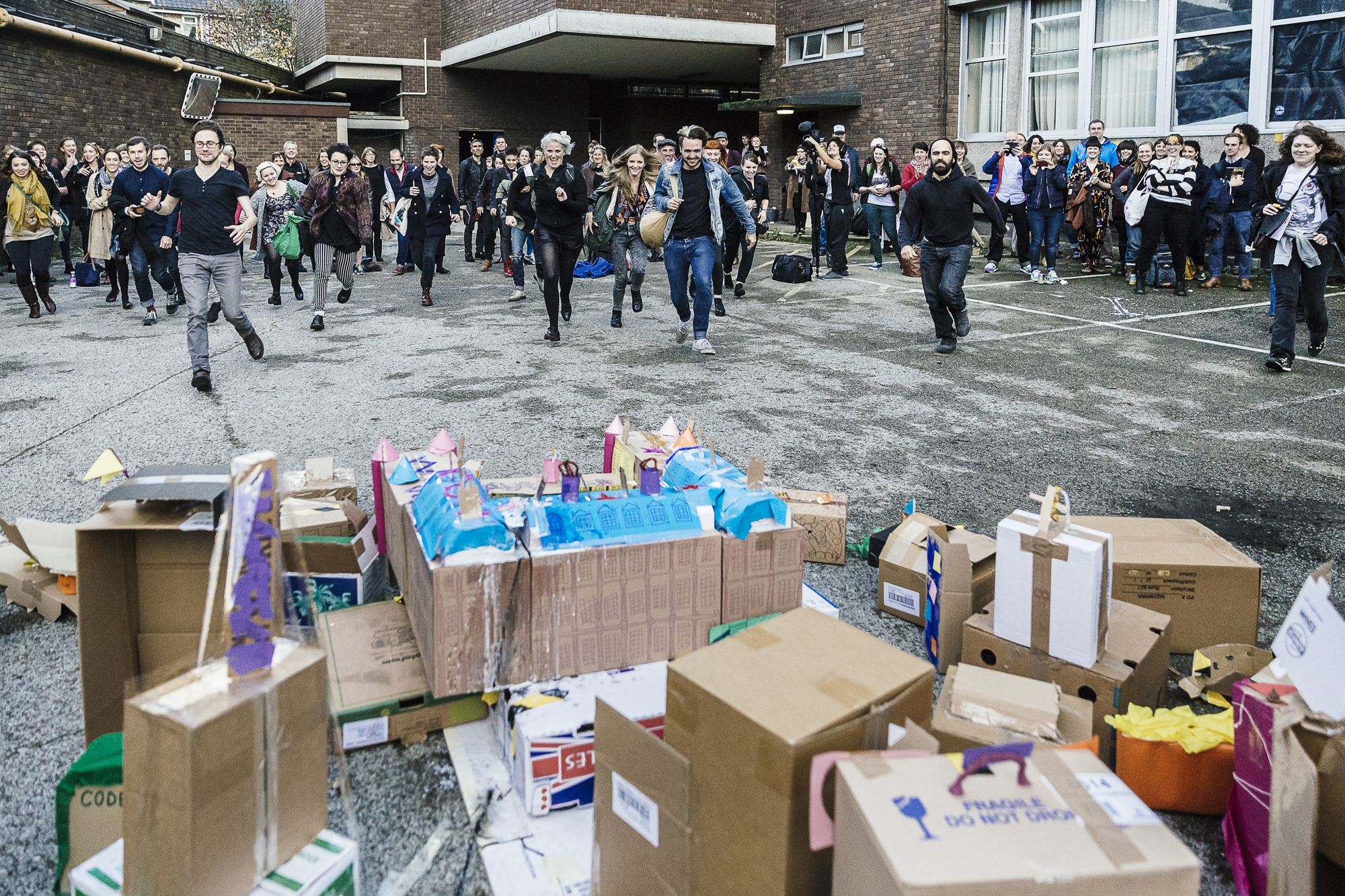
photo (c) Guido Mencari, SPILL Festival of Performance 2014

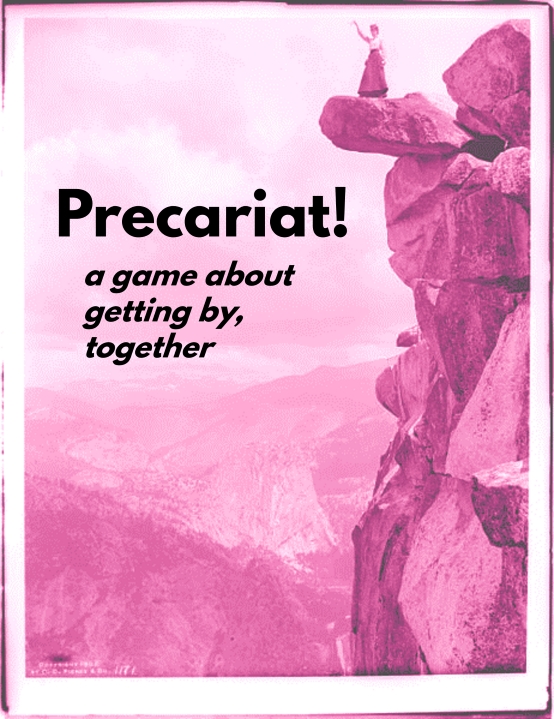
Precariat! a game about getting by, together

Game

Precariat Cover 1

It never gets easier. Each month more unbearable than the last. Last couple of hours you’ve been trying to make a room of suits, people supposedly paying for your expertise, actually listen to you. You don’t have a lot in the fridge — some dried pasta, sauces, nothing actually fresh — there’s damp in your room, and you haven’t created anything in weeks; your flat is so cold that your hands go numb unless you wrap yourself in blankets as you work.

But, you think, smile creeping onto your face as key slides into lock, I live with some bloody rad people. Meike and Ali: people who make you feel good about who you are, make you feel human, alive. Work is shit, you’re not sure if you can make rent this month, but you’re not alone.

Tonight you’ll party. You’ll invite some friends, cook tasty food and drink good wine. You’ll spend money you don’t have, but who gives a fuck? Everything will be great.

* * *

Precariat! is a storytelling improv game by me and Adam Dixon. It’s about people building meaning on the edge; about not just surviving but loving, making and fighting against life’s hardness. They’re collaborative stories: you’ll tell the story together with friends, and a lot of the story will be about how your characters support each other when they fight, make up, make out and make do.

You might tell the story of a pair of misfits living in a loft in Weimar Berlin, dodging fascist mobs and singing in nightclubs, or of a family of spacepeons, picking up jobs on the Orbitals around Fade for the oxycreds that’ll let you can breathe for another month.

There are an infinite number of stories you might tell, but what connects them all is that they’re stories about life’s precariousness and where survival is about supporting each other.

It’s a game designed to be played over several sessions, exploring a group of workers through their time together. Each session represents a season, 12 weeks in the worker’s lives. Each week you try to make rent, keep each other happy, make stuff and resist the people that’ll tear you apart. At the weekend we explore our worker’s lives further, finding out more about them as people. The weeks are crunchy and mechanical; the weekends allow us to roleplay and examine our characters.

Precariat v0.1 for the #rentpunk game jam:
Download the rules
Download a Realm Sheet
Download a Worker Sheet

This is a public beta, so we’ll be playing and thinking and working on a full release: let us know what you think!