Days 7-8: Readings at the Common / Boneshaker

Uncategorized

(This is the travel blog from my North American Poetry Tour (really just the northeast bit). I’m doing features and trying out slams and meeting organisers, finding ideas for Scottish spoken word and for touring. I hope you’ll follow along and share, and ask questions! If you’ve got ideas of things you want me to find out, tell me and I’ll chase it down.)

I headed back to Toronto for the next leg of the tour, to check out smaller reading series, interview organisers and follow the Southern Ontario Spoken Word Circuit, getting a snapshot of different forms of spoken word in a major active global spoken word hub. Like New York and London England, Toronto and the greater Southern Ontario region is hugely active in performance poetry, spoken word and live literature — there’s an event almost every night, and plenty of mailing lists and websites to help you find your way around.

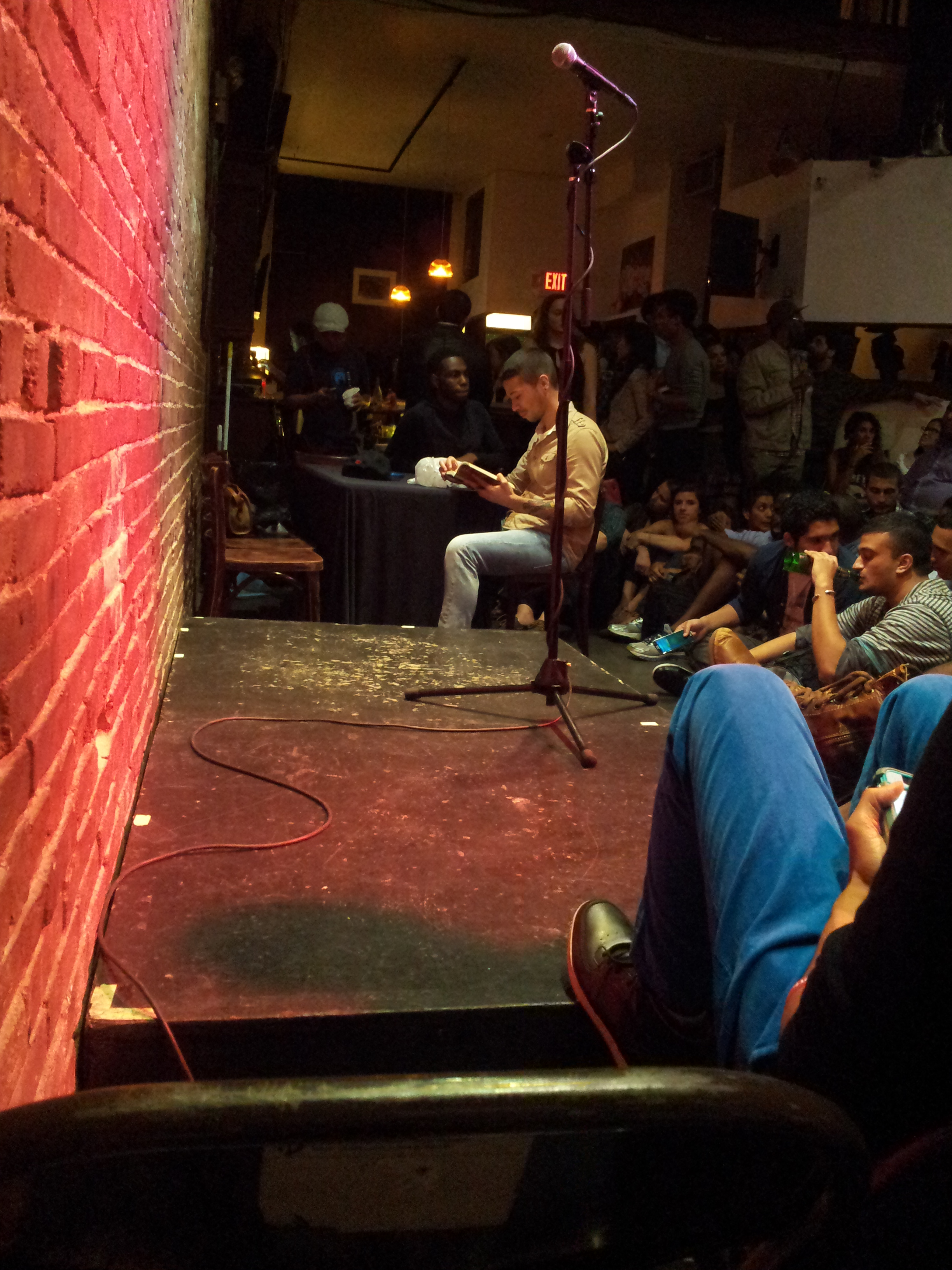
Readings at the Common is a monthly candlelit reading series at The Common, a little café with a great reputation for coffee. Hosted by Jessica Moore and Daniel Renton, its focus is on the literary and publishing end of poetry. My co-readers that night were Irene Marques, writing in Portuguese and English, and Laurie D Graham, an editor for Brick whose work has been shortlisted for multiple major Canadian awards. The night was quiet and relaxed, with a friendly and hugely attentive audience, fuelled by great tea and coffee. I spoke to Jessica about the origins of the event — it’s been running for three years now, and began at the instigation of the café’s owner as a way to make artistic use of the space in the evenings. Toronto’s a city of neighbourhoods, and the Common is right next door to Little Korea, Little Italy and Little Portugal, as well as to the hugely popular community space Dufferin Grove Park: Jessica sees the Readings as a neighbourhood event, with most of the audience local to the café.

Boneshaker is a library-based reading series, running for the last 4 years at the St Clair Public Library. Organised by librarian Lillian Necakov, it began as a way to bring more adults into the library’s programme and has now built both a loyal and visiting audience. Toronto boasts the world’s busiest urban public library system, something Lillian was very proud of, with local libraries hugely important centres of services and events as well as books. It excited me to see local reading series brought into that as part of what libraries can offer. Reading with poet and novelist Robert Earl Stewart, I again had a wonderfully warm and receptive audience — and I sold out of the pamphlets I’d brought with me, only halfway through the tour!

Both nights, I tried out a set of mixed English and Scots material, warming people up to the Scots by starting with intertwining the poems with English translations before doing longer and faster work. I felt like I was finding my feet more in how to perform Scots for an overseas audience; rather than clobbering them over the head with the strangeness of it, I was able to make points of connection and bring audiences into the music more. With Scots migrants being a big part of Canada’s settler-colonial history, I had plenty of conversations about Scots ancestors, and many people spoke to me about how they remembered words and phrases grandparents would use. Laurie Graham at the Common said that it felt like a language she “knew but didn’t know”; although her direct family don’t speak it, it’s in her line, and we wondered if there are things that accents and tongues remember.

The events couldn’t have been more different from the week in New York — and I couldn’t have been more grateful for the change. I love smaller and quieter events like these as much as the noisy celebrations, and I think they are just as important. It’s as great to be able to connect directly with each individual in the room as it is to a huge and unified crowd, and as wonderful to have meandering and exploratory conversations as it is to dance and cheer to poetry.

With Toronto being a city of small neighbourhoods, I wondered about the role of events like these, bringing professional writers from in and out of the city to local audiences and local venues — here, poetry can be a relaxing evening in for a neighbourhood, rather than a riotous celebration for a political community. That’s something that can be supported by major cities, but is also important for Scotland, with its relatively dispersed population and many local identities. There’s a risk of always thinking that bigger is better, and for poets trying to make a living a risk that we feel we always need to gravitate to the centre; poetry needs multiple models and multiple communities to thrive.

*
Thursday 18th: Burlington Poetry Slam
Friday 19th: London Poetry Slam
Saturday 20th: Guelph Poetry Slam
Sunday 21st: Words and Music, Montreal
Monday 22nd: The Poet in New York, The Bowery
Days 2-4: Nuyorican Poetry Slams

Uncategorized

(This is the travel blog from my North American Poetry Tour (really just the northeast bit). I’m doing features and trying out slams and meeting organisers, finding ideas for Scottish spoken word and for touring. I hope you’ll follow along and share, and ask questions! If you’ve got ideas of things you want me to find out, tell me and I’ll chase it down.)

568-entertainment

The Nuyorican Poets Café is one of the world’s beating hearts of performance poetry. Founded by a pioneering group of Puerto Rican artists and activists in 1973, it became a vital hub for artists of colour whose work was not accepted by mainstream industries. It’s now housed in a former tenement on the Lower East Side, in the middle of a strong Nuyorican cultural community in Manhattan. Along with the Uptown Poetry Slam, the Nuyorican Poetry Slam is one of the events that made slam a huge international artform. So when it came to organising a North American poetry tour, this is absolutely where I had to go.

I’d been told to queue an hour early if I wanted to join in the Wednesday Night Open Slam, and when I arrived at the door at 8pm there were already two other nervous poets jogging from foot to foot. We early birds quickly formed a queue community of slammers — there was me, a touring poet from Scotland; Liana, originally from Latvia and now studying nursing in New York; Kevan, a regular on the New Jersey scene who also teaches meditation; and Phil, a high school student in New York. We were all slamming here for the first time, and excited to be there. Quickly the queue grew behind us as we joked and encouraged each other and swapped poetry stories.

The slam, hosted by the amazing Jive Poetic, was unlike anything else I’ve ever been to — or rather, it was like all the slams I’ve been to, only so much more so. The crowd was completely packed once the whole queue had been squeezed in, and needed no encouragement to yell and cheer and finger-snap and boost every performer. Any judge who dared give lower than a 9 to a poet was viciously booed. There was a diversity of styles, but more work rooted clearly in hip-hop, and more work in the confessional slam style than you usually see in the UK. As an open slam, there were the same mix of nervous first-timers and pros throwing in their hat and total surprises. There were also, as I’d expected, way more writers and performers of colour, and the politics of voice and community ran powerfully through the night. It felt like a political event as much as an artistic event: or, to put it better, in this poetry slam art and politics were intertwined and extricable. Here slam was clearly about taking voice, taking the stage, speaking out and being heard.

I decided to hit the slam with as full on a burst of Scots poetry as I could. It was wild. I’m used to performing Scots to local audiences where the language and the references are familiar — I can predict where the laughs will come, the mmhmms, the cheers. Here I was consciously performing my own oral poetry for a community that wasn’t mine. Performance-wise I probably went off the rails, but in a really fun way: the audience were bemused, shocked, delighted, didn’t know what to make of it but loved it, laughed and cheered in strange places, and roared whenever they caught a reference that meant something. It was great to be with them, and have them with me; the applause that comes after a slam performance, and the out-breath, and the exhausted collapse into your seat — these are some of my favourite feelings in the world. Said Jive Poetic afterwards, “I’ve never seen an audience pay attention That Aggressively.” I’m not sure I’d do it again — or maybe I’d love to do it again and make it really work.

*

I came back again on Friday to watch the invitational slam — win a Wednesday night slam and you can enter a Friday, win a Friday and you can be part of the run-offs for the Nuyorican Slam Team that heads to the National Poetry Slam. This time you have to arrive at least an hour early just to get in the audience. In the queue, I chatted with Lisa Mary MacNair, a Boricua/Scottish wordworker who used to work as a Literary Manager at the café. She remembered the area when it was much more strongly Puerto Rican — now rising rents and gentrification have changed the demographics of the Lower East Side dramatically. The Nuyorican owns its building, or it might have gone the way of The Living Theatre or the Bowery Poetry Club, both forced to move, the former now without a permanent venue. Whereas before the Nuyorican was at the geographical heart of its community, now poets are travelling from all across the city to perform there. At the start of the slam, host Mahogany Browne gave shout-outs to each Borough — Bronx and Queens got by far the biggest cheers.

I started thinking about the importance of arts venues to local communities, and how big economic changes can affect the kind of poetry we’re doing. When I was working at Govanhill Baths the writing I was making and supporting there came from that community, but when I’m just writing alone sometimes my poetry feels adrift. Again there’s a politics here: when a community is denied a loud voice in the mainstream, it’s vital it has spaces to take a voice for itself, and that’s something that has to be protected in an era of gentrification.

If I thought the Wednesday Slam was astonishing, the Friday Slam doubled down. On Wednesday the crowd filled all the seats, the bar and the balcony; on Friday they sat on every inch of floor, squeezed up against the walls, all aching for a poetry party. And the Wednesday Slam seemed sedate in comparison — this night was as much of a party as a slam, with crowd-stoking hosting, intense DJing, a dance-off in the breaks. It kicked off with a brilliant feature set from Angel Nafis, and a stunning sacrificial poem from Frequency (who won on Wednesday), before heading into the main event: three poets performing three poems each, competing for a slot on the Slam Team. A thread of politics and identity ran through the poetry — but the poems were often about family, or love, or faith; rather than being bald statements of politics, they were poems about life informed by identity and radical community.

What struck me most was how much the poetry was happening in collaboration with its audience. Most of the audience had been to slam and the Nuyorican before, and knew not just what to expect, but what it wanted: it wanted righteous truths, but it also wanted surprises; it wanted to be in political community with the performers, but it also wanted to be challenged and shocked. It wasn’t just a slam night but a slam audience. This made sense of one thing I’ve always found deeply weird about slam in Scotland: while traditionally and in most of the world slam is judged by randomly-selected audience members, in Scotland most slams have selected judging panels. But in Scotland I don’t think we’ve built a committed audience for slam, and slam isn’t urgently emerging from a community or artistic scene: our slams are great, but they’re a novelty, a crowd-puller and an entertainment rather than something that’s necessarily about our community and our politics. They’re also, in the main, very very white. Maybe our resistance to audience judges is that we haven’t yet built an audience that’s part of the poetry. Having random audience judges means trusting your audience, and in Scottish slam we don’t know who the audience is, so instead we place our trust in selected judges. I think that maybe one way of building a slam audience is to bring audience judges into the centre of it — but another is to make our slam more diverse, and reach out to the communities who aren’t performing, who we can support in taking their voice.

After the Slam came the Open Stage, where a ragtag bunch of poets hung behind to share their ideas. I gave another Scots poem for Lisa, whose roots made reading a Scots poem in a Nuyorican venue a really special feeling. A couple of experienced slammers tried out some early work, and an older Nuyorican veteran took the stage to sing a Ginsbergian poetry chant to his drum. Afterwards, at 1.30am, he came up to me as we all filed out into a warm night, and pushed the Nuyorican Symphony CD into my hand: “You should listen to this,” he said. “There’s a lot of history in here.”

At the Nuyorican, slam is a movement. The poetry is brilliant, but for me the best thing about it was the audiences: people hungry for poetry, and truth, and voice, and surprise. Making great poetry is as much about growing great audiences as it is about the words

*.

Monday 15th: Readings at the Common, Toronto
Tuesday 16th: Boneshaker, Toronto
Thursday 18th: Burlington Poetry Slam
Friday 19th: London Poetry Slam
Saturday 20th: Guelph Poetry Slam
Sunday 21st: Words and Music, Montreal
Monday 22nd: The Poet in New York, The Bowery

Day 1, Toronto: Howl Radio and the Art Bar

Uncategorized

(This is the travel blog from my North American Poetry Tour (really just the northeast bit). I’m doing features and trying out slams and meeting organisers, finding ideas for Scottish spoken word and for touring. I hope you’ll follow along and share, and ask questions! If you’ve got ideas of things you want me to find out, tell me and I’ll chase it down.)

This tour first started coming together back in February, when by great good luck a work trip happened to coincide with the Art Bar‘s Discovery Night, an annual event where Canada’s longest-running weekly poetry series hunts out new talent, and by even greater luck I ended up winning (the first time an international poet has scooped the prize), which landed me an invitation to come back in the Autumn. I’ve built this tour off the back of that, which I’m so grateful for. Mostly poetry success is built on graft, but sometimes a delicious fluke can snowball into something wonderful. Anyway, it’s great to start in Toronto, which is going to be my home base for the next fortnight-and-a-bit.

I met with Nancy Bullis, who has run Discovery Night since 1999, for an interview with the regular poetry show Howl on CIUT, Ontario’s biggest community radio station. (That interview will air at 10pm Eastern Time on 23rd September, and it’ll be available online on their website and then here afterwards.) We also chatted with Ken Stowar, who runs CIUT.

Howl, said Nancy, is trying to represent as many kinds of poetry as possible — poetry from the publishing scene in Canda, experimental poetry, spoken word and slam, everything. We’d talked about the problem of policed divides in poetry communities, especially between publishing and the slam circuit — something I’m increasingly proud of Scotland’s scene for working to productively bridge — and about how something like Howl can bring different folk together. Nancy told me about when technical troubles had taken Howl off the air for a week, and how poets from all sorts of different events had asked after the show.

Ken’s really passionate about the power of radio, too: “It’s the most unlimited medium,” he said, “But it’s not truly used to its full potential, including for poetry.” I’ve been part of a lot of conversations bemoaning BBC Radio’s weak engagement with poetry (both written and spoken); wouldn’t it be great if we could follow CIUT’s lead and make poetry radio of our own in Scotland? The SPL has laid a trail for this, as did the Scottish season on Indiefeed Performance Poetry: let’s do more!

Toronto was by far the easiest city for me to programme in my tour: there was more information online, events were quicker to respond to emails, and there was a willingness to bring in touring poets. I asked both Ken and Nancy why that was. Ken thought that it might be to do with Toronto increasingly marketing itself as a destination, but Nancy added that Canada’s culture of touring poets might be a big part of it: events are used to people traveling from out of town, and looking for that kind of cross-pollination. We’re getting a lot better at (and getting better funding to) bring touring poets to Scottish events, but I really want to see more happening in the other direction: more Scottish poets, especially spoken word acts, touring the UK and beyond. You learn so much when you tour: it makes your own work better, and you pick up new ideas and see new styles, so it’s crucial to a diverse scene.

That night I headed along to the Art Bar for my feature and the first gig of the tour. The Art Bar is a really well-established Toronto night, with good funding support for poets. It’s focussed at the more literary/publishing end of the scene, but features slam-style acts too, and has regular open mics, so it’s a great community event. Sharing the bill with me were David B. Goldstein,  based in Toronto, and Tammy Armstrong, who’d driven hundreds of miles from a tiny lobster town in Nova Scotia — both great poets.

I chatted with Stephen Humphrey, one of the event organisers, and Valentino Assenza, former Toronto Poetry Slam Team member, who hosted the night. We talked about how important open mics are to this kind of project — “A lot of nights are totally against them,” Stephen said, “But they’re a big part of what we do and they build a community of people coming to support events.” I love events like Art Bar that mix up a diverse open mic with professional feature acts, where everyone’s supporting each other. I was really glad to see a funded night keeping that at its heart, too.

Part of what I’m doing with this tour is trying out work in Scots to international audiences — sometimes I get frustrated with how little Scots gets beyond our borders, and I want to find ways of making it accessible to and enjoyable for non-speakers. So I mixed up English and Scots material in the set. I had some great conversations with people afterwards — a lot of people had found it hard to follow all the language, but spoke about enjoying the music and sounds of it too; there was a real interest in linguistic diversity and what that means for poetry; and of course everyone wanted to talk about the referendum. I tried performing a piece in Scots and then in English, which seemed to work well, but I also tried pieces without translation, which worked best with the funnier or more high energy stuff. I’d love to find ways that didn’t just involved giving people the English afterwards. Poetry with surtitles? Explaining words in the middle? (That works sometimes as a funny aside.) How can we make Scots have more reach? What interest can international audiences find in it? How do we perform ourselves overseas? I’m looking forward to finding out what happens at different nights.

Next up, New York!

Wednesday 10th: Nuyorican Wednesday Slam, New York
Friday 12th: Nuyorican Friday Slam / Open House, New York
Monday 15th: Readings at the Common, Toronto
Tuesday 16th: Boneshaker, Toronto
Wednesday 17th, Articulated Noise, Toronto
Thursday 18th: Burlington Poetry Slam
Friday 19th: London Poetry Slam
Saturday 20th: Guelph Poetry Slam
Sunday 21st: Words and Music, Montreal
Monday 22nd: The Poet in New York, The Bowery