This is not a riot: Edinburgh

Events, Politics, Theatre

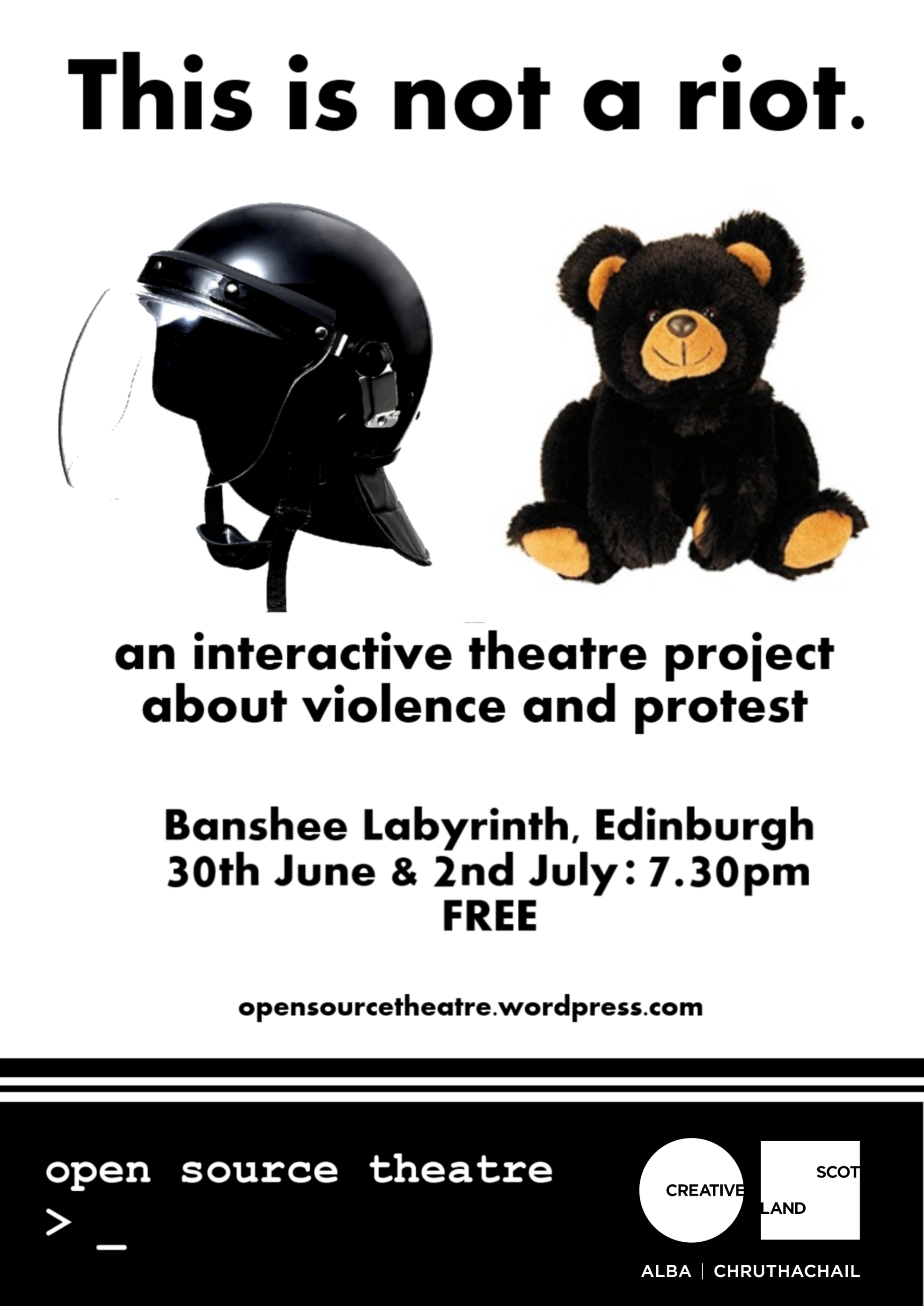
THIS IS NOT A RIOT
an interactive theatre project about violence and protest

30th June and 2nd July
7.30pm (90 mins), Banshee Labyrinth, Edinburgh
FREE

Part performance, part survival training, part blazing argument, “This is not a riot” is a new theatre project looking at what violence is, why we do it, and when it might be useful. Includes stuffed animals.

Following a year of performances at venues and festivals around the UK, from The Yard Hackney to Buzzcut Glasgow, “This is not a riot” is appearing for two special free performances in Edinburgh in preparation for touring to the CrisisArt Festival in Tuscany.

Supported by Creative Scotland.

Olympics opening ceremony details revealed

Politics, Rambles

Edit Post

Preview(opens in a new tab)Add titleOlympics opening ceremony details revealed

http://www.bbc.co.uk/news/uk-18392025

The Olympic Stadium will be transformed into the “British countryside” for the opening ceremony of the London 2012 Games on 27 July.

A cast of 10,000 unpaid workers will help recreate country scenes, against a backdrop featuring farmyard animals and landmarks like Glastonbury Tor.

The opening scene of the ceremony, which will cost the same as 1200 teachers’ annual salaries, will be called “Green and Pleasant”, artistic director Danny Boyle revealed.

He added the show would create “a picture of ourselves as one proud, undivided nation.”

“The best way to tell that story is through working with real people,” said Boyle, revealing that the ceremony will open with a parade of NHS nurses, Polish builders, traditional British civil servants and Scotch clansmen wearing their tartan regalia.

“We’re thinking about giving the audience scorecards, so that they can vote for their favourite national hero in the parade,” he added, a small trail of spittle involuntarily running from the corner of his mouth.

The set will feature meadows and hills, with families taking picnics, people playing sports on the village green and jolly farmers spraying the fields with industrial chemicals.

A river of sparkling gin and tonic will wind its way around the traditional British buildings in the set: a church, where a female vicar will be marrying specially selected gay couples; a village hall, complete with jam competition; and a working slaughterhouse, where the traditional farmyard animals will be turned into burgers and sausages for sale to the audience (£8.50 each).

One billion people worldwide are expected to watch the opening ceremony, and international news commentators are already practising sneering cultural superiority to compete with British coverage of previous years’ opening ceremonies.

The world’s largest harmonically-tuned bell will ring inside the Stadium to start the spectacle. “We’ve got real families to donate 900 pink-cheeked children from all the local boroughs,” said Danny Boyle, shifting in his jeans, “and what plans we have for them!”

Among the other features will be two bear-pits filled with benefit claimants, who will compete for their weekly hand-outs through a series of inventive gladiorial combats using hand-crafted British weapons.

“We really want this ceremony to be for everybody,” the director said, clouds of sulphurous smoke puffing from his nostrils.

The set will feature real grass, an oak tree and teflon clouds held up by a human pyramid of beggars and prostitutes. Black blood seeping from his eye sockets, the director explained: “We really wanted to make sure we gave something back to the community by providing a role to all those who might not otherwise be able to take part in the Games.”

When asked if they were going to give people their houses back, he said “What do you mean. Ha ha ha.”

The home nations will be represented in the set by titanic blood-red phalluses topped with a thistle, a leek, a rose and flax.

“We’re trying to represent everyone’s dreams in this ceremony, and I personally hope it will be a proud reflection of every individual in this great country,” said Danny Boyle, tearing the last remnants of the latex mask from his face to reveal the skeletal visage of Azathoth, Archduke of Hell.

The ceremony will close with the launch of ground-to-air missiles from the houses surrounding Olympic Park, detonating in a co-ordinated display of coloured lights that will rain burning nuclear death on the indifferent population below.

http://www.protestlondon2012.com/10reasons.html
Interactive Theatre: Why, How, &c.

Politics, Rambles, Theatre

I say I specialise in interactive theatre. That means a whole range of stuff, but at the core of it it means I get excited when audiences get up on the stage. I think there’s something genuinely revolutionary about it. I ended up doing interactive theatre largely because of my involvement in contemporary social movements, and in the end I couldn’t help applying the same radical analysis to theatre that I was applying to politics. If I was demanding that politics be participatory, non-hierarchical, ecological, how could I not demand the same of theatre? If I thought that the answers to capitalism lay in creating autonomous spaces, how could I not want to create them in theatre buildings? Arguments by analogy have never been particular sound, but they can take us some interesting places. Still, I’ve found it hard to make the full rational argument for the theatre that I make. Instead, I wave lyrically in its direction. When trying to write a manifesto I came up with:

Open Source Theatre is the idea that anyone can make theatre.
Open Source Theatre
is the idea that everyone should make theatre.
Open Source Theatre takes audiences seriously. We make theatre with them.
Open Source Theatre thinks that everyone who participates in making theatre, including “audiences”, should feel empowered.
Open Source Theatre says that the theatre space is a personal space.
Open Source Theatre says that the revolutionary space is a theatre space.
Open Source Theatre wonders if the technologies of our immensely privileged Information-based societies might be able to make the above statements true.

I’ve been reading Darren O’Donnell’s “Social Acupuncture“, a messy but stimulating book about theatre and politics. (You can get a full .pdf from Mammalian Diving Reflex here.) Bits of it got my back up, bits of it I found tiresome, but big chunks had me punching the air. Yes! I’d say. That’s what I meant! That’s how I feel! O’Donnell has an exciting clarity of style, and a real knack for linking the socioeconomic to the psychological. The book’s like a theatrical “Anti-Oedipus“, but much less obscure. And this post is really just an excuse to post a couple of those light-filled passages.

Here’s him diagnosing the artistic problem:

The classical canon and traditional approaches to representation still hold the theatrical imagination captive. Most theatre still hasn’t managed to dispense with coherent, pithy and supposedly interesting characters whose lives occur incident by incident. Presenting false possibilities of selfknowing – even among nominally postmodern dramatists – still dominates: characters’ lives are summed up, they understand their various shortcomings and blind spots, and they’re offered some sort of redemption, whether or not they choose to take it. And if they don’t, then, at the very least, the audience is offered that possibility. Representational work – work that derives its meaning from the portrayal of other people in other places doing other things – still dominates, imposing its inherent limitations around the construction of transparent subjectivities and the illusory possibility of an objective position from which observation can occur. It also brings along its tyrannical emphasis on narrative; it’s a dramaturgical cliché that the fundamental component of theatre is story and storytelling.

While stories may be one way to get the job done, they’re not the only way; stories are simply one tool among many. What theatre is really about – like any other form – is generating affect, and that’s it. Feelings. And, if things go well, quickly following feelings will be thoughts. Stories certainly can do this, but they’re not the only thing to do it, and they’re no longer always the best way to do it. Yet representational narrative continues to dominate, keeping the experience sheltered from the possibility of a direct encounter between audience and artist, between bodies in the same room at the same time.

But he’s equally clear in his diagnosis of the difficulties with the participatory solution. Folk who’ve been to my shows will know that they’re in parts messy and awkward. I put considerable effort into making informal spaces full of possibility, in creating dramatic moments which one night will carry us all away and which the next will putter out entirely. I’ve previously put this down to experimental risk. But maybe it’s inherent to the form:

The innocent gestures of the spontaneous will always tell us complex and politically charged things about this very moment, giving theatre artists the opportunity to find rigorous ways to generate and frame it. That’s the challenge, with theatre’s addiction to a very particular understanding of a rigidly rehearsed virtuosity standing in its way. It’s easy with film and tv – you just edit out the dull shit, focusing on the telling spontaneous moments. This is not so easy when the interactions are live, and particularly so if they involve audience interaction. There will always be annoying fumbles and distractions, and a final product that doesn’t have the same concision that editing allows.

The path to a rigorous participatory theatre is fraught with dorkiness, earnestness, amateurism, social work and therapy. It’s a minefield. And no one can be blamed for feeling squeamish or repulsed by the notion. We like our work rehearsed and we like it well rehearsed, like a nice charbroiled steak from Denny’s. The question for the theatre artist anxious to break with debilitating habits of the past is how to create thoughtful, rigorous work while allowing for the unknown, the unexpected and the awkward – how to find meaning in qualities other than virtuosity and razzle-dazzle.

That argument is the artistic and psychosocial rationale for the theatre I’m trying to make. You’ll need to read the rest of the book – or go to one of his projects? or, better still, one of mine? – to talk more about how that ties into the political. But, briefly:

Representation and narrative will always be comfortable and tyrannical. No matter how deconstructed, the artist will always be telling you a neat story about how the world is. If that story is political, they will always be presenting a platform, making an argument, raising awareness? – representational theatre can’t help but be so liberal. The most radical thing a politician can do is get down from the podium and invite a bunch of other people to speak. The most radical thing a theatre-maker can do is as the audience to invade the stage space and make their own contributions from it. This will always be aesthetically uncertain and awkward. Anything aesthetically fixed and polished can only communicate a message: to have a conversation, you have to disrupt the aesthetic calm you’ve created. And that will lead to far greater artistic magic.