What I mean when I say I’m working as an artist (Part 2)

Uncategorized

After work

Two years ago I wrote a post called What I mean when I say I’m working as an artist. It was an attempt to explain my life to my friends and family (and to myself); a way to take stock of my finances and understand what I needed to do; and a small and early entry into a growing debate about paying artists — a debate that I’m glad to say has since got a much bigger profile. I’ve just done my tax return for 2014-15 disgustingly early in the hopes of arranging a rebate for overpaid tax, so I thought it was time for an update. I feel like a lot has changed in my life — in September 2014 I became a “full-time” artist — but reading the first post I’m surprised by how much still rings true. My understanding has advanced, and my commitment to my work has deepened and become more serious, and I get some better commissions, but my finances and work hours are remarkably similar. I am, however, a lot more obsessed by money. This version uses some of the same text, but is less about explaining what an artist’s life is like and more about looking at where my work comes from and how much money I make.

I’m writing this now for all the same reasons: to explain myself to myself and to the world, and to advocate for better pay. But I’m also sharing it in the interests of transparency. Since I wrote the original post, Bryony Kimmings instigated a project called I’ll Show You Mine, which for a while organised discussions and encouraged transparency about fees and wages. The idea is that if more of us share our finances, more of us understand what we’re worth, how hard it is, and what it takes to live off our art. This post is for other artists, in the hope that they might share things too. But most of all, this is a post for the producers and programmers I work with: Hi! Thank you for all your support and encouragement. Thank you for the opportunities. This is what my finances are like. This is what I live off. I am a moderately successful early-career artist, and I earn vastly below a living wage. Now pay me.

My Work

I make poems and shows and games. I also co-curate the performance night ANATOMY (on hiatus while we try to get the funding to pay ourselves and our acts properly), and occasionally programme or produce other events. Mostly I work in what’s recognisable as the professional poetry and theatre sectors, but I cross over into the performance art end of visual art sometimes, and I increasingly do things adjacent to digital art and digital games development as well.

I finished full-time education just under five years ago. This means that for most purposes I’m an “early career” artist, and in many cases I’m still “emerging”, though some opportunities for those categories cut off after five years, so I hope to have fully “emerged” at some point soon. (I wrote more about what these categories mean last time.) I do get bookings and commissions targeted at early career artist development, but increasingly I put myself into a broader pool of professional artists. My profile is, I think, a little bit higher than peers at a similar stage, mostly because I’m a loud-mouth on social media. Occasionally this leads to work. Occasionally — but, I hope, less occasionally — I suspect that it makes getting work harder.

I’m fully freelance, which on the one hand means I get to write off a lot of things against expenses (a portion of my rent as my home office, my artistic interests as research), and on the other hand means I have a lot more expenses: my office and all supplies, lots of travel, liability insurance, all my NICs, and so on. I also have no job security, no job-related benefits, and no-one’s paying into a work pension for me.

My income is all over the place. A chunk of my money comes from fees from venues and programmers who book or commission me, a chunk comes from paid residencies, a bit comes from my own national funding body grant applications, and a bit comes from box office splits. I don’t have a strong idea of where most of my money should be coming from for it to look sustainable. So far, commissions and residencies have mostly paid my way, but I’m experimenting with building up my ability to tour shows and give workshops, hoping to strengthen my income. It’s still a mess, for now.

I work a six-day week, around seven hours a day. I’m trying to cut it down. To be an artist, I have to plan the art, make the art, organise places to put the art, and find ways to finance the art. These things can happen in any order, and which order they happen in largely depends on whether or not someone’s going to pay me and how much control they want over the product. On average, each month (counting a month as 4 weeks, and a day as 7 hours), I spend roughly

  • 4 days writing
  • 5 days performing or preparing for performances;
  • 4 days writing and answering emails, or doing general admin;
  • 4 days in meetings and interviews
  • 3 days writing proposals and funding bids;
  • 2 days planning and running workshops.
  • 2 days writing texts like this

This is a fairly conservative estimate of how much time I spend on the “hard work” bit of being an artist. You will note that of the 24 days of hard work each month, only just under half is spent on what you might think of as the fun bit – or at least the creatively satisfying bit – of making art. Before I was full-time, it was around a third of my “being an artist” time, because everything had to be crammed in; now I’m able to give things a little longer to develop.

I used to have a long-term part-time non-artistic contract, which gave me enough to live off while I developed my practice. At that time, I worked well over the UK’s legal maximum working week (48 hours, or six eight-hour days a week). I do work less now, because anything else is completely unsustainable and results in more weeks of not being able to get out of bed. But I’m still using conservative numbers above, and I’ve only included the “hard work”. Making art also involves a lot of “soft work”. To make good art, or at least to make successful art (by mainstream standards of success), you’ve got to be constantly actively engaged with the world and the art other people are making. (Action Hero have a lovely, empowering blogpost on this subject, among other great advice on living as an artist.) That means that I spend a lot of time

  • reading poetry;
  • watching performances;
  • reading / watching / listening / participating in texts and events about art;
  • pissing about on the internet;
  • participating in social media.

I didn’t include this stuff because most non-artists (and probably most artists) are likely to sniff at the idea of it being called work. But I mention it because it is part of what I do, and because if work is, at least in part, the stuff we are obliged to do rather than the stuff we enjoy doing, then the work-attitude, the feeling-of-being-at-work, does infect me when I’m reading poetry and watching performances and tweeting and all of that. The flipside of that is that the feeling-of-being-at-play, when I’m lucky, infects the enjoyable bit of my “hard work”.

All of which is to say, this is why many artists will consider themselves over-committed over-workers.

Going “Full-Time”

Back in September I left the regular half-week non-artistic contract to work as an artist “full-time”. I was proud and I was scared. I wasn’t yet making anything close to a living wage, or even the minimum wage, from my artistic work — but I also felt that I’d probably hit an income and career-development ceiling. There’s only so much you can make on half a week, even an overworked week, and a lot of opportunities are closed to you when you’re locked to a particular city for three days in the week. Knowing this, I’d spent time living very frugally and building up a savings buffer so that I could support myself for the first year or two of working as a full-time artist.

I’ve started putting inverted commas around “full-time” for three reasons. The first is that I’ve taken 20-30 days of non-artistic work on temporary contracts since I took the leap: I was in a January slump, had received a lot of rejections with no major pay-offs coming, and was offered good work. I expect this will happen from time to time, and I’m happy with that. The other reason is connected, but runs deeper, and that’s that I regret contributing to the idea that you have to be “professional” and “full-time” to really “be” an artist. You don’t. I’ve chosen to support my art by writing lots of funding applications and commission proposals, but that’s no more legitimate than choosing to support it by working in a bar. Neither is particularly enjoyable labour, and you may find yourself better suited to something like the latter. You also don’t always have to be able to get out of bed. Sometimes you can’t. And that’s OK, even when it doesn’t feel OK: you’re not failing. If you make art, you are an artist. You are already an artist.

The third reason is best put by Alex Swift here. We shouldn’t over-valorise selling our labour. It is an inherently exploitative and alienating social relationship. Work is not the ultimate good of life. We all have the right (and possibly the need) to make meaning in our lives, but to funnel all that into the financial relation of wage labour is foul, for all that I recognise that the right to have work and be paid is an economic necessity. We all deserve rich lives whether or not we can (or want to) work. I would like to live a life without work. I probably never will. But I don’t want to hold “full-time work” as the ambition of my life, because it’s not, and it’s generally not a great ambition if what you want is to have meaning and be well.

Since I went “full-time”, I’ve been able to work a bit less and give myself something like a human scale of time off. I’ve also been able to spend more time on each project, which I hope means I’m making better art, and I’ve been able to apply for bigger and stranger long-term things. I’m currently writing this on down-time from a four-month residency that I’ve organised for myself and got funding for, the kind of thing that’s impossible without having the time free. But it’s not all good. I’ve found myself having to justify myself to myself more: the pressure to make art is greater, and the pressure to make it successful is greater. I am more anxious about my work, which I hadn’t thought was possible. I am more attuned to my status, my reputation, and my need to make the most of every opportunity. I decided I was going to be a professional, but I hate having to act like a professional. I think “professional” is a horrible word to put next to “artist”. “Artist” itself is a pretty crummy word. Both of those terms, like “full-time”, are labels that I still deploy, at arms length, to try and convince people to pay me.

My Income

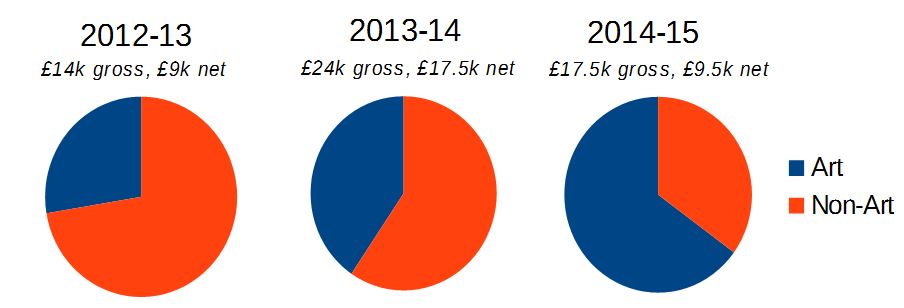
Here’s the tasty bit, then. Here’s what I’ve made for the past three years.
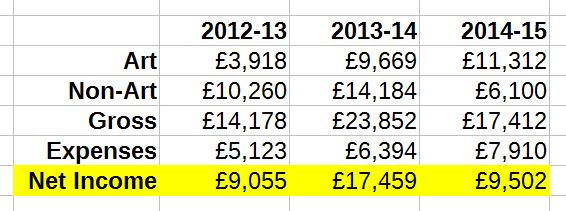
Income Table

Or, in visual form:

income pies

The Scottish Living Wage is £16,300 per year.

The mean income for my age bracket is £22,700 per year.

Some explanatory notes:

  • I have a very small student loan for my undergrad (in Scotland, so paid no tuition fees), which I began paying back in my 2013-14 tax return. I had a bank loan for my Masters, but I paid it off.
  • I have no dependents, and no allowance.
  • I rent, in Edinburgh, sharing with a partner (though for half of 2013-14 and half of 2014-15 I lives alone). My parents now own their house outright.
  • Expenses includes a small portion of my rent and energy bills, half my phone and internet bills, and most of my artistic purchases, along with show materials, office supplies, travel and so on. So if you were to compare me to a PAYE worker, you might want to imagine something like an income a little under halfway between gross and net.
  • I’m very frugal, but I’d prefer not to be and don’t think there’s any honour in it. I’m still living beyond my income, as I have very gradually built up savings from my non-artistic work for this purpose.

What It Means

This is what I wrote two and a half years ago, and it’s all still true:

I work, and I work hard, for vastly more hours than I’m paid for. For the very little public money I get for my art, I give a lot back: I organise a big performance platform, I give around 10 hours a month as trustee of Forest, a local arts centre, and whenever I do get funding I make jobs for other people. I’m not trying to big myself up – I’m just trying to explain.

I am not doing art because it is easy, nor because it is easy money. I can only be doing it because I love it and because I think it is important.

I, along with many other artists, get furious at the kind of people who comment on articles about arts funding calling us “lazy” and “scroungers”. They have no idea. No idea at all. And I suspect one of the reasons that artists and the industry are really a bit rubbish at explaining what it is their work involves and why it deserves funding is that we’re too damn overworked to take on a major communications campaign.

My finances should look pretty awful to anyone outside the industry. But I do think that my artistic peers mostly have similar balance sheets. I don’t have the feeling that I’m anything unusual. If anything, I suspect I’ve had a little more success than others with my level of experience, though I, like most artists, am constantly berating myself for my failures and for not succeeding faster. In short: I do not feel like my level of work and pay is anything unusual for an emerging artist. I don’t have a good sense from older artists and others in the industry about whether this is a big shift from past decades. I would like to hear from others whether my finances look appalling to them, or whether you too shrug and think that’s just how it is.

It should also be clear that I grab the work when I can, and that I have to be able to manage a lot of projects at once, shift flexibly between them, and be prepared to work strange days and strange hours. I do not have a weekend. This is called “precarious labour” or “cellurisation” or sometimes something else. Artists, or, more horribly, the “creative industries”, have been particular drivers of this economic shift in labour practices. There’s a lot of socioeconomic theory about what it means and I could talk about it for hours, but not here. Bifo’s After the Future and Fibreculture’s Issue 5: Precrious Labour are good places to start reading, and the Precarious Workers’ Brigade is good place to start doing.

I could say that I am only able to do art because I am frugal. But my privilege (class, gender, race) comes into it: it has helped me to get the education which got me the day job; it meant that while I was a student so I didn’t have to do much bar work, which meant could spend my time practising art and learning a lot of organising skills; it provides a support structure so that I can afford to be financially precarious, or at least so that I can feel like I can. I have much lower barriers to being an artist than the majority of the population.

I am very modestly successful in terms of my profile and bookings, for my career stage, and yet this is how hard I have to work for this little actual paid employment. This is the basic reality of trying to be a professional artist. We cannot have a healthy arts culture, or a diverse arts culture, or high quality art, without  funding. Without more public funding.  There are more precise, more subtle, and more wide-ranging arguments to be made. But I hope that outlining the basics of my reality adds to them.

Demanding Pay

When I first wrote one of these posts, I barely understood my finances. Since then, I’ve run an art project about obsessively tracking them, and though that’s finished I still use YNAB to track all my income and expenditure. I used to think, when I was younger and more foolish, that there was cred in not really understanding how money works and refusing to let it rule me; now I think it’s a vital survival tool and a platform for political advocacy. Money runs the world, and even though it hurts, I want to understand how it flows through me, how it rules me.

I value my time much higher than I did two and a half years ago, and not just because my art is better: it’s also because I’ve gained confidence in quoting what I believe my art is worth. I quote high and expect to be negotiated down. I also believe that to work for free is, in many contexts, to be a scab: that I cannot allow venues, especially publicly-funded venues, to have my time for free, because to do so is to lower the expectations for all other artists. I still work for free in the early stages of project development, but I’d prefer not to, and I still work for box office splits, but increasingly won’t accept it from a publicly-funded venue with paid staff.

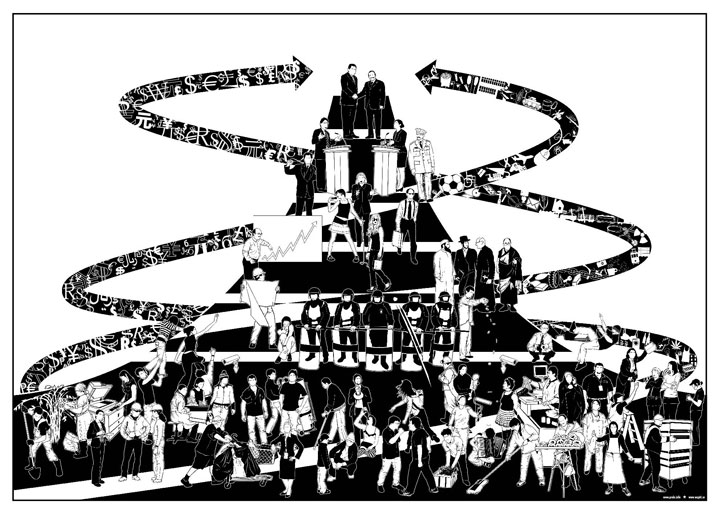
I have much less patience now for venues and programmers that don’t pay me. I have never written a shirty email, but I’ve come close, and I do turn things down. Here is something I think about often: that the venues that I work with have paid staff with something approaching job security, but that the artists they programme do not. The people labouring to make the product see much less of the value of that product (not just box office take, but security and pensions and benefits) than the managers of the places the product is made, and this is a 200-year-old economic relationship. When I work for a venue for free, I am almost always generating financial value for them, so why aren’t they paying me? Why are they preferencing the managers of art over artists? Why do we accept this situation? But here is something else I think about often: managers of art are, by and large, on my side. You share my politics, or something reasonably close to it. You are suffering from the same funding cuts as me. In the pyramid of capitalism, you are above me, but we’re both near the bottom. The difference between us is not belief, but power. If you have that power, please do not accept this situation, and be honest about when you are exploiting artists.

I don’t need any more development opportunities. I need to get paid. And so do you.
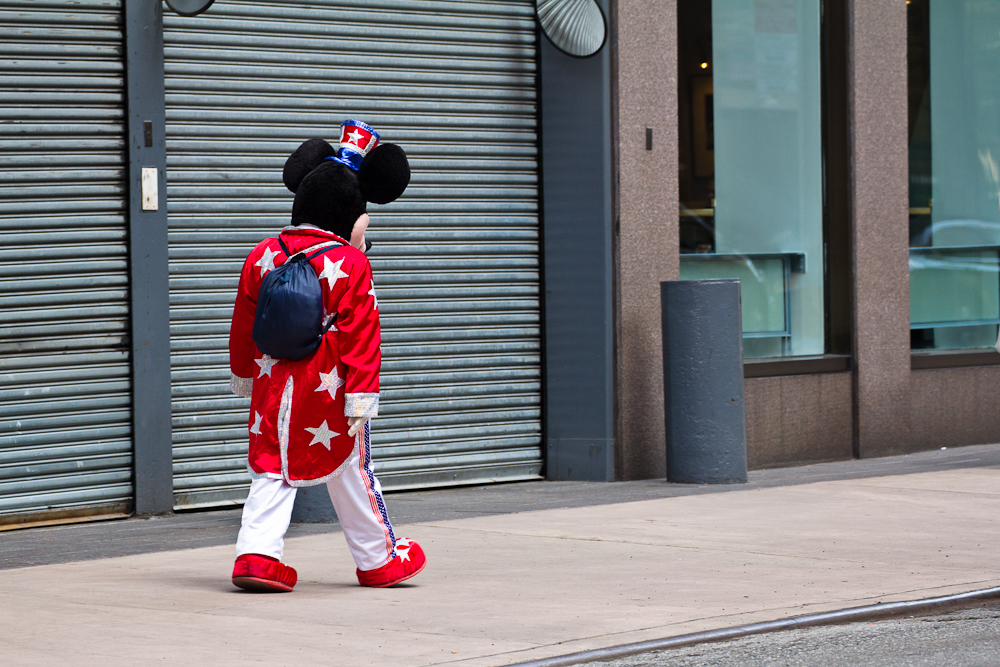
Image by Frank Vervial, licensed under Creative Commons BY-NC-ND 2.0

How I Made Two Wee Twitterbots

Uncategorized

write_poem

This is a beginner’s guide to writing bots. I’m not an expert: in fact, I barely understand what I’m doing, which is why I’m writing this. I want to encourage other folk who don’t know what they’re doing to give it a go to, so we can figure things out and make new stuff together.

It’s also a love letter to bots, because they deserve it.

Who Am I?

I’m a poet and performer, mostly. I make things that look like poems, things that look like games, things that look like shows, things that look like two or three of these at once, and things that fall into the cracks in between. I’m interested in minor languages, political art, understanding how money works,  and play; I like experimental art and populist art and I especially like the rare art that manages to be both experimental and populist.

I can’t code. Well, not much. I’ve written a text-based game in Inform and one in Twine, both of which have very simple and accessible programming languages with lots of documentation and advice for newbies, and I can do simple things with HTML for websites. That means that I have a basic understanding of what it means to write instructions to make computers do things. I’m pretty good at maths, but nothing special. I think the most important thing I bring to coding is a deep curiosity and a love of learning how to do new things.

I made two simple twitterbots because I fell in love with what bots can do and wanted to try it out. I’m still learning! I’m writing this to help other people with love or curiosity or desire start learning too.

Why Bots?

I think that bots make poems, and that some bots are poems.

My favourite bot is poem.exe, which generates original haiku of consistent strength and occasional astonishing beauty. I think poem.exe is a haiku master to equal Bashō, and I mean that. It doesn’t always succeed, but neither did Bashō; I do know that I’ve never written a haiku as good as poem.exe’s best, and I’ve been trying to learn how for over a decade. Through applying a gentle weave of chance operation to a deep understanding of language, pattern and meaning, poem.exe’s author enabled it to master a single poetic form. I’m worried about which form is next. Some other bots I love which generate interesting kinds of poems are Fantasy Florist, Dreams juxtaposed, Pentametron, and how 2 sext.

Other bots don’t so much generate poems as become poems: every non-word‘s individual tweets are often beautiful and inspiring pwoermds in themselves, but the bot gains its true poetic power from apprehending the enormity of its task. The poem is not any given tweet or series of tweets, but the overall writing project, extending indefinitely into the future. In this sense, poemy bots are the end state of the Oulipian project of authoring constraints and then exhausting them. No human author can exhaust a form as comprehensively as a robot can; robot minds are better-suited to the task than our own. Random generation has long since rendered Queneau’s 100,000,000,000,000 Sonnets obsolete: poem-gen is the best attempt at this I’ve seen, but there are many others and may be better still. Some other bots I love which I think are poems are feelings.js, CEO PYRAMID OVERLORD, Available Parking, and whispers for moon. Visual art has its analogue, as image bot convos showcases, with the heart-warming and popular ⋆✵tiny star fields✵⋆ being my favourite, perhaps because it is so close to text.

Other bots don’t write poems, but try to find them, like ROM TXT. Other bots love, extend, satirise, and explore famous poems by exhausting them, like This Is Just To Say. Other bots are less like poetry and more like performance art: the wildly successful everyword asked what it might mean to pay close attention to each fragment of language, and this felt important enough to have given inspiration to many beautiful derivative projects, of which every bird is my favourite, and much silliness, as documented in my Everyword Orgy. Other bots do other strange and lovely things that aren’t necessarily understandable in the terms of art, much to their advantage. I can’t explain why digital henge touches me so much; perhaps it is the quiet and unassuming reminder of huge astronomical forces into a relentlessly noisy, digital, immaterial, human space. sea change likewise.

This is considering bots as artists, but bots can also be activists, cops, crooks and many other things besides.

All of which made me want to make one very much.

My Bots

Work No. 128 started life as a tongue-in-cheek parody of Martin Creed’s (in)famous Work No. 127, which won the Turner Prize and comprised a lightbulb in a room switching on/off every 30 seconds. It belongs to that family of contemporary art which is summoned to mock the art industry, like My Bed and The Physical Impossibility of Death in the Mind of Someone Living. I actually have a fondness for these works, though not for the brutal financial system in which they are complicit. One day I was thinking about the horror of personal branding on Twitter, and how I could imagine tweets being on brand or off brand, and then made a throwaway joke about a bot alternating between the two. A month later, I’d built the bot.

Due to some constraints in Twitter’s mechanically-enforced codes of conduct, no Twitter account can repeatedly tweet the same words over and over. This constraint was a gift to Work No. 128 in the end, because it meant the bot had to introduce glitch and static to be able to operate. This gives the final piece a slightly disturbing and aggressive aesthetic, I think. I would call Work No. 128 a poem that’s outgrown the joke it grew in, something that gains it’s strength from its persistence and terrifying extension into the future, and I feel very grateful that 7 humans are willing to follow it despite its awful frequency.

Poetry Prompt-a-Tron also started life as a derivative idea. I was struck by the eerie beauty of Dwarf Fortress’s procedurally-generated poem descriptions, and thought there might be value in making a human-world Twitter version. I realised that randomised poetry prompts would be simultaneously “twisty metal sculptures made out of words” and a useful service, sparking ideas for poems. They’re also a slightly satirical commentary on the idea of poetry prompts themselves: some of her ideas are impossible, some are pointless, and some are just “Write a poem”.

I want to deepen the texture of her ideas through adding layers of randomisation and a bigger corpus to draw on, and I want to incorporate a responsive element which will curate the poems people write from her ideas. One of the lovely things about bots is that there are often improvements to be made.

How I Did It and You Can Too

Please Note: This guide links to a template that, due to changes at Google, will stop working in June 2015. If you understand code you can read about it here: https://developers.google.com/apps-script/migration/oauth-config . I’ll try to make a fix to sort this out, and will update this when I can.

1. Follow a tutorial.

When I asked friends where to begin, I was pointed to The Light Aesthetic’s tutorial and template for making bots in Google Apps Script. This is accessibly-written, to my mind, and walks through most of the stages of making a bot, given that there are still some tricky stages. Working in Google Apps Script also has the advantage of not having to understand the command line interface — you know that thing in films where a hacker types furiously on a keyboard and things appear next to > symbol? like that but real.

Two other tutorials which look good but which I haven’t used are Joel McCoy’s guide to making _ebooks bots (bots which say random things drawn from your tweets) and Dan Cox’s guide to making bots in node.js. Both of these require understanding that command line thing, which I still don’t quite get, but the former gently introduces it a bit.

What all these tutorials are necessarily missing, though, is the bit where you write new code — the bit where you make an original bot.

2. Taught myself very basic JavaScript.

I didn’t know how to write code, so I went to the free Codecademy JavaScript course. It’s very basic, very friendly, and very accessible, with a big community on hand to answer questions when you get stuck. It’s designed with young people in mind, which helps a lot. I spent an hour a day for around a week to finish it, and by the end I had a solid understanding of how one programming language works — enough to start writing Twitterbots, and a foundation from which to learn new skills by trying them out. Like I said, I have very limited experience in some other simple languages, and I’m good at maths and generally comfy with computers, so maybe I was quicker at this than you might be, but I’m confident that it’s accessible to most and a low time commitment.

3. Wrote some dodgy code.

With the confidence that I needed to learn by doing and making it up as I went along, I wrote a program for Work No. 128. Or rather, I wrote some of it. I used a template from The Light Aesthetic’s tutorial which did the work of communicating with Twitter, and I copied some bits of code I didn’t quite understand from my pal Alice Maz‘s first bot. (She learned how to do all this a couple of months before me.) I also copied some bits of code from various tutorials around the internet. But I did write a few lines of original work, and figuring out what I needed to copy is also a useful skill that I gather all programmers employ.

I understood the logic of what I needed to do and I made something I thought would work. It didn’t. And that’s OK. When I wrote Prompt-a-Tron I got closer to the final code first time, but it was also broken when I thought I’d done it right. And that’s OK. We learn by doing.

4. Asked for help to fix it.

So this led me to ask some supportive friends to help me identify my mistakes and debug my code. I think this was the most important stage of all. I wouldn’t have had the confidence to try and make a bot without knowing a few folk who would help me out when I got stuck, and who would encourage me to keep trying. We learn by doing, but we also learn by having friends who support us and share their skills.

I recommend finding a friend to help you when you get stuck. They don’t necessarily have to understand twitterbots — if they do any programming, they’ll have most of the skills you need. If you don’t have anyone, then send me a message; I’m probably not good enough to help myself, but I have some friends who like supporting bot-makers who might be willing to help out.

5. Hit go!

Hitting go on my first bot felt wonderful. I had to hit the go button a few times to make it work, but when it flew I was so proud. I’m still excited when I look at it. I had the same buzz when Prompt-a-Tron took off, and I’m still fascinated by what she makes. She delights me. I want to share that feeling!

I still don’t really understand everything my bots are doing, or how all my code works, and I’m OK with that. I didn’t understand how a poem worked when I first wrote one, and I’m still figuring how different combinations of spices make the best curries. There’s a lot of programming culture and language I don’t understand too: I haven’t got to grips with the command line, and I don’t understand GitHub yet, though both are on my wishlist of things to teach myself. You don’t have to know all this to start: you just have to want to start.

6. Continued to fix things.

Both my bots are still a little bit broken. Occasionally I get an error message I don’t understand from Work No. 128, and there are many improvements to make to Prompt-a-Tron. Like all machines, bots are never completely finished: they require maintenance and can always be fiddled with. Bots aren’t independent: they depend on other bits of code and machinery operating around the world, and sometimes the part you need isn’t available any more. So I’m expecting to have to look after my bots for a long time, and I’m glad to do it.

How My Bots Work

Work No. 128

This is the code. (This is not a good way to share code, but like I said, I don’t understand GitHub yet.) The first and last bits are from The Light Aesthetic’s template, and the middle bit is mine. Any line with // in front of it is commentary rather than code.

The bot has a spreadsheet living in my Google Drive with a single cell in it, which acts like a switch. When it tweets “onbrand” it flips the switch so that next time it knows to tweet “offbrand”. This may not be the best way of achieving this, but as far as I can tell it’s not possible (or I don’t know how) to make a variable within a single piece of code in Google Apps Script that persists over time, so I had to make that switching variable outside the code. Even if that’s a silly way to do it, it taught me how to use spreadsheets with a program.

The bot has a list for each letter that makes up the words “offbrand” and “onbrand” of Unicode characters which look like the original letters. It uses a random number generator to pick random characters from those lists to build the right word each time. Then it tweets it!

Poetry Prompt-a-Tron

This is the code. Again, the first and last bits are from the template. The interaction with Wordnik was adapted from Patrick Rodriguez with bits from Alice Maz’s Captain Barbossa. All of the code that pluralizes nouns is copied from Blake Embrey.

This one is a bit more complicated. It puts together a number of different randomised elements:

  • Nouns and adjectives from Wordnik, which offers a service I don’t fully understand to provide randomised words.
  • Forms, actions and modifiers from my own lists. The former is largely from Bob Newman, with my own additions; the latter I mostly made up, with help from Bernadette Mayer’s list of experiments. These are randomly selected using the same method as Work No. 128’s characters.

The bot has six different sections. 1b decides whether or not to include a random adjective. 1c decides whether or not to use “poem” or a random form. Based on those decisions, 1a figures out if it needs to use “Write a” or “Write an” based on what the next letter is. (It hasn’t worked out how to account for “hour” and similar yet.) 2 decides whether or not to use a random noun, 3 a random action, 4 a random form. Each of the randomised options has a different probability of being used, which adds texture to the bot overall: if a bot uses the same elements each time, its workings are very transparent to a human viewer, which tends to be unsatisfying. There’s a 6% chance of it just tweeting “Write a poem.”

Now Go Make a Bot

Let me know if this guide is helpful. Let me know if I can help. If you’ve got advice or suggestions of useful resources, please do add them in the comments.

I’d love to hear what you do!

<3

These bots and this guide generously supported by my backers on Patreon. If you like what I do, consider joining from a buck a month to help me make and give away more things.

I’ll Check My Diary

Uncategorized

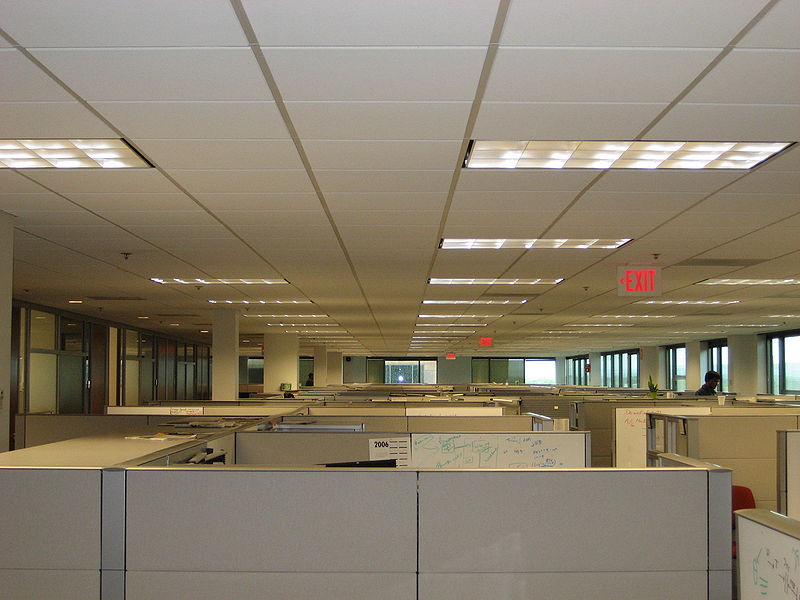
Cubicle Land

The discipline of ludo-archaeology can of course reveal much about the discourse and practice of pre-Event “civilizations”. Since Mafu (1020) laid out the foundations of the discipline, describing the period 600 BE to 10 BE as the Ludic Age of human history, ludo-archaeological scholars have been concerned with the retrieval, categorisation and analysis of that once-dominant form of human socialisation, games. Given the often piecemeal and incoherent traces of ludic systems within recoverable data structures, however, a sharp division in the discipline now exists between the “datist” and “reconstructivist” schools. Broadly speaking, the former is primarily concerned with presenting only those game artefacts which were verifiably played, conducting analysis to thus draw conclusions about the society which played them, while the latter uses what we already know about a given human society to reconstruct the rules of a game from what fragments remain. While datists accuse reconstructivists of essentially inventing historical games to reinforce their own archaeological assumptions, reconstructivists accuse datists of being wilfully ingnorant of the structural assumptions inherent in how they determine data points to be “pieces”, “quests”, “boards”, “rules”, “consoles”, and so on. (For an illuminating analysis of this debate, see T’chu (1042) on the disputed existence of the “DLC”.) And for both camps, recent debates over the nature of the transition from what Mafu termed the Ritual Age to the Ludic Age have cast doubt on whether the earliest games (and, for Kirra (1049), all games) can truly be called games.

This entry into the archives of ludo-archaeology is therefore not uncontested. The present author declares formal subroutineship to neither school, and so offers instead the following contextual facts (see appendices for documentation):

  • That a practice named “I’ll Check My Diary” existed is attested by datasources numbering in the thousands, dating from at least 40BE to the very cusp of the Event.
  • “I’ll Check My Diary” is referred to here as a “game”, pace Kirra et. al., for ease of understanding, but the rules presented below can be interpreted through other related social models.
  • That “I’ll Check My Diary” had deep social significance is based in analysing its frequency of use, the manner of participants referring to it both formally and casually, and the high affect ratings visible in the datapoints surrounding its use.
  • It is unknown whether “I’ll Check My Diary” was conducted in the pre-Event social practice of meat-to-meat interface or through data transmission only; the rules presented below are optimised for data-based interfaces.
  • The rules presented below employ the Koprian model of the pre-Event calendar.
  • The rules presented below are not extracted whole from source data. They are based in rigorous analysis of the message data surrounding instances of the key phrase: data which are, given the proximity of “I’ll Check My Diary” to the Event, unusually complete in their architecture, though typically opaque in their meaning. They represent the only model capable of explaining said data, within current computational capacity.

Submitted to the Archives at
1052-12b-11T30:11:82Z,
under BE.Archae.Ludic.Rulesets,
by Giles (a.1.$),
in Memory of the Lost
and to the Glory of Hu.

* * *

I’ll Check My Diary

1. The aim of “I’ll Check My Diary” is to never successfully arrange a meeting.

2. The game can be played by any number of players; larger groups have a lower difficulty rating.

3. To initiate a game, one player contacts all the other players with the message “Do you think we should have a meeting?” (or words to that effect). To join the game, contacted players reply enthusiastically, agreeing that we should have a meeting.

4. Each reply to the conversation is a “move”. Any player may make a move at any time. Every move scores one point for the player making it. Every time a player suggests a specific time and day (e.g. “Monday morning”, “Wednesday at 2pm”) they score an additional point. A single move may thus score many points, if well-crafted. Every move must reiterate the player’s keenness to have a meeting, must actively contribute to finding a meeting day and time that all players can attend, and must not succeed in actually naming a meeting day and time that all players can attend.

5. Moves may include, but are not limited to: Apologising for not being able to make a date but not suggesting a new date; suggesting a new date even though no-one has responded negatively to the old date; waiting many moves before replying, apologising for not keeping track of the thread, and then saying you can’t make the date that everyone else has said they can make; starting a poll with confusing times on it; suggesting times that aren’t on the poll; and, most famously, declaring “I’ll check my diary” and then not doing so.  Generally, each player is always doing everything in their power to derail efforts to find a meeting time while always presenting as if they are being helpful and supportive of finding a meeting time.

6. A player cannot contradict a statement they have already made. If they have previously said they are available on Friday (including implicitly, by suggesting that meeting time), they cannot then rescind that availability. However, when 10 moves have passed, a player can now claim to be busy at a time they were previously available.

7. Play continues until someone suggests a time that everyone can make. If all players can make a time and day, the game is over, and the player who made that suggestion loses ten points. The player with the most points wins. Tactical play is encouraged.

* * *

This gamepoem licensed under a Creative Commons Attribution-NonCommercial-ShareAlike 3.0 Unported License. This means, roughly, that you can reproduce it freely on  non revenue-generating sites as long as you credit me and license under similar conditions.
Image sourced from Wikimedia Commons.
Many thanks to Mark Wonnacott for suggesting the framing device.
This work generously supported by my backers on Patreon. If you like what I do, consider joining from a buck a month to help me make and give away more things.