Outriders: Returning to the Bay

Outriders, Uncategorized

I’m in a cemetery just outside of Mantayo Seepee / Churchill, Manitoba, on the edge of Kîhcikamîy / Hudson Bay, in Ininiwak / Cree traditional territory. The snow has drifted several feet deep in places, covering many of the stones and wooden crosses, but it’s packed and frozen enough that in most places I can walk on it. I try to step lightly. Just north, beyond the fence, across the snow-drifted rocks, are hundreds of miles of frozen ocean. It’s -15 degrees out, minus a few more for wind chill. Every body surface I can cover is covered, most with four layers, and my cheeks are stinging with cold. There’s a track of something leaving over the drifts — maybe an arctic fox, maybe a rabbit or hare. There are bird tracks too: snow bunting, I think, and maybe some from one of the big, human-sounding ravens that’s been flying overhead. I look down at the gravestones: the surnames are Flett, Oman, Sinclair, Spence. Names from home.
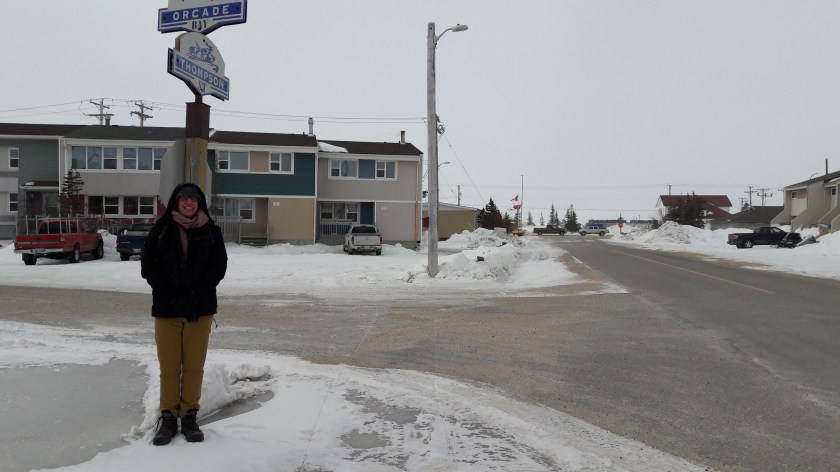
Your correspondent stands beneath a blue street sign reading "Orcade Bay", wrapped up and looking very cold. Snow underfoot, housing blocks behind, and a grey sky.

Your correspondent stands beneath a blue street sign reading “Orcade Bay”, wrapped up and looking very cold. Snow underfoot, housing blocks behind, and a grey sky.

We’ve been here for three days, towards the end of the long freeze, well in the off-season, after the best polar bear watching and before the best beluga watching. The national parks are closed, and only a couple of guides are still available. It’s a bad time for tourism and a good time for social history: it’s easier to find folk with time to chat about themselves and about history.

But there’s plenty still here to see: We’ve visited the Itsanitaq Museum, which has an extraordinary collection of Inuit art collected by the Catholic church, and the Arctic Trading Company, which still serves as a traditional trading post for furs and artwork, and where we were shown the beadwork, tufting and slipper-making workshop, but which also sells cuddly polar bears and t-shirts. We ate at Gypsy’s, which does pretty spectacular fried chicken and apple fritters. (Full disclosure: that’s true, but I also got given a donut for saying that.) We drove out to the Northern Studies Centre, past shipwreck, plane crash, and abandoned rocket testing site. We visited the oldest prefrabricated building in Canada, an Anglican church with ornate stained glass. I rode around the boreal forest, right agaisnt the tree line, in a dog sled. We’ve hiked out through the snow to the very point of Cape Merry, where the frozen Churchill River meets the frozen bay, and where we can just see the snowed-in buildings of Prince of Wales Fort across the ice. If we had the energy, the gear and the company, we could walk there straight across the river.
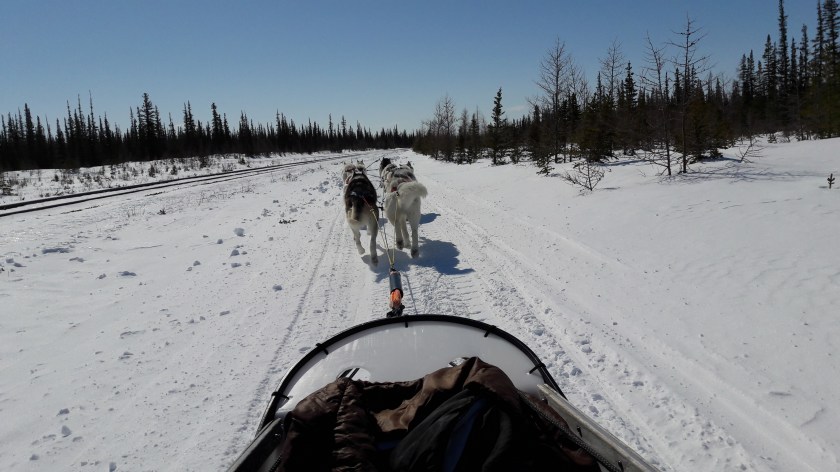
Eight huskies run through the snow, pulling a sled, just visible in the foreground. They're by a railway track and running into a low forest of spruce and tamarack.

Eight huskies run through the snow, pulling a sled, just visible in the foreground. They’re by a railway track and running into a low forest of spruce and tamarack.

In all the places we’ve visited, I’ve chatted to folk about my research. I’ve talked about Orkney, which, unusually for people halfway round the world, most folk here have heard of (there’s a street named Orcade Bay), about tracking the Hudson Bay workers and their descendants, about wanting to tell stories from here back towards my own home. Mostly, folk are cautiously curious. I grew up on an island of 700 folk, and Churchill has 900, so I’m assuming that word gets around about who the very tall person who’s chosen an odd time to come is.

And as I think about this, I realise what I’m sounding most like, with my too-big smile and my eagerness to talk about my project: the Americans and Canadians who would visit Westray, where I grew up, to look through the kirkyards and local history archives in search of their ancestors. I’m doing it the wrong way round, but it’s just as strange a pursuit, and my preconceptions are probably just as misguided. I start to feel embarrassed, and spend more time looking at the snow.
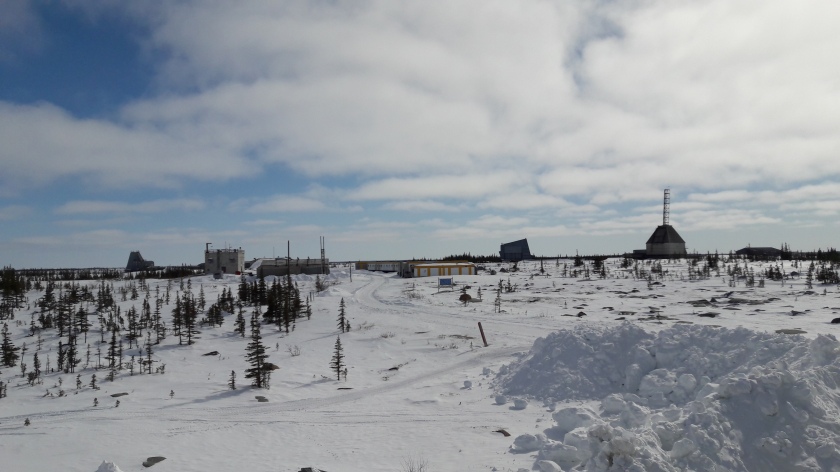
Blue sky and white clouds above, snow drifts and sparse boreal forest below. In between, an old rocket range: blocky huts of different shapes, one with a metal gantry pointing to the sky.

Blue sky and white clouds above, snow drifts and sparse boreal forest below. In between, an old rocket range: blocky huts of different shapes, one with a metal gantry pointing to the sky.

One big thing is different from when I was growing up, though: Facebook. I join the Churchill Online Bulletin Board, where folk post local events, lost and found items, and general news. At the encouragement of a couple of locals I met, I post there about my project, and soon the comments are filled with people descended from Orkney folk, amused to hear about their namesakes in Scotland. Patricia Sinclair Kandiurin wants her Sinclair castle back and to know what her tartan is; for once, I think, yes, go you, please take the castle, I’ll help.

At the same time, I’m posting about the project in various Orkney groups and reaching out to contacts on Facebook there. The two conversations are mirrors of each other: Orcadians sharing what they know of ancestors who travelled over; Churchill folk sharing what they know of ancestors who stayed. There are Métis, Cree, Dene and Inuit folk here with Orkney names. Folk on both sides of the Atlantic want to hear about their cousins. I’m starting to introduce them to each other, and I’d like to hear about the conversations that result: conversations across climates, communities, and colonisation.
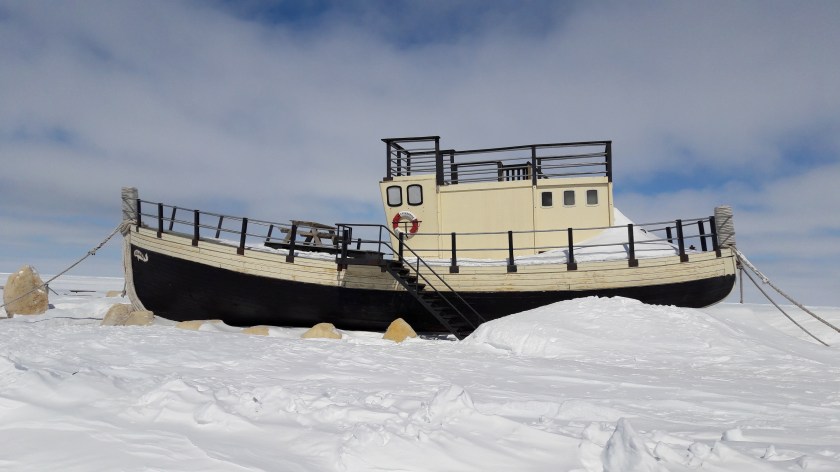
A little black and gold fishing boat, with steps leading up to it and a bench on top, moored and banked in by snow. You can't tell from the picture, but it was built in Buckie!

A little black and gold fishing boat, with steps leading up to it and a bench on top, moored and banked in by snow. You can’t tell from the picture, but it was built in Buckie!

I’ve been tracing some more historical connections, too. Pam Eyland told me about Alexander Kennedy Isbister, currently being celebrated during the 140th anniversary of the University of Manitoba. The Métis son of an Orkneyman, he was born on the Bay, but was sent to Orkney, to the school in St Margaret’s Hope, for a few years of education. (Do any Orkney folk know which building was the school in the 1820s?) He eventually worked for the HBC himself, but ended up quitting due to the racial discrimination he faced. He travelled back to Scotland for study at the Universities of Aberdeen and Edinburgh, and became a very successful lawyer working mostly in England. He became an outspoken advocate for progressive causes, particularly Métis rights. And the reason for the University’s celebration is that he left a major bequest for scholarships for students that was explicitly regardless of gender, race or creed: an early mission to diversify the student population and make education accessible to all.

I want to know so much more about this man. What it was like for him as a lawyer in England, yes, but even more so, what was it like for him as a child in the Hope? How was he received by the community there? What was the attitude of Orkney families to the HBC men’s indigenous wives? What was the men’s attitude? Most importantly, what were the experiences of the wives and children? I’ve been told that some of them came back to Orkney and stayed, although I haven’t found specific histories and biographies yet: I very much want to hear more. As well as Orkney folk having First Nations and Métis cousins and namesakes here, who from those people stayed in Orkney, or Scotland more widely?

A tiny soapstone sculpture of arctic terns (inniqqutailaq), on a post, is flying. They are white birds with red feet and beaks and a black cap. The background is red.

A tiny soapstone sculpture of arctic terns (inniqqutailaq), on a post, is flying. They are white birds with red feet and beaks and a black cap. The background is red. The artist was unknown, from Naujaat (Repulse Bay)

I keep making comparisons to Westray as I walk around Churchill. There are many connections. The arctic terns that come here in the snow-free summer are in Orkney, especially Papa Westray, in spring: at home they are pickiternos; here one of their names is iniqqutailaq. Both are small communities on the edge of their country; both are now tourism-dominated economies, with the public sector the other major employer, plus folk working in traditional economic activity and a bit of larger industrial work. Both were once a major naval base. Both have a government allowance for distant living. There’s only two main roads. Everyone has a car. Folk have multiple jobs: you keep seeing the same faces in different places; some shops and businesses just operate out of people’s homes. There are locally-organised cultural events that bring everyone together

A lot of this is common to many small rural communities, but I think there are some elements that belong to places on the edge. I fancy, too, that I can see a link between the mannerisms and ways of talking: the driest and most deadpan humour I know, conversations that don’t waste words at all but seem to get everything organised very quickly, a quiet amusement at the things incomers get up to, keen observation, the habit of asking you questions until you work out how we’re connected and placed in relation to each other, which at home we call “speiran at”. As always, this could be as much preconception as reality. And for all those connections, there are enormous differences: bigger than the ice sheets, the two different legacies of colonialism, where the profit was made and where the destruction was enacted.
20170422_163140

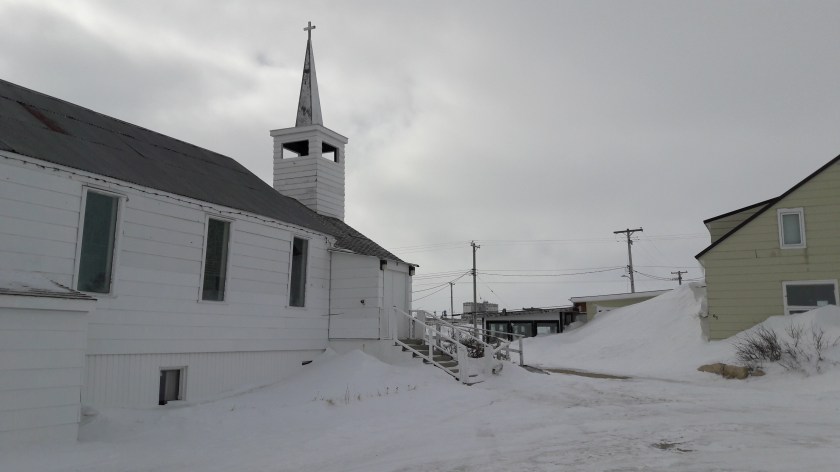
Left, a wood and metal white Victorian church with a short spire topped with a cross; right, a wood and metal yellow house. In between are big snow drifts and power lines; above, a grey sky; in the far distance, a port factory.
20170424_141209(0)

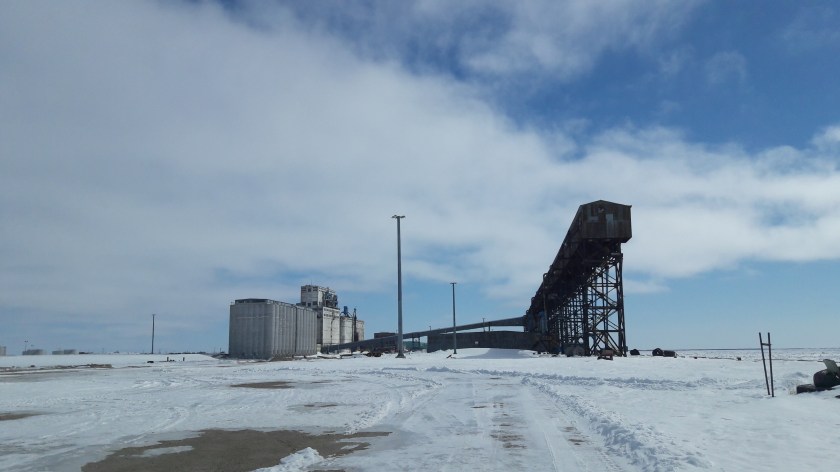
A vast and old looking grain elevator: the main structure, grey and yellow, is a huge box on the left; the dark and tall gantry, leaning slightly, is on the right. For scale, there’s a digger shifting snow right in the centre.

As with Winnipeg, I catch myself taking pride in the connections, and then think hard about in what that pride is based. Here, though, I’m finding more layers and complexities. Colonialism is many-layered and decolonisation can’t be centred around white consciousness and white guilt. There are some folk here keen to hear about Orkney, and who want to know about those ancestors too; there are some folk here who’ve already visited. There are folk like Alexander Selkirk who chose to stay in the UK, but remained attached to Métis identity and Métis rights. The stories are not one-dimensional. Though I’m part of it, how the story continues to be told is mostly not for me to say.

Why am I writing, then? I’m well aware that my own project has its own colonial layers: five Scottish writers exploring the Americas and bringing back tales. I have my own issues to work through and my own learning to do, but I don’t want to take up more space that I should. As I’ve written before, I think it’s vital for Scottish folk (for all folk from colonising nations) to be free from denial about how they have profited and how they continue to profit from ongoing colonial processes, and that involves doing some of this work. I want Scotland to recognise its part in this, and to know that colonialism is a huge and ongoing process (and one that’s different and more extensive, though related, to what the Gàidhealtachd went through), and to understand the extent of the damage and the necessity of reparation. I haven’t talked a great deal about the details of this, because again it’s not my story to tell. Here are three books I’m reading at the moment that I strongly recommend:

  •  This Accident of Being Lost, knife-sharp contemporary stories and songs by Nishbaabeg storyteller and writer Leanne Betasamosake Simpson. Decolonial love stories and discomforting provocations
  • A Two-Spirit Journey, the autobiography of a lesbian Ojibwa-Cree elder, Ma-Nee Chacaby, with Mary Louisa Plummer. An starkly and compassionately honest narrative of trauma and recovery.
  • Voices from Hudson Bay, an oral history of Cree elders from York Factory, an HBC post and settlement just round the bay from Churchill.
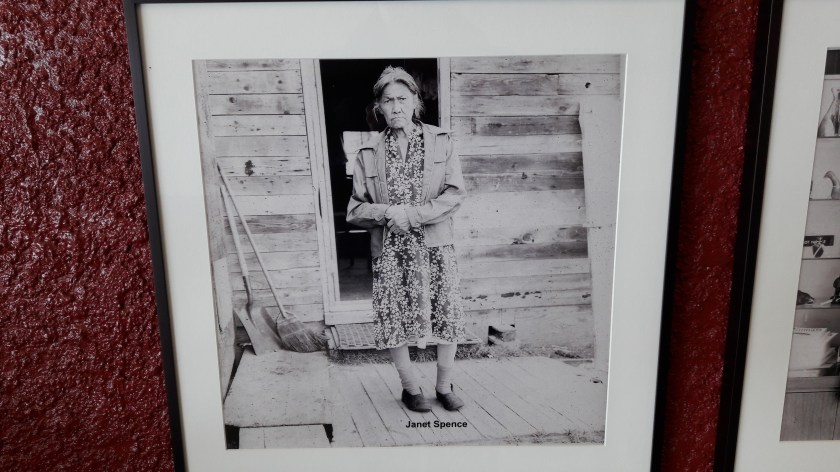
Janet Spence, a late middle aged woman standing in the door of her wooden house. She is wearing a print patterned dress and a short coatel and broom lean in the left of the picture. Her hands are clasped. The photo is labelled at the bottom. The photographer was not labelled in the gallery.

Janet Spence, a late middle aged woman standing in the door of her wooden house. She is wearing a print patterned dress and a short coatel and broom lean in the left of the picture. Her hands are clasped. The photo is labelled at the bottom. The photographer was not labelled in the gallery (Pioneer Gallery, Town Complex, Churchill).
20170422_162413

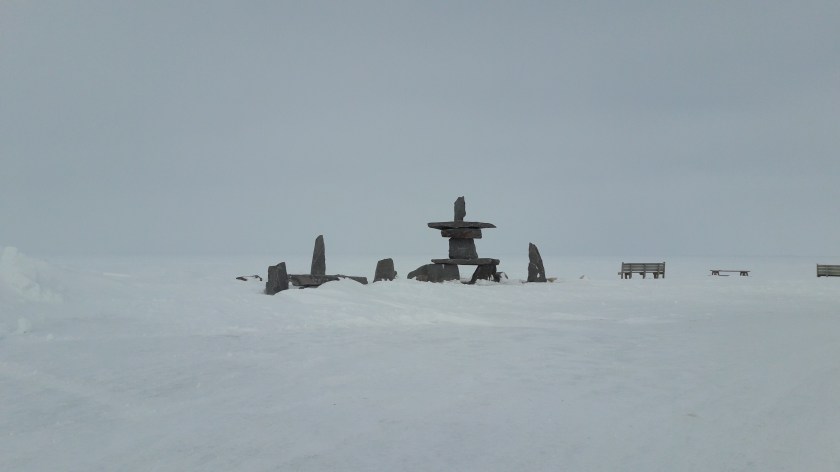
A ten foot high inukshuk (Inuit stone sculpture and landscape marker that echoes a human figure) is central, with smaller stones either side and benches to the right. The background is all snow, white and grey, with land, bay and sky just distinguishable from each other.
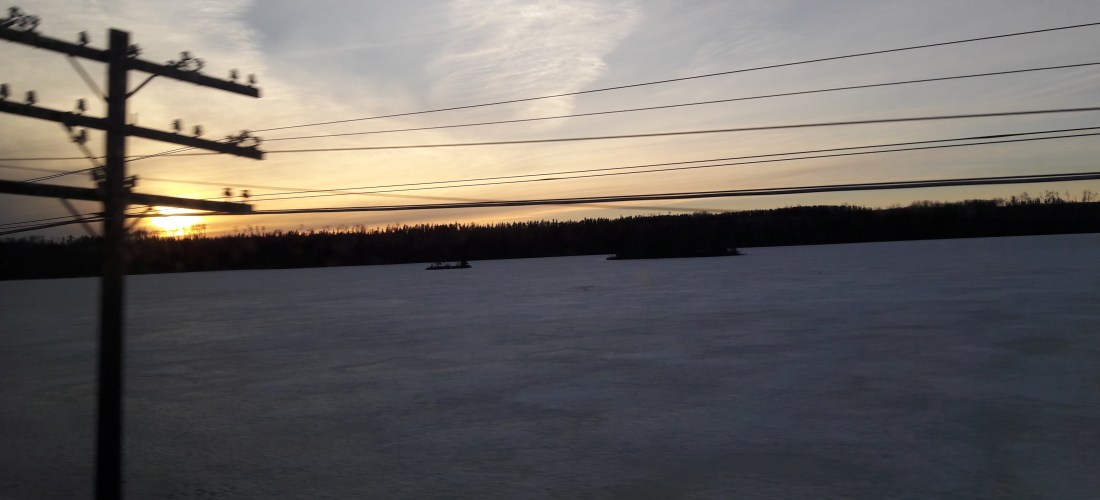
A sunset over an ice-covered lake, black firs in the background and telegraph wires in the foreground.

Outriders: Following the Line

Outriders, Uncategorized

The Canadian, the transcontinental passenger line in Canada, running from Toronto to Vancouver, is pausing for a break in Armstrong, Ontario. There are a few wooden huts and dirt tracks, small heaps of spring snow, and all around us acres of fir and birch. I’ve been travelling on this train for nearly 24 hours now, with 12 to go: it’s the slow way to get around.

Since we left downtown Toronto at 11pm last night, with pink lights shooting up and around the CN tower like it’s in rehearsal for a role in a cyberpunk dystopia, we’ve been surrounded by these trees: acres and acres of forest, occasionally breaking into a small  railway settlement, quarry, logging site, derelict coal tower, solar farm, ghost town, or huge, ice-covered lake. The sky is big and grey, giving us just a couple of hours of blue, yellow, pink and gold for sunset.

About the sky and the trees I keep wanting to say “endless”, but of course it’s not true. There’s an illusion of infinity in a train like this, it’s own world, literally operating in its own timezone, surrounded by trees, as if it’s a journey that will go on forever through a landscape that goes on forever. It’s the inverse of the fractal infinity of my digital diary, where I can’t see the edges and each day is infinitely expandable, so I keep adding more appointments far beyond my limited capacity. And, in some ways, it’s the false infinity that drives colonisation and resource extraction: there’s enough land for everyone, so we’ll keep taking it; there’s enough coal and enough atmosphere, so we’ll keep burning it. But there are people, there are limits, and the journey ends somewhere.

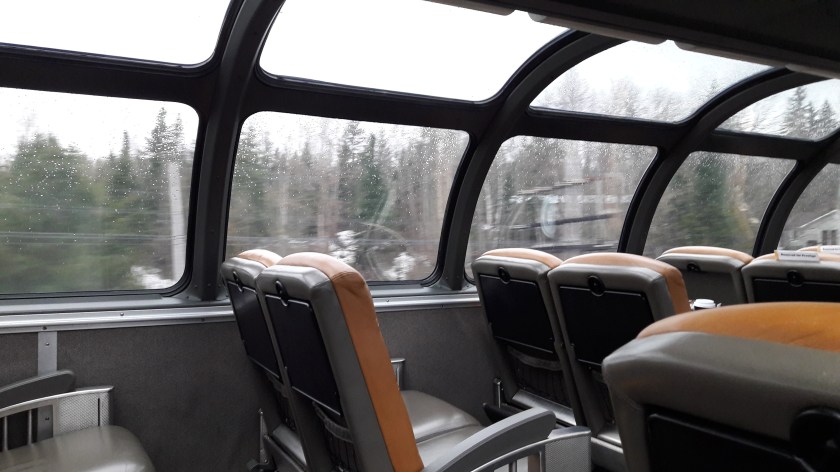
A 70s-style passenger dome on The Canadian: brown leather seats, a curved plexiglass roof, trees, telegraph poles and huts whooshing past outside.

A 70s-style passenger dome on The Canadian: brown leather seats, a curved plexiglass roof, trees, telegraph poles and huts whooshing past outside.

I’ve spent most of the day sitting in the dome at the end of the dozen-carriage train. There’s curved glass on either side and above, brown leather seats and bright steel fittings. Below, there’s a small bar that served fizzy wine for a “Bon Voyage Reception” this morning. This car has been in operation since 1956. I was rocked to sleep in my roomette last night, a bit of cunning 70s sleeper design, with a neat bunk that pulls down over the leather seat and heavy-lidded toilet, and a window looking out over the passing trees.

I love faded grandeur and always have, and this train is exemplary. It’s the last passenger line left running the route, and today there are only 70 people on board, most paying a premium to get the faded luxury treatment with personable concierges, prestige seats at the front of the dome, free muffins, wine on a tray, and so on. The crowd is a mix of tourists (older and wealthy in the sleepers at the back, young and roughing it in the economy seats at the front), both Canadian and international, train enthusiasts and former train employees, plus an anabaptist family whose purple and green dresses have a patterned cloth I’m quite envious of, though not of the cut and the fabric. The majority of the traffic (and profit) on this route is made by freight, and freight takes priority: every so often we pause to let a couple of miles of shipping containers shoot past. We left before midnight so as to stay ahead of the high priority freight that leaves Toronto: it’s behind us and ensuring we keep to time the entire route, because if we ever end up behind it we’ll be travelling at slow freight speeds all the way to Vancouver.

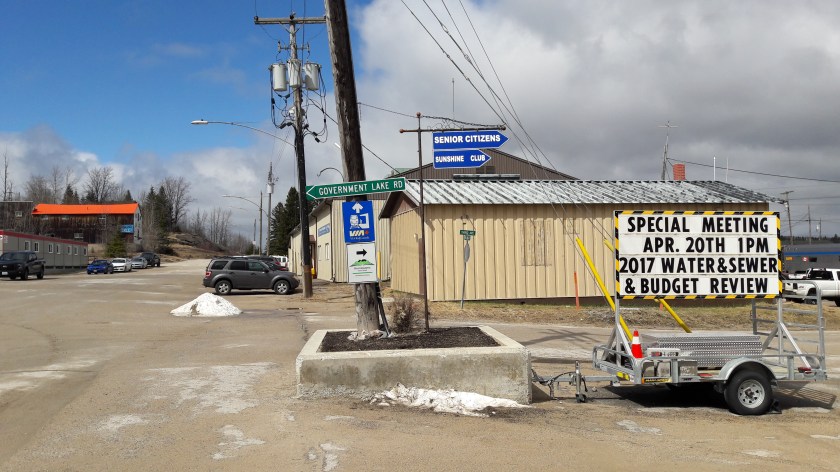
Hornepayne, Ontario: a logging town. Various signs read "Government Lane Rd", "Senior Citizens Sunshine Club" and "Special Meeting Apr. 20th 1pm 2017Water & Sewer & Budget Review". Telegraph poles, dirt road and bare trees, corrugated sheeting huts, clouds and blue in the sky.

Hornepayne, Ontario: a logging town. Various signs read “Government Lane Rd”, “Senior Citizens Sunshine Club” and “Special Meeting Apr. 20th 1pm 2017Water & Sewer & Budget Review”. Telegraph poles, dirt road and bare trees, corrugated sheeting huts, clouds and blue in the sky.

At one point the host tells us that this passenger line is mandated by the constitution: when British Columbia joined, it required that it always be serviced by a passenger line to the east coast, and that clause has never been written out, even in the age of air travel. (Its building was also something of a political power-grab and money-making scheme for those involved.) But even if that clause is now symbolic, it’s clear that it’s not just sentimentality that keeps this passenger line running and government-subsidised: it’s called the Canadian, and even faded, even no longer needing most of the ghosted railway settlements along the track, it’s still a necessary symbol of Canada’s history as a settler-colonial state. It’s also no coincidence that each carriage (Dollard, Elgin, Dawson…) is named after British and French government and military men from an age of Canadian expansion.

The host talks about the process of building the line carriage by carriage across the hard rock and icy bog of the Canadian Shield: the carriage advances a carriage-length, digs in and lays down track, then advances a carriage-length. Later, before planes, before cars, and before extensive roads, the trains are what allow people to travel distances across the country, what link communities together, and what, for a while, bring employment to the small settlements along the track. Now, though, it’s only freight that really needs the trains here: North America has gone over, while the oil lasts, to freeways and air travel. I’m reminded of Felix Gilman’s book The Half-Made World, a semi-fantastical account of North American colonisation, where the industrial gothic force of “The Line” extends itself across desert and mountain, governed by sentient Engines who build tracks ahead of them, expanding and bringing time, bureaucracy, industry, hierarchy and order.

So this train is something very different from the long-distance trains of Europe. I’m used to train travel being an ordinary way of getting about: setting up as commuter lines has renewed the meanings of the railway within the contemporary economy. The romance of miniature railways or the steam Jacobite, given a little extra life by Harry Potter fans, is a long way from what railways now mean. But colonial romance is what the Canadian seems to have left as a passenger service, and having the passenger service helps to maintain the image of coloniality as a romance rather than as a crime. In the otherworld of the train, we’re travelling in luxury across infinite space.

The sun’s set now, and I can only just make out the trees against the blue-black sky, so I’m going to pull down my bunk and be rocked back to sleep.

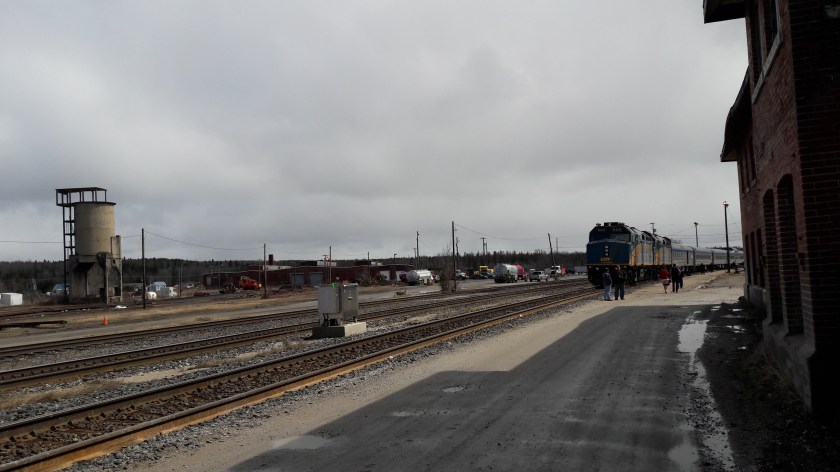
The derelict Hornpayne station on the right; an abandoned coal tower on the left; centre, the Canadian train curving on its tracks into the distance. Grey sky above, grey gravel and concrete below.

The derelict Hornpayne station on the right; an abandoned coal tower on the left; centre, the Canadian train curving on its tracks into the distance. Grey sky above, grey gravel and concrete below.

An industrial landscape on the outskirts of Montreal: above, blue sky; below, blue water, in between, towers, motorways, bridges, cranes, tanks.

Outriders: Talking Languages

Outriders, Uncategorized


I’m on a train from Montréal to Toronto, watching big fields, big skies and small stations pass by. This is the journey starting properly: we’re about to take a two-day train from Toronto to Winnipeg. One without WiFi, by the way, so you won’t hear from me a bit. I’m planning to be off-grid in the “panorama car”, which sounds wonderful. We’ve been seen off on our way by a pair of big, rambling conversations across food and drink: last night with Natasha Kanapé Fontaine, an Innu poet who appeared at the Edinburgh International Book Festival in 2015, and this morning with Jonathan Lamy, a multi-disciplinary poet based in Montréal, and Rachel McCrum, poet and promoter formerly of Edinburgh and now living and working in Montréal too. We talked about language, politics, journeys, poetry, colonialism, and language, language, language.

English is the ground against which we’re talking, often. It’s the dominant language of globalisation, the language of the majority of the internet — as Jonathan says, “If people have English as a first language, they don’t think they have to learn another.” English has a colonising effect on indigenous languages (and on many languages worldwide) — as it asserts dominance, and it’s a language that eats languages — a linguaphage — incorporating parts of them into its body and discarding the rest. In Québec, French is dominant, but there’s a conscious resistance to English and necessary promotion of French to maintain this. Natasha and Katherena discuss how this defensiveness of French can make it harder for other minority and marginalised languages to survive.

I think about the erasure of dialect and language variety in the British Isles, both the deliberate education, cultural and socioeconomic policies that attacked the Celtic languages, and the standardisation processes which marginalise and extinguish class and regional variants. It’s a question that’s devilled the Scots language movement: although there have been various attempts at standardising Scots, at reconciling the huge gulf between Shetlandic and Glaswegian into one language, and although most of the tools are in place, we still don’t have one accepted standard, and the current dominant position is to teach Scots as a non-standardised language. Whether that’s to its benefit or not I just don’t know. It’s an experiment, to have a national language without a standard. Some of the same questions, Katherena says, are arising in different ways in indigenous language movements: Anishinaabemowin has many dialects with a common orthography, and can be taught differently in different places

When you look at the history of language standardisation in Europe, you start to see that it can’t be pulled apart from the process of settler-colonisation: whether it’s the English of London or the French of Paris, having a powerful version of the language that is “right” and “proper” is part of creating an identity that’s “best” and so has a right to dominate, to take. I wonder aloud, “Maybe the best thing for English would be the end of the UK and USA, so there’s no longer a state that needs a standard language. Then everyone could just speak bad English as the lingua franca, English as a second language, and maybe linguistic diversity would flourish again.” I rethink, “That’s not the most important reason to end the UK and USA, but–” “–it is a fun one!” says Katherena.

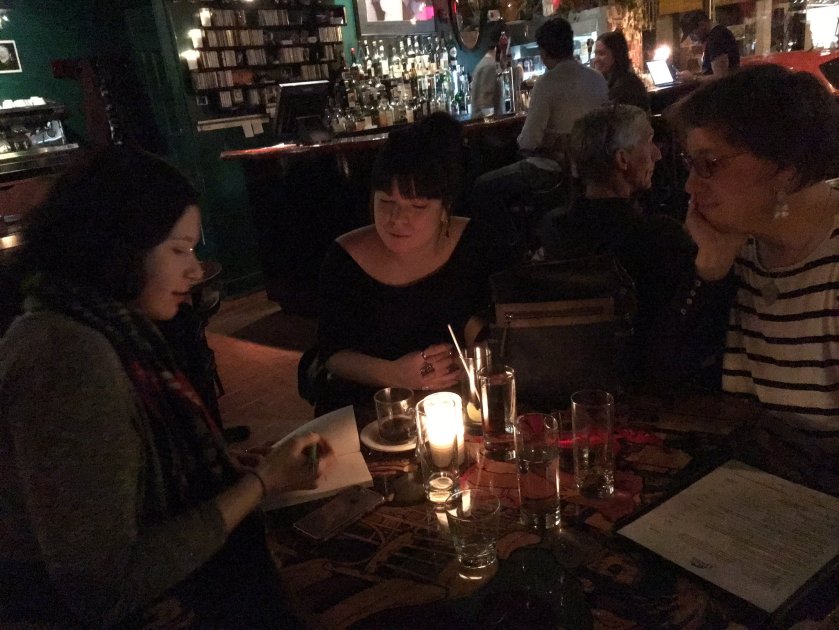
C9qQq1MWsAAQ5CT.jpg_large.jpeg

Katherena, Natasha and I (left to right) chatting by candlelight in a bar in Montréal: Else’s, founded by an elderly Norwegian punk.

Rachel talks about what it’s like to be learning to live in French. She says it’s humbling in a good way, to be in a social situation and not necessarily be good at the language. You have to concentrate, to work at it all the time. I’ve been fumbling my way through with my Standard Grade French for the last 24 hours, mumbling “merci” and “pardon” and attempting a broken French that has everyone switching to English is response. I think, too, about what it’s been like to relearn Orcadian: I have to dig back through layers of English and southern Scots to get to the language I was surrounded with when I was a child. All the words, structures and sounds are there, but I have to work to get back to them; they flow out fairly easily when I’m in Orkney, but when I’m away it’s hard to find them and hold on. The words slip away (I start to say “trousers” instead of “breeks”), then the sounds (“she” instead of “sheu”), then the grammar (“I have” instead of “A’m got”). But with digging it comes back.

At some point, when you learn a language, whether for the first time or relearning, your brain seems to switch over: you can talk and write and think without having to internally translate and interpret all the time. You have a new way of thinking. Sometimes this has radical differences to it: Anishinaabemowin is highly focussed on action and happening, using verbs with temporal inflections where English would often use adjectives. Gaelic only uses possessive determiners for inalieable possessions, like body parts, meaning that “my father” and “my book” have very different grammatical meanings. I’ve been watching and reading a lot of sci fi recently (for research, honest), and this idea is often taken to extremes there. In the recent film Arrival (SPOILERS), learning an alien language with circular expressions brings with it the ability to perceive time differently and, crudely, to see into the future. In Suzanne Elgin’s Native Tongue, attempting to learn non-humanoid alien languages causes infants to (gruesomely) self-destruct, while women creating their own language leads to a revolution into a new reality. These effects happen to readers to: in Marge Piercy’s Woman on the Edge of Time, the only personal pronoun is “per” (no “him” or “her”), which makes you see characters gendered very differently in your mind, just as gender has changed dramatically in the future. Ann Leckie’s Ancillary Justice does something related, putting you in the mind of a lead character whose culture has no gender distinctions, rendered in English by using “her” for every character in every culture, however they are gendered.

Like many older languages, Orcadian has a number of grammatical distinctions lacking in English. We have “yin” as well as “this” and “that”, to indicate something that’s over there (like the Scots and Old English “thon”); we have a distinction between the gerund and the present participle, so that “A’m washan me washeen” rather than “washing my washing”. (Except, I’m told, in South Ronaldsay, because even somewhere as small as Orkney can have, or had, big distinctions between island dialects.) The modern standardised languages of European nation-states often smoothed over or simplified these distinctions over time. On an island you really need a pronoun for “all the way over there”; do you need it in a city? Will the internet give rise to new pronouns for “the thing on the other side of the world that I just saw”? And new ways of thinking to go with the grammar? Or will English keep simplifying into Globlish? I think, again, about sci fi: how common a trope it is for a planet, or even a whole species, just to have one language, which surely makes no sense on a planetary or galactic scale. Maybe all we’re getting is the simplified global Klingon and there’s actually all sorts of variation planetside. Or maybe the language future is staler than we might hope.

As I walk around Montréal, I also notice how different cities and cultures have their own languages of design, and thus different bodily ways of thinking. Sometimes it’s the same: a gentrifying block of flats looks the same even if it’s called a block of condos. Sometimes there are direct cognates: the recycling bin colours are different. Sometimes there are bigger changes in thinking and doing: at home, at crossroads, the pedestrian crossings mostly turn green at once, so that you can (if you’re quick) cut diagonally across; here, as in Europe, the vertical and horizontal crosswalks alternate, and cars can turn right on a red, slowing pedestrains right down. And sometimes the idea is untranslatable, like trying to explain to your body an American town where every shop has a car park and you can’t walk anywhere, especially when you’re from an island you can (and do) walk across in an hour or two.

These design languages have historical and political meanings: how cities grew is written in their street patterns. Hiroshima’s grid pattern remembers, and so does London’s maze. In Berlin, the cultural architecture of the city is in constant commemoration of both the Third Reich and the Wall. But in Britain, we barely see, or are in denial, of the things our streetnames, buildings and statues remember: slavery, imperialism, theft. Many towns in North America have a Colonial Road (or Rue). What would it be like to rewrite the city so that we stopped persistently forgetting? Rachel and I talk about how Scotland and Northern Ireland have, in recent years, got better at remembering our own histories: when I was at school we barely knew what the Clearances were, but younger folk I speak to now definitely do. But still, our stories tend to stop there: we know the Highlands were cleared, but we don’t talk about what happened next, and the clearing that cleared folk undertook in the Americas. New and old languages both need remembering, and remembering needs both new and old languages.