#NaBoMaMo: 30 Bot Victory

Uncategorized

I made it! In November I made 30 twitterbots in 30 days. For the first 15 bots, see this post; for the second 15 and some more reflections, read on.

Why 30 Bots in 30 Days?

As I hit the end of the month, it became very clear that making 30 bots in 30 days was a very silly thing to do. I am feeling very triumphant about it, but I could also feel myself hitting the limitations of what you can do working at that pace — not least my own tiredness from overwork, keeping other projects and my full-time PhD going while I made a bunch of bots.

But first, what’s gained from this process. Obviously, output! Doing a #NaXxXxMo project means aiming or output over quality, practising getting it done rather than getting it perfect. As Darius Kazemi says, buying lots of lottery tickets is a worthwhile approach to internet art: I’m proud of at least half of the ideas, and in a few cases the execution is close to finished. If you struggle with getting it done, then absurd targets properly push you, and even if you miss the target or some of the ideas are rubbish, you’ll get at least one good thing out the other end.

It runs a little deeper than that, though. For the course of the month a part of my brain was always working away at the bot question, which was problematic when I was trying to sleep. Even when I wasn’t writing a bot, the back of my mind would be poking at the question of how to make the next bot, undoing a tricky structural problem or thinking through a coding dilemma. That meant that my work got noticeably deeper and more skilled over the course of the month: I was pushing my bot-mind harder and further each week, and so I started coming up with much more difficult ideas and executions than I would have done without the pressure. Even now I’ve let my bot mind go for a while to go back to my books, I feel like next time I summon the bot mind I’ll be starting from a richer place.

A third reason to do something like #NaXxXxMo is to make an event of it. I like performance and I like events. This was a bit of a 30 day endurance art marathon, and that meant a bunch of people willing me on (which is a lovely feeling!), a hook to hang the project on which meant more attention for my wider work, and participation in a community of folk doing a similar thing. It gave the art a social context, and that always amplifies an artwork.

But there are drawbacks, of course. Some of the bots are little more than sketches made to fulfil a commitment; my favourite ideas are mostly half-finished, though everything’s at least at minimum-viable-artwork stage; some ideas could have been better developed before release; and now I have enough development work to last me at least a year. It’s that last part that most daunts (and excites) me. I now feel like a bot gardener, like I have a rich ecology of my own bots to gently tend to. I want to grow them over time, to feed their corpora and prune and graft their code. I want folk following my bots to see them flourish. I want to make art in public, like a garden: something that people enjoy the growing of as well as the result.

Lastly, I want to extend tremendous thanks to the #botALLY community. Not only to those whose code I borrowed or whose tutorials I used (I’ve tried to link these in the notes every time), but also to the many folk who offered answers to sometimes very basic technical questions, and who gave a lot of encouragement to me as I worked. There is absolutely no way I could have managed this month without them. I would never have made one bot without someone helping me, let alone 30 (or 34, counting previous projects). The artbot community is characterised by openness and generosity: it’s still at a stage where we help each other out with ideas and jokes and code, and long may that last. My hope is that the unmonetisability of artbots continues strong, and that this remains a project dedicated to the commons. To that end, I’m releasing as much of my code and process as I can (with a delay while I learn appropriate means of doing so), and if you want a hand with your bots then I’m happy to pass on what’s been passed on to me.

Bots 16 to 30

16. Debate Coach

This is an experiment less in procedural poetry and more into the social utility of Twitterbots. How can a bot help us have better conversations on Twitter?

As well as tweeting thoughts on looking after yourself in an argument every 6 hours, if you send a message to Coach she’ll reply with advice or a question about dealing with an argument. Things like “Can you be compassionate to the person you’re talking with?” but also like “Anger is sometimes useful and sometimes not.”

The bot won’t reply to anyone except you, so you can @ her while tweeting someone else, or you can @ her separately if you don’t want them to know. She can take up to 5 minutes to respond, and misses 5% of messages, due to platform limitations, so you don’t hear from her, @ her again.

I put a lot of thought into this desig, trying to make something that was constructive, useful, non-judgemental and hard to abuse. I’d be really interested in hearing what you think should be included, and especially if you use Coach and have feedback!

Platform: CBDQ (source)
Dev time: 90 minutes
To do: Expand library, with a focus on expanding the subtlety of her responses to keywords.

17. Every Reversal

A dreadful joke bot, suggested by Nora Reed. I am embarrassed by it! But that day I was too tired to come up with a good idea, and doing this was a useful exercise in learning to select and manipulate random words correctly: it’s not trivial to get nouns and transitive non-first-person-present verbs to match properly, especially when using WordNik rather than RiTa, as the former is much less discriminating. I used the WordNik API again, plus the npm libraries singularize and conjugate  — it was useful to learn better how to find and use new libraries that did what I needed, and I reused that skill a lot later in the month.

I’ve justified this bot by saying that, now that there’s a bot for it, no-one ever needs to make a Russian reversal joke again.

Platform: Node.js and Herokuu (source tba)
Dev time: 1 hour
To do: Nevr again.

18. Everybody Nodes

This is my most complex bot ever, despite the silliness of the results. Although it’s the same sort of model as @JohnnyBotten, for Johnny I hand-picked rhyming lists for every syllable, for for Leonard all the substituted words are generated procedurally: when the code hits a substitution, it goes to the dictionary for a word that matches part of speech, syllables, metre, tense, and, if necessary, rhyme.

No way could I do it myself. Most of the conceptual work I learned from this tutorial on @SortingBot: http://tinysubversions.com/notes/sorting-bot. I will eventually share the messy and hacky source, but Darius does it all better, so copy from that instead.

This was quite difficult for me to do, but learning it made making a much wider variety of bots much easier. And this time the process was pretty smooth: I more or less understood everything I was doing, for the first time. The ratio of copy/pasting magic spells and hoping they work to actually learning how to write magic spells improved. It’s thrilling to start from close to zero knowledge and understanding and then to get to being able to make a toy like this.

Thanks also to Alec Finlay for the request and Tully Hansen for the name.

Platform: Node.js and Herokuu (source tba)
Dev time:  6 hours
To do: Learn how to chain tweets together so he tweets a whole song in sequence

19. Work No. 128

This was a resurrection of the first bot I ever made, which died due to its Google Apps Script system being deprecated and me not having the skills yet to fix it. I took the core of the old code (generating two types of tweet based on similar unicode characters) and reimplemented it. The big probem was figuring out how to make the tweets alternate (see Julian of Norwich below), and I still haven’t learned how to do this reliably in code: instead I wrote two different programs, set them both to tweet hourly and offset them by half an hour! A good dodge for a rest day.

Conceptually, this is supposed to be my most pointless bot. It’s a bit of a vicious and easy take on Martin Creed’s original lightbulb going on and off, and on the emptiness of YBA art in general. It’s also an exercise in seeing just how useless Twitter will let me be without banning my bot. But, gallingly, I think the result has a kind of spooky beauty to it. One friend called it the bass beat to his timeline.

Platform: Node.js and Herokuu (source tba)
Dev time:  30 minutes
To do: Finished!

20. Auto Else

A tribute to Baroness Elsa von Freytag-Loringhoven, my favourite Dadaist and true originator of Duchamp’s Fountain. It takes 10 verse models from  her extraordinary complete poems and perfoms word substitutions on them, using exactly the same process as Everybody Nodes, with a bit of sound poetry modelling from Uberursonate thrown in.

I don’t feel the result is yet as representative of her extensive work as I’d like — the playfulness and rhythm is there, but not the range, and getting the viscerality of her writing down is tricky when working with word substitution. Perhaps adding to the pallette will be enough, but once I see that I may have to do something more extensive.

Platform: Node.js and Herokuu (source tba)
Dev time:  90 minutes
To do: Automate more poems and fragments and then see

21. Orkney Visit

A fantasy travel guide for Orkney. I was aiming for verisimilitude, and getting the name generation right so that each name was basically believable (but unlikely to be real) and felt Orcadian was where I put most of my time. There was some fiddly work around how frequent to make different variable elements and where to capitalise what, but I’m pleased with those results. Being tired, I didn’t have as much time left to get the framing right, and I’m unsatisfied with the limited variety of the descriptions: I need a much bigger set of syntaxes based on what a tourist guide could include, ad potentially wholly different kinds of tweets. Perhaps it could create an Orkney with a touch more fantasy in it, occasional intrusions of magic. One thing I’ve learned this month is that speculative worldbuilding is more fun than direct parody of existing conditions.

Thanks to for the suggestion

Platform: CBDQ (source)
Dev time:  30 minutes
To do: Need to rethink the framing extensively

22. Rules for the Day

From a suggestion from , this is an instructional poem in the vein of Autoflaneur, but a little more difficult and abstract (and quicker to make). It comes from my interest in instructional performance (as does the later bot Tiny Situationist and my other work like Casual Games for Casual Hikers).This is much less frequent than most of my bots to give it the right context: it tweets a set of rules every 12 hours, so you can get the latest rules for the day whatever your timezone, but only one set.

What happens when we give ourselves strange rules and try to follow them? How does it invite new experience, new ways of thinking? What does it mean to follow a rule? I haven’t tried these rules out yet but I’m keen to.

Platform: Node.js and Heroku (source tba)
Dev time:  20 minutes
To do: Finished!

23. New Border Ballads

This bot takes an old project and improves it, importing the results to Twitter. It generates markov chains (a kind of procedural generation based on analysing the probability that a given word or character will follow another) from Walter Scott’s Minstrelsy of the Scottish Border, and then breaks up the chain into verselike tweets.

I used the first markov chain library I could get working, and got the result functional without too much thought about how it was working. There’s a lot I want to do. I want to learn how markov chains really work so that I can tweak them for more satisfying results. I want to combine this with RiTa’s tools for parsing metre and rhyme to producing verses that scan and rhyme. But this is a long way off, and there’s a lot of stumbling blocks on the way! I’m doing it bit by bit, and this bit is fun in itself.

Platform: Node.js and Heroku (source tba)
Dev time:  90 minutes
To do: Lots.

24. Glasgow Makes People

An easy bot that didn’t involve learning new techniques, but curiously effective! SVG tutorials from w3schools, words from the same lists I used at the beginning of the month.

It is, though, the riskiest bot I’ve done: I’m pretty confident it contravenes the IP of the original corporate slogan, and Britain doesn’t have very good legal protections for parody work. That was a deliberate choice on my part: I like crossing the line when I think it’s a line that deserves to be crossed, and I await with pleasure the result when Glasgow City Marketing Board notices.

The text glitch was added at a whim right at the end of the process, copy/pasting from Zalgo rather than generating procedurally. It makes the result spookier, but I’m not sure if it’s better or not! Perhaps if I made it appear less often I’d like it more. The image glitch came from making a mistake in the SVG code, making the stroke width of the outline letters too wide, and I loved the result so I kept it.

Platform: CBDQ (source)
Dev time:  30 minutes
To do: Might tweak the glitch, or find a good library for varied glitch generation.

25. Tiny Situationist

This is a direct but loving détournement of Jonny Sun’s , which took care bots mainstream this month, building on work by Nora Reed and others. Because tinycarebot has a profile and a creator within a specific culture (let’s call it millennial, oh dear), it’s also faced unfair backlash and parody. And I do like the bot, but have my own criticisms of self-care — or rather, of the neoliberal appropriation of self-care as individualistic rather than collective. So, from a suggestion from I decided to have a play with what self-care can mean. Using the RiTa tools I learned to use during the month, Tiny Situationist takes each of the syntaxes of tinycarebot’s tweets and substitutes parts of speech to make absurd suggestions in the same polite tone. The result, I think, is a kind of situationism for Twitter — détourning a popular artwork and constructing situations which question social space. That too is a kind of care.

Platform: Node / Heroku (source tba)
Dev time:  30 minutes
To do: I think this one’s finished, but if tinycarebot goes I might grow this one.

26. Infinite Laughter

A direct take-off of ‘s , but working with the opposite affect (or is it the same?) There’s not much to say here! Except that the source has some neat tricks for producing maximum variety with minimum effort, varying repetition and spaces of everything, and nesting persistent variables.

Platform: CBDQ (source)
Dev time:  15 minutes
To do: And yet more international laughter

27. I Think You’ll Find

Similarly to Plural Fan, this bot makes light fun of the pedantic tendency in internet arguments (and my own proclivity for showing off by knowing the names of things). Fallacy-spotting irritates me because, while it’s logically accurate, it’s so rhetorically weak: it never convinces anyone they’re wrong if you name the Latinate fallacy they’ve just used, and I don’t think people learn how to make more intelligent arguments by learniing the names of fallacies.

This is a very simple bot, but part of my interest in (and bots’ suitedness to) getting inside a specific language and then twisting it. The bot just splits the names of everything on Wikipedia’s List of Fallacies in half and then recombines them. It’s fascinating to me that the results sometimes produce genuine meaning (“I love spotting an abusive ignorance in someone’s argument.”), sometimes nonsense (“Association herring is the fallacy I hate most.”), and sometimes something spookily neither (“No true stone: ugh.”) I’m not wholly satisified with the result — the joke doesn’t stay funny and the poetry doesn’t stay beautiful — but I’m not sure how to fix it.

The idea for this one came from Nora Reed.

Platform: CBDQ (source)
Dev time:  30 minutes
To do: ????

28. BotRail

This is maybe the single bot this month that I’m most proud of. Partly because I’m really pleased with the effect — a seriocomic utopian imagining of Scotland’s collectivist public transport future, summoned through maps and announcements only — and partly because to make it I pulled together so much of what I’d learned through other bots in the month.

The maps were built by getting to grips with the SVG tutorials at w3schools. The Scottish placename generator was nicked from my poem-game Ghost Highland Way and expanded through what I’d learned about satisfying name-generation from making Orkney Visit. The text effects were achieved in Unicode using an online widget, using delim.co and textmechanic to process them quickly. The idea came from Henry Bell, whose bot Radical Glasgow I used for researching memorial names. And the concept was developed by remembering what I’d learned from JJUrbanExplorer, that procedurally generated stories become much more satisfying if you root them in real world locations, if you give them a bounded shape and specific flavour, rather than sampling the whole world of words.

Platform: CBDQ (source)
Dev time:  2 and a half hours
To do: Vary the map shapes, expand the naming further

29. Julian of Norwich

Julian of Norwich wrote the first known book in English by a woman. She was an anchorite who experienced mystical visions during a serious illness, and interpreted them through a Christian framework. The result is strange, trippy and beautiful, even to atheists like me. I wanted to celebrate it, and a meditation also seemed like an appropriate choice for the concept at hand: tweeting an entire book one character at a time. It’s barely readable, but it is still readable, though if you’re following along you’re liable to read each individual word a few times. It slows everything right down.

This concept was offered by Gabriel Spector, and I was also influenced in the execution by Neil Simpson’s work on extreme slowing down of text.

I was hoping for this to be an easy execution, but I hit a major stumbling block: Heroku, which is the hosting service used by most bot tutorials, is unsuitable for projects which proceed in a specific order through a list of tweets. (This is because it doesn’t maintain variable states long-term: it keeps resetting to the beginning.) I explored a lot of different options for fixing this — learning a new hosting system, indexing to an external spreadsheet, indexing to the real time — but in the end I went for the quickest available. @air_hadoken had shared an excellent Google Apps Script library for Twitterbots, and I was familiar with the platform having used it for my first bots, so I was able to copy my simple code into that library without too much trouble. This taught me a couple of things: first, that hosting a bot is a way harder problem than coding a bot; second, that I still have a huge amount to learn about how to do weird internet art. I’ve learned the magic spells for Heroku and node.js, but as soon as I need a new spell or a new spellbook then the difficult curve goes vertical again. I start copy/pasting without really understanding what I’m doing again. My hope is that eventually I’ll learn the basics of enough schools of magic to be able to get to grips with new schools without as much trouble, but that’s a long way off. That said, I like being a novice. It’s where all the best books start.

Platform: Google Apps Script (library here)
Dev time: 15 minutes to write the basic code, 2 hours to figure out the hosting
To do: Keep an eye on it for 35 years to make sure it keeps going, adapt the format of the — dividers so the balance looks right as the numbers get longer.

30. Some Endings.

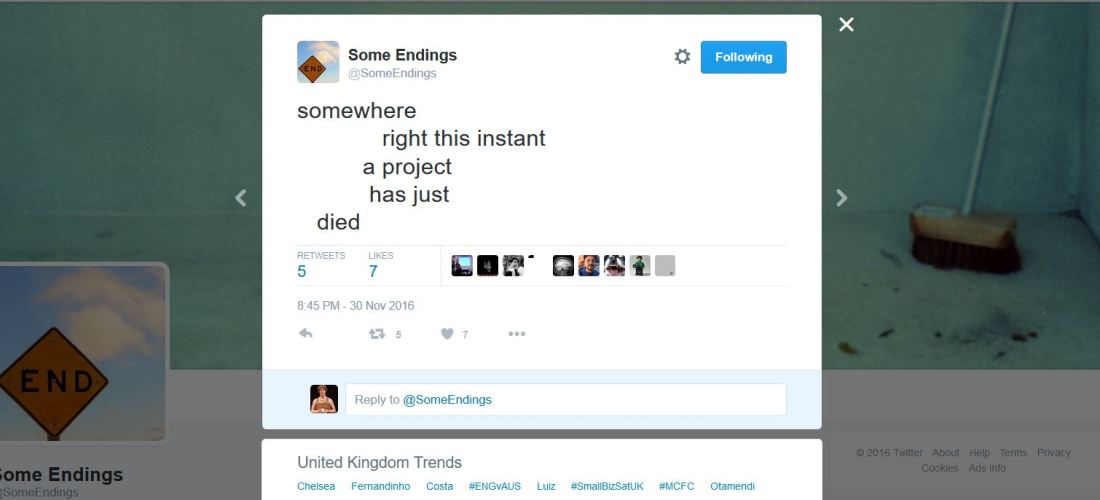
A simple meditation on death and endings: it’s a very macabre bot! I was struggling with the idea of how to end the project, and had all sorts of grand thoughts: in the end, I was very tired, and made a simple substitution poem in CBDQ, and that felt like the most appropriate way to finish.

There’s a structural limitation of simpler bots, which is that Twitter is liable to ban accounts which it thinks are posting repeat tweets. A way many bots get around this is by inserting random stretches of blank space. Originally I had this after each line, so that it was invisible, and then I realised that placing it before the words as well turned the structural limitation into an aesthetic pleasure. It doesn’t display in some browsers or circumstances which trim extra spaces, meaning that the poems are always contingent. As every poem is.

Platform: Cheap Bots Done Quick (source)
Dev time:  30 minutes
To do: Expand the library of substitutions, consider whether I want to vary the syntax (probably not)

Find all the bots at

https://twitter.com/HarryGiles/lists/my-lovely-bots

and an Extra Thanks

to my backers on Patreon, who give me the freedom to do very strange and free projects like this.
Now Make A Bot

Releasing a Tiny Game and Trying to Get Paid

Game, Politics, Rambles, Uncategorized

Raik Money

Introduction

Raik is a text-based game I released in December 2015. It’s a Scots fantasia about anxiety. I work professionally mostly in theatre and poetry, but I do quite a bit of crossover work in games (mostly physical, public and other non-digital forms of games). I was interested to find out how well the self-producing strategies I’ve learned in other artforms could work in games, so I decided to do something like a commercial release: hiring an illustrator to give it a good cover, sending out press packs to try and get coverage, asking people to pay for the game. There’s a creatively thriving sector of independent games, working from obscure artgame-makers to quite wealthy full-time indie studios (a bit like so-called independent music, really), and I wanted to dip my toe in. Six months down the line, I thought it might be useful to share what I’ve learned with other very small-scale game-makers. I’m obsessed by how money works and how it interacts with the arts – partly because I’m trying to make a living, and partly because I think that if you don’t learn how to make the obscene money-system work for you then you’ll end up working for it. I love tiny games and small-scale makers, so I hope what I’ve learned helps you out.

How I Did Publicity

My game is not exactly a commercial heavy-hitter. It’s only 30 minutes long; it’s text-only; half of it is written in an obscure European language; and it’s about mental health and fantasy. Going into this, I knew that sales and coverage weren’t going to by high – instead, I needed to trade on the unique aspects of the game. I billed it extensively as “the first game in Scots”, hoping that that would be enough to grab interest in people’s inboxes, pulling them in with a discussion about the game’s themes. I commissioned an illustrator (Kitt Byrne) to do some lovely cover art, which would grab better attention on social media feeds (I think this was the best commercial decision I made, but I also love the result). And as well as selling it as an unusual game to the indie games community, I sold it as an unusual way to do poetry and Scots to the literary community.

I asked professional games friends for their advice on marketing a game, and also Googled “how to sell a game” a lot. The blogs I found most useful were Chris Priestman, Kieron Gillen and Retro Remakes. I made a very simple two-page presskit with details about the game, me, and Scots. I then made a list of every games journalist and website I thought might be interested, gouging this (out of date) list of websites from Pixel Prospector, Googling, and asking friends for good contacts. In each case, I wrote down some notes about why I thought my game might appeal to them in particular, so that I could personalise each email. Emailing people about my work is my least favourite job in all of the arts, and the one I’m worst at, and the one that has the highest mental cost for me, so I set aside two days to do this and made sure I had plenty of chocolate on hand. I sent around 30 emails, most of which did not get a reply, but two of these emails led directly to my two biggest pieces of coverage.

I decided to extend the experiment and release the game under a “Trust System Sliding Scale Pricing”. In my performance work, I do a lot of “Pay-What-You-Decide” gigs, because I like how accessible they are, and I find that I often get a larger audience and the same size of income as when I set a specific ticket price. In games, I’m a total unknown, so I thought that people were unlikely to download my game unless they could get it free or cheap, and I also like spreading a bit of consciousness about the economics of art. After a preamble about trying to make a living from my art, I wrote, “I’ve set £4 as a rough price for this game based on a triangulation of how long it took me, how much I hope to sell, how experienced I am, how the art market functions, how much I think folk are willing to pay, and sheer guesswork. (Mostly guesswork.) If you’re earning an average wage (UK: c£26k) then pay me that. If you’re earning more, pay me more. If you’re earning less, pay me less. If you’re earning less than the Living Wage (UK: c£16k) then don’t pay me anything, and I hope you enjoy the game. This system isn’t policed, and if you’ve got a better idea of how artists should make a living (I hope you do!) then pay whatever you think is right.”

Then I launched the game! This involved posting release notices on relevant forums, and doing a lot of tweeting and Facebooking for a few days. I didn’t directly ask friends to tweet about it for me (which I think is a totally reasonable thing to do, but I make a lot of art and don’t want to have to do this constantly, so I save up my asks for when I really need it), but lots of them did anyway, which was nice. Then I sat back and waited to get rich.

How Coverage Went

Because I had a pretty unique game, and because I did a halfway competent job of publicity, I got far more coverage for the game than I expected. I was covered in Rock Paper Shotgun and PC Gamer in their indie games round-ups, got a small feature on IndieGames.com (which led to a lot of reposts from various reblogging websites and Twitter accounts), and had a big interview and feature video on Eurogamer. The Twitter and Facebook launch went exceptionally well, getting more interest than most of my publicity for theatre and poetry shows (I didn’t keep track of clicks and website visits though, whoops), with a few prominent games figures and journalists giving shout-outs to the game. This felt great!

On the other hand, most of the coverage referred to Raik as a “free game”. There’s an existing infrastructure for “free games”, and trying to get across the messaging that actually it was on a Trust System Sliding Scale price was too much to get into major games platforms. This is a shame, but I also could have foreseen it.

How Sales Went

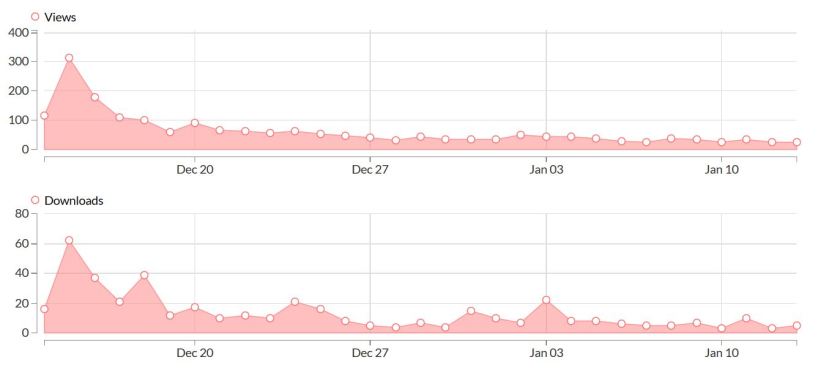
Raik has been downloaded 861 times, and paid for 46 times.

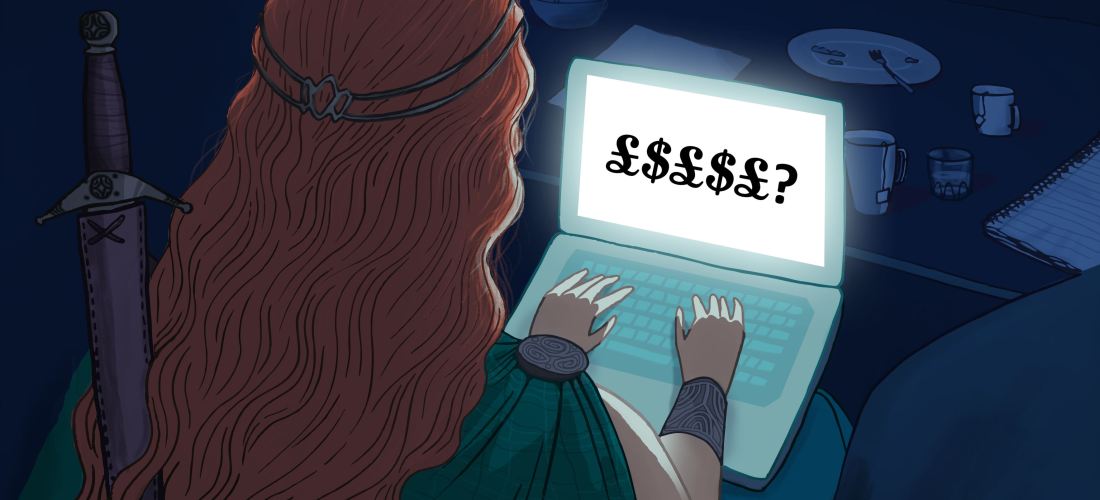
I was not actually expecting to get rich. I was hoping to cover my costs and get a bit extra on top. I’ve made £206 and 50 pence (about $300 American money). That covers the illustration commission, but on top of that it does not even pay for a single professional day of press and publicity work, let alone the weeks I spent writing it.

On the other hand, that is twice the number of downloads I was aiming for: the game, and thus my wider work, got much wider coverage than I expected. More people have read my work than would have happened if I’d done this without putting serious publicity work in, and that feels good.

Here’s the graph of visits and views to the game’s page on Itch:

raikstats

This is exactly the graph you’d expect: a big spike of interest followed by a long tail-off. The tail dwindled to 20 views a day by the end of March, 10 views a fay by the end of April, and is now down at 5. For what it’s worth, visitors referred from IndieGames.com were more likely to pay for the game than Rock Paper Shotgun, though the game was billed as primarily free on both sites: I don’t know why, and maybe this is within the margin of error. I didn’t keep accurate records, but from memory folk in launch week were as likely to be referred by social media as from one of these sites; in the long tail, folk are as likely to be referred by my professional website as by the archives of indie games sites, but those sites still do provide a decent number of clicks.

What I Learned

Trying to make money from a tiny game when you’re a complete unknown is a silly idea. If you want to make money from small games or artgames, you need to expect to spend years building up skills and reputation. This is the same as in the other artforms I work in.

That said, games is a bit more financially brutal than either theatre or poetry, which is funny, because poetry is already financially brutal. It is harder to get people to pay for games than for any other artform I work in. I could make more money for less work elsewhere. That said, in both theatre and poetry most of my money comes not from sales but from commissions and public funding: trying to make a living off sales in any small-scale artform is a mug’s game.

However, even if you’re extremely small-scale then treating your game professionally – making a presskit, doing professional publicity work – is actually worth it, and if your game is good or interesting enough it can lead to more attention for your work. I only spent 2-3 working days on publicity in total, and I’m glad I did.

A significant proportion of the people who actually paid for my game were people who already had an existing relationship with my work: they’d come to a show, or bought a book, or we were part of the same artistic community in some way. If people had a social connection to me, they were more likely to pay attention to my pricing model; most people felt free to ignore it.

That said, from talking to friends who’ve released similar-scale games on a “voluntary donation” model rather than a “trust system sliding scale” model, I think I got a better sold:downloaded ratio than I would have done if I’d just shaken a tip jar. It’s a bit galling to see so many people just ignore your text about pricing, but it might be worth it just to get a little extra cash and spread a little awareness about money.

I don’t think the game would have done so well if I didn’t already have a decent career in theatre and poetry: it meant I had an existing audience to market a new artform too. Leveraging all existing connections and communities was well worth it.

I could have done a lot more work. I have a tendency to just move on from a project after launch week – I don’t look after the long tail of sales, I don’t do lots of extra plugs and promotions later on, I didn’t in this case use the initial press I got to try and leverage extra press. This is because I find marketing miserable and gruelling: every day I spend doing this is a day I’m not actually making art (or writing funding applications, which is where I can actually make money), and whittles down my desire to make art a bit further. I wasn’t actually out to make money on this, but to learn: if I’d worked harder on sales, I could have sold a bit more. Maybe. But there would definitely have been diminishing returns. In theatre, I’m moving away from self-producing and towards working with professionals to do my sales and marketing for me, because I’m currently hiring a substandard employee (me). When I next do a game on a significant scale, I might do the same.

How I Feel About All This

I feel great! This post may sound cynical and mercenary, but that’s just because I’m letting my money brain out of the box for a while, to try and share learning with you. I had a great time making the game, I’m proud of the result, and it got much better coverage and playership than I expected. I’ve learned a lot that I can build on next time.

That said, if I was wanted to make my living primarily from games, I’d feel terrible. Essentially, I was able to subsidise my work on Raik through my other artistic work; if I wasn’t making a living from that, I would have been subsidising Raik through waitressing (or environmental management, which is what I actually did before going full-time artist). Games is a harder market than I expected, and at the small-scale end of things, it looks to be getting harder. It’s not just tiny makers like me who find it hard to make a buck, but also significant professional independent studios.

I can only make a living as an artist because of public funding. The majority of my income comes not from sales but from grants or via charities and institutions who hire me or commission me and who are themselves largely publicly-funded. I’m doing OK (I’m going to be writing up some more details of this soon), but even then I find the freelance hustle exhausting and not always conducive to good work: I’m actually escaping it for a while into the arms of academia, having successfully nabbed government funding to do a creative writing PhD for three years. If I were in a country (like America) where public funding is very scarce, or an industry (like games) where public funding is very scarce, I don’t know how I’d survive. I think the huge success of games at the mega-commercial scale makes it harder to advocate for public funding for games: I see this in theatre, even, where the success of West End musicals is used as a hammer to hit the subsidised sector, despite the vast majority of West End actors spending large sections of their career also in the subsidised sector.

It seems to me a miracle that artgames have been such a creative success so far. We have a huge wealth of cultural creation that is having an increasingly significant impact on the public imagination. I don’t know if that can keep going. My sense is that more and more game-makers are getting disillusioned, and that enthusiasm for artgames is decreasing (or at least hitting blunt reality) even as commercial games seem to make more and more money. I’m not sure what comes next. Art always seems to find a way, because it’s so central to human living – but who’s making that art, and how, and whether they can live: those are harder questions.

P.S.

My favourite essay on how to make a buck from art is Why Your Music Is Worthless (And How To Sell It Anyway) by the Indelicates. They’re in music, another arts sector which has sod-all public funding and so has to find a way to live off sales, but their thinking applies very widely. Read it!

Shock and Care

Uncategorized

8779559131_669cb47c47_k.jpg

Shock and Care

an essay about art, politics and responsibility

Content note: includes discussion of sex, violence and self-injury in an artistic context.
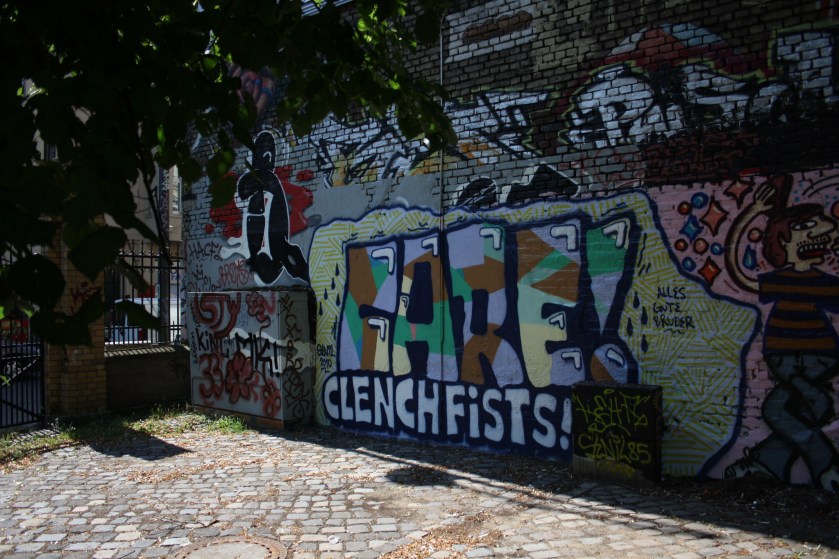
Cover image from Flickr user wallsdontlie, licensed under Creative Commons.

I. Proposition.

Learning how to care for your audience is actually far more aesthetically interesting and politically disruptive than working out how to shock them.

II. Shock

The history of art is often told as a history of shocks. The first performance of the Rite of Spring being so dissonant and suggestive as to provoke a riot. Duchamp’s urinal (which may have actually been Elsa von Freytag-Loringhoven’s) forever changing the course of what is considered to be art. The publication of Ginsberg’s Howl changing what it’s possible to print. Though this way of telling history might have limitations, we often expect art to continue advancing through this kind of creative rupture: socially proscribed acts and new creative forms which continue to push artistic and social possibility forward. This way of thinking about art encourages artists to pursue social shocks and creative ruptures in their own work.

Meanwhile, certain artistic theories also depend on the revolutionary potential of the shock. The Situationists, for example, advocated a range of disruptive creative strategies – forms of street theatre, repurposing existing art objects, engaging in deep psychological and creative improvisation – designed to wake an audience up from the torpor of everyday life, from the numbing spectacle offered to them by capitalist society. This tradition has also given us the idea that the shocking artistic act can be revolutionary for the audience or artist, can inspire an awakening of self- and political consciousness, can be reparative through disruption.

But in the present political moment, we can understand neoliberalism as a state of constant shock, of constant stimulation. Extremes of violence confront me whenever I look at a newspaper, a television, a website. I am faced with constant excitation, a thousand interruptions which demand my attention, many of which make a claim to changing my life to the better. My generation reads more language than ever before, consumes more culture than ever before. My generation in my country experiences higher reported rates of mental illness than ever before: whether its source is in daily experience of violence, the high presence of reported violence, the economic demands of high productivity, the bath of constant stimulation, the saturation of surveillance and self-surveillance in daily life – whatever its source, the dominant affect of the 21st century in the West is not boredom but anxiety. If the current cultural moment is dominated by shock, we need to question what role the idea of the artistic shock can now have.

Moreover, we need to look at how the idea of the artistic shock is itself complicit in the development of neoliberalism. The idea of “disruptive innovation”, which can be seen as much in the idea of art progressing through creative ruptures as through Uber forcing down wages, heightening precarity and fighting worker organisation, is central to the functioning of the neoliberal project. The creative focus on newness and artistic innovation is hard to distinguish from cycles of new iPhone releases driving consumer demand. The idea of constant excitation, constant attention demand, constant need which requires constant fulfilment, is central to a consumer-driven society. And the situationist idea that a rupture in everyday life can bring about a revolution in consciousness has been very easily repurposed into a way to sell exciting products. Culture has perhaps been more complicit in than resistant to the onward march of neoliberalism.

And moreover still, it becomes harder and harder for artists to find material which has the capacity to shock. Expression through self-injury is as much a feature of Jackass films as it is a move in performance art; naked flesh is as much a huge portion of internet traffic as much as it is the cliché of performance art festivals; accounts of suffering, of trauma, of violence, of horror are all a search term away and are free to access. While there are still and will always be taboos to break, more often than not they have already been broken on the internet; while there are acts which are still socially proscribed and punished, they are still freely shared and talked about on the internet; so what role can art have now in engaging transgression? In an age of total cultural saturation and ease of access, what is it worth art’s time talking about? What can art provide that the rest of the world cannot? Is there still a role for shock?

III. Care

One of the defining features of neoliberalism is the dramatic erosion of structures of care. Whereas care for family members was previously often managed within domestic settings, most often reliant on the unacknowledged and unpaid labour of women, care is now more likely to be outsourced to public or private institutions, which are most often reliant on the underpaid and overstretched labour of women, particularly migrant women. Meanwhile, austerity economics has involved the defunding and privatisation of the welfare state, reducing individuals’ access to the economic resources required for good care, and attacking the infrastructure and institutions which provide care to the public, from hospitals to libraries to home visitors. Emblematic is the case of mental health: while the end of the asylum system was widely welcomed because of its institutional sheltering of abuse and violence, the promised Care in the Community has often failed to emerge, with mental health service consumers, survivors and ex-patients left with even less support to access. An abusive and hierarchical model of institutional and domestic care, after a brief interlude in which the idea of social security and social care was welcomed, has been replaced by the defunding and demolition of care, by precarity as the norm.

Moreover, we can also observe the devaluing of the act of care as a social good. Neoliberal society values individualism, self-actualisation and achievement: it economically rewards these actions, and economically punishes those who choose to devote time to looking after others. Though the parent-child relationship of care is still often maintained, broader family or community relationships of care have been undermined, as has intergenerational care. And when, as an example, a child chooses, against the grain of society, to care for an elderly parent, they might find that they do not have the skills and training to do so, and have very little access to forms of support which could help them. There is no investment in care as something a person might want to do.

So, in a political situation in which care is both exceptionally necessary and exceptionally underprovided, acts of care begin to look politically radical. To care is to act against the grain of social and economic orthodoxy: to advocate care is, in the present moment, to advocate a kind of political rupture. But by its nature, care must be a rupture which involves taking account of, centring, and, most importantly, taking responsibility for those for whom you are caring. Is providing care thus a valuable avenue of artistic exploration? Is the art of care a form of radical political art? Is care, in a society which devalues care, itself shocking?

I want to explore what the art of care might look like. My thoughts are partial and exploratory. It is not easy to take responsibility for the audience; it is not easy to provide care in a way which centres the desires, needs and agency of the audience; it is not easy to make good art about anything, including the art of care. Learning how to care will always involve asking questions, trying experiments and making mistakes.

IV. Interlude: Some Things That Happened At Buzzcut

(Content note: this section includes examples of sexual coercion and genital violence in an artistic context. The essay returns to more general discussion in the next section.)

In that spirit of learning, I want to talk about a few incidents in which I experienced both dramatic failures of care and dramatic provision of care at an art event. Buzzcut is a performance art festival in Glasgow. It has become an iconic event in the UK scene, and is often talked about as a hub of the performance art community, as a community in itself. This year their increasing focus on deeper accessibility was very evident. Two of the questions they asked in their programme were: “How do we welcome and look after the most vulnerable?” and “How do we celebrate diversity, rebellion and risk?” In my conversations with and about Buzzcut, I have often found that the idea of caring about and caring for the artists and audiences is central to the festival’s philosophy. So, unsuprisingly, many things I experienced there this year made me think about shock and care:

Kris Canavan is angry about trigger warnings. They read three times an essay consisting of short statements which take the form, “If you think that censoring art through trigger warnings is more important than the fact that poor people are suffering, please fucking leave the room now.” These statements attempt no genuine engagement with the ethics or politics of the safer spaces movement and have the same level of analysis and reaction as a Telegraph editorial. These statements foreclose all possible action by the audience and prevent the audience from having any agency over their meaning: to stay is to indicate agreement, to leave is to acquiesce to the artist’s definition of why you are leaving. The action is self-consciously tyrannical. Several people leave. I contemplate actions of refusal such as taking the microphone to speak or standing and turning my back on the performance, but do nothing bar refusing to clap at the end. After repeating the essay three times, the artist pins their mouth closed through their lips, and then staples up their genitals. This has the unfortunate effect of implying that being prevented from saying whatever you want whenever you want is similar to not being allowed to put your genitals wherever you want whenever you want. They stare at the audience accusatorily for a while. Then the performance ends. It takes the audience a long time to understand that this is what has happened. There is no opportunity given for discussion or any other form of aftercare.

I go to see a quiet and thoughtful piece about gender performativity by Lucy Hutson called Bound. Before I enter, a woman outside says, “Just so you know, there are breasts.” The woman ahead of me in the queue says “That’s OK, I have some too.” This is the only content note I hear at the whole festival, and also the least necessary. (I was only there for part of two days.)

The producers have organised a quiet room. It has mattresses, rugs and some soft chairs. There is a sign outside asking people to respect the room as a space of silence, rest and recuperation. I am absurdly glad of its existence. When I do not feel able to talk to anyone between performances, I go to the quiet room. This enables me to stay for longer at the festival than I expected. The quiet room is my second favourite artwork of the whole festival.

I go to see Gavin Crastin‘s Rough Musick. There are lots of interesting psychosexual tableaux I find hard to interpret: a person vacuum-sealed inside a plastic packet like a chicken fillet, a person in a fetish mask and boots goose-stepping and queen-waving to the national anthem, a burial of a fake puppy corpse in salt. It’s all a bit ridiculous and is aesthetically indistinguishable from the parodic performance art event in Spaced, but I still more or less like it. Towards the climax, the most mobile performer, in a fetish mask, performs sexual dancing very close to audience members. Then he pulls an audience member onto the stage, dances close to him, and begins grabbing at his crotch. The audience member pushes the artist away from his crotch. The artist persists. The audience member resists. Eventually the artist gives up and tries another man. The artist succeeds in extracting items from the audience members’ pockets. He scatters them amongst the performance art debris on the floor. Eventually he finds what he is looking for, a credit card, and swipes it through his arsecheeks. The audience members he has interacted with have been pressured to accept these interactions, have not been given an opportunity to clearly refuse consent, and have had to forcibly and repeatedly refuse in order to prevent sexual actions from happening to them. A large section of the rest of the audience laughs very loudly at each of these interactions.

I go to see Katy Dye‘s Baby Face. It is about the connection between sexualisation and infantilisation for women. It is disturbing and funny and well-made. At several points the artist asks an audience member to help her do things on stage. She picks the most Dadly-looking audience member: he is big, friendly, balding, and has a knitted jumper. He is respectful and solicitous of everything she asks. It is clear that her requests are a critique: she asks him to do things she is capable of doing herself, and she has spoken to us about how men in her life have infantilised her by, for example, carrying her around, which she then asks the audience member to do. She is making fun of him, but she always asks clearly if he will do something for her: it would be difficult for him to refuse, but there is a space for it. Towards the climax of the show she talks about the complex feeling that sometimes she might want to be infantilised, might want to be cared for in a deep but non-agential way, might even have a sexual or romantic connection to this idea. Then she asks the audience member to spoonfeed her baby food. Before each spoon, he looks at her for acceptance and she nods. Eventually she puts up a hand and he stops. The sequence is tender and horrifying.

The crowds at Buzzcut are huge, loud and intense. They fill the performances, the intermission spaces, and the corridors. When I go to Buzzcut, I know I have to save up energy and plan recuperation time, because I know I will find these crowds immensely difficult and draining. (My brain does not cope well with large human crowds and is liable to have panic attacks in them, along with other responses such as going non-verbal.) I have several friends who have been to Buzzcut once and will not go back because they find these crowds so unpleasant. The crowds are a direct result of Buzzcut’s approach to audiences: the events are not ticketed, and the door staff of each performance try to fit as many people in as possible. This approach enables the largest number of people to attend the festival, but at the cost of limiting access for people with mental and physical disabilities, and for people who just find entering a room which is wall-to-wall in-crowd artists quite intimidating. I do not know how I would resolve this contradiction, apart from giving the producers all the space and money they could need to achieve their wildest goals, because I believe they have the right intention and effort, even when it fails.

I go to see The Robot and Bob’s DRONE DANCE, a piece about robots and Morris dancing. Early on, they ask for volunteers. I jump up like an eager schoolchild because I love robots and country dancing. We and the robots are given instructions by a robot voice in how to do a morris dance. The instructions are given very badly: I think this is part of what the piece was about, and I like it very much. Halfway through my volunteering. I realise I am beginning to feel quite tired and overheated. At that moment, serendipitously, the parodically intimidating robot voice says, “Remember, there is water available if you need it.” I see where the water is, grab a bottle, drink half of it, and so enjoy myself much more.

I am queueing, in the middle of those difficult crowds, with a friend who has said to me that he too finds them very difficult. He is holding his thumb up to his mouth. I smile at him. He says, “I’m blowing on my thumb to relieve social stress. Sometimes I do this until I get dizzy.” I do not speak, because the crowds have made me non-verbal. Instead, I roll up my sleeve and show him where I am, at that moment, pinching very hard the skin on my forearm, because the focus of that pain is what will prevent me from having a panic attack. He smiles. The queue moves forward and we lose each other. This interaction was my favourite moment of the festival.

V: Care as Shock

I now want to talk about other performances I have seen which explore how we can positively, creatively and with deep meaning care for the audience. I want to look in more detail at what caring for the audience might mean.

I first properly learned about caring for the audience from Adrian Howells. Adrian’s later practice focussed on intimate and one-to-one performance. His 2008 piece Foot-Washing for the Sole involved washing the feet of strangers as part of a confessional ritual: other work involved holding, bathing, dancing and otherwise physically caring for audience members while sharing deeply of himself. Adrian helped me develop the initial idea, and later the full performance, of What We Owe, my one-to-one performance about debt. This show involves an intimate conversation with audience members, asking them to discuss their debts to people and the world. When we spoke about the piece, Adrian would ask me questions not about how to push the audience, but how to lead the audience into creatively interesting and productive spaces of conversation. He wanted me to think about how looking after the audience in the conversation could help the work be better. My instincts were to be puckish and to ask difficult questions; Adrian nurtured those instincts by showing how a caring frame could make those approaches work better artistically. I learned how to give audience members space to refuse to answer a difficult question, and how by giving them that space I made them more able to answer or otherwise engage. I learned to have tissues available for when someone cried and how to provide space for sadness in the performance. While early performances focussed on uncovering debt, later performances moved towards talking about how we could manage debt, and often ended in rituals of personal debt forgiveness. I remember feeling like this learning, at each stage, revolutionary.

One of the most shocking performances I have ever encountered was Verity Standen‘s Hug, a choral work in which each audience member is blindfolded, sat individually, and held by a singer. The choral bath delighted and astonished my ears, and the musical effects were heightened by the physical presence: I felt my singer move as they sang, I felt the vibrations of their body, I was held by their hands and by their voice. I wept hard. It was beautiful. And yet the same actions could have easily led to panic for me: the disorientation, the touching by strangers. This was avoided because what was going to happen to me was explained and I was given time always to adjust and to object if necessary. In testing the tightness of the blindfold, in leading me carefully to my chair, in touching me lightly in a way that indicated a check on my wellbeing – in all these ways the performers looked after me so that the performance could cut into my heart. I was shocked by how held I felt, by how looked after I felt. I very much needed this holding at that time in my life.

The curatorial project I have learned the most from is SEEP, presented by Cachín Cachán Cachunga. The two SEEP exhibitions and event programmes have centred the work of LGBTQ artists, with an added focus on disabled and Deaf, migrant and racialised communities, and have taken a radically deep and intersectional approach to disability: venues have strong physical accessibility, all events are BSL interpreted and audio-described, content notes are provided, seating provides space to move and breathe, there is quiet space to escape to – accessibility has been properly thought through in multiple dimensions. I attended an exhibition tour in which each exhibit was described and conceptually introduced, and in which many exhibits had a tactile component we were encouraged to explore. It was an exhibition for multiple senses at once, which respected the different senses of different people. As a result, the art was revealed to me in completely new and surprising ways: my experience of the our was a creative shock. In addition, I’ve attended an Open Barbers session with Cachín which offered pay-what-you-can haircuts respecting many genders and presentations, and a post-apocalyptic holiday comedown party which respected different sensory and mental needs enough (quiet music, no scents, welcomes, quiet space) for weirdos like me to attend and enjoy (I never go to parties) – in other words, an accessible community is being built around the art, which matters to the art.

While writing about these ideas on Twitter, I was introduced to Lily Einhorn’s work with the Young Vic Two Boroughs programme. She describes the many ways local audiences are welcomed and invited to participate in the theatre building, and in particular talks about an adaptation of Happy Days with local groups of unpaid female carers. It was a project in which carers were asked to talk about care, and needed to be looked after or taken responsibility for by the theatre in order to do that work, as part of the theatre’s work in looking after and taking responsibility for its local communities. The result, by all reports I’ve read (though I did not see the show), was an artistically stunning exploration of ideas around care.

The argument I’m trying to build through these examples is that experiences of deep and genuine care are themselves shocking, shocking through their incongruity with a wider uncaring world. They are also necessary, because so few of us have the option to be cared for. And they define your audiences, because to choose not to care – to not take account of – audiences made up of different people with very different needs, whether those are needs based on disability, class, mental health or otherwise – is to limit your audience, which is to limit the conversation your art is having and thus the possibilities of the art you can make.

VI: Shock as Care

But, as many readers are no doubt thinking, there are limitations and complications to this way of thinking. Does focussing on care preclude other vital political possibilities? Am I suggesting shutting out what’s difficult, what’s uncomfortable, what’s unpleasant? Am I trying to create a safe and sanitised world for only art that feels nice? Am I trying to censor art?

I do think there are important questions to be asked (and I finish on these below), but I think this set of common objections is a little too simplistic. First, I want to be clear that I’m not advocating banning art that in some way fails to take care of its audience: rather, I’m encouraging artists to think about the ethics of audience responsibility as a means of making more interesting and more radical art. Second, I also want to suggest that developing these ethics actually makes it more possible to perform art that’s difficult, uncomfortable and unpleasant, and more possible for that art to find its audience. And I think this is important because difficult and painful art – art that’s shocking, even – can itself perform acts of care.

I remember seeing the vacuum cleaner‘s Mental, an autobiographical show about state violence and mental health. The artist intertwines his police surveillance reports with his medical record, using the documents to uncover how his psychological history and the interventions of the state are intertwined. It is, of necessity, a harrowing narrative, coming at great emotional cost to the artist and the audience. The artist is asking us to bear witness to trauma, and to be part of that trauma: it is not an easy thing to ask. But what I also remember about this piece is the context the work was given: as a small audience we were driven to a special location, we mingled in a foyer, and we were given cups of tea and biscuits before heading in. We were forewarned of the content of the piece, and given considerable opportunity to connect with other audience members. For the show itself, we were sat around the artist in his bed. The result of all of this was to create an audience which had responsibility and vulnerability to each other and to the artist: we were more present, more involved, and more able to look after ourselves. If someone needed to leave, they could: if the artist needed to leave, he could. I remember, almost more than the content of the show, feeling an extraordinary generosity of spirit between the artist and the audience, each supporting the other to continue.

But shock-as-care can extend beyond difficult autobiographical material. Personally, I have a strong affection for very loud noise art and body-based art which involves physical and injurious extremes, and I find in both vital catharsis, vital intensity, and vital presence to the many horrors of the world. With noise and intensity, for me, it’s a strange contradiction: my sensory issues make high-stimulation environments very difficult for me, but I find noise art almost comforting. In the supermarket, the extremes of light, noise, crowds and choices are a direct route to a panic attack that I can generally only cope with by wearing headphones, but I can very happily sit and watch extraordinarily loud and dissonant noise art – it feels like a warm bath of sound that shuts out the rest of the world and allows me, for once, to think clearly. I remember watching Torycore, the hardcore band of musicians and artists that screams Tory speeches to crashing guitars and drums, and feeling at once horrified and cared for; I remember watching them play a minute’s rage for Paul Reekie, a pure minute of screaming violent noise in rage and grief and protest against the DWP-triggered suicides of disabled people, and feeling more present and more possible than I had in weeks. Recently, as co-director of ANATOMY, I programmed The Cloud of Unknowing‘s Palimpsest: Iain Duncan Smith, featuring distorted guitars, butoh-based bodily contortions and vile extracts of IDS speeches, and feeling that same wash of sadness and possibility. But when we presented that work, we did our best to make it clear to the audience that noise, flashing lights and difficult themes were coming, and we did our best to enable people to leave (and return) if they needed to, to make the informed choice about whether or not to participate. In order for these deep bodily shocks to care for me, I need to choose them, or else they will merely re-enact – rather than exorcise – their violence.

But let’s push this further still. I’ve long admired the work of Liberate Tate, the arts-activist collective who organised creative protests against BP sponsorship of the arts, raising awareness of key political issues in the oil industry and eventually winning the campaign. Their works are disruptive and beautiful, and of activist necessity could not involve the kind of audience care I’ve been discussing or they could not take place at all. While one audience – visitors to the gallery – received the gift of free art, sometimes including invitations to participate, another audience – those in power at the gallery – was supposed to be disrupted and pissed off by the work. What we can find in Liberate Tate’s work, however, is a strong sense of political responsibility around the work: informed research offered freely to the public, press campaigns around each artwork to set the sociopolitical context, engagement with and highlighting of those most directly affected by BP’s activities, particularly indigenous campaigners in the Tar Sands region, and overall a body of work to ensure that the disruption was given strong ethico-political grounding and the best possible chance to communicate to a wide audience. In this case, the shock to the institution is an act of care for the world.

And to push this one last step, perhaps beyond the capacity of this partial and introductory theory to account for, consider the work of Voina and related performance artists from Russia. They have, amongst many other disruptions, had public sex in a state museum, shoplifted a cart of groceries while wearing an Orthodox robe and a police hat, and welded shut the doors of an elite club. One art collective founded in part by former members of Voina is Pussy Riot, the feminist punk act who gained global attention after performing an impromptu anti-patriarchal gig in an Orthodox Church and suffering extreme legal punishment as a result. Another Russian performance artist making work in a similar vein is Petr Pavlensky, whose works include cutting off his earlobe in protest against psychiatric abuse and firebombing the doors of the Lubyanka. In each of these works, it is clear the people are actively harmed by the art, and this raises vital artistic and political questions. Who is it that is harmed, and why? Is it worth it? In Pussy Riot’s case, the punk gig offends worshippers and people who believe in a certain sanctity of the church space, who feel violated, but I would argue that in this case the violence is justified in the cause of attacking a patriarchy whose foundations rest in part on that very sanctity. But these are not easy arguments to make, and they are not artworks that I think can be taken or performed lightly.

For me, the artistic justification – artists have the right to harm in the cause of their art, because they must be free to make art as they choose – is not sufficient. I think it is very easy to harm people in this world, so easy that you don’t need an artistic justification to do; unless artistic freedom is under dramatic political and legal threat (which is also true in the case of Pussy Riot), I do not think that we need to actively harm people to maintain the case for artistic freedom. But how are these judgements made, and by whom? I don’t have the answers here, but in my belief that shocking acts can also be acts of care, I think the vital question to ask is “Who will I harm, and why, and is it worth it?” Once you have admitted the possibility that your work can do harm, you can take responsibility for it.

VII: Strategies

Having made the case for taking care as a radical practice, I want to suggest a few practical strategies artists can experiment with to begin learning how to take care.

First, when preparing an artwork, I think it is vital to consider who you are preventing from seeing it. Are you excluding a D/deaf audience? Are you excluding people with physical or mental accessibility needs? Are you pricing people out of access to the artwork? Are you putting social barriers to entry around the artwork? We all do these things, and the world does not make it easy to make art accessible to everyone, but I think artists should admit that they are making active choices to exclude people, and to take responsibility for it. And I think that most artists can do much more work to enable greater access than they might first think: if you decide that not excluding people is actually a priority, there is much work you can do. And I think that the wider the range of people you have in the room, in general, the more interesting are the conversations you can have.

Second, when making artwork involving challenging material, particularly violence, sex, loud noises and flashing nights, consider whether there is truly any artistic merit in not forewarning the audience. If you simply give a brief content note beforehand, what do you lose? If the effect of the art largely relies on delivering an unexpected reveal, is the art really any good, or is it rather shallow? And in this sociopolitical moment, is delivering sudden and unexpected sex or violence really an interesting or valuable thing to do? On the other side from all of these questions, consider: will providing a content note enable more people to better engage with your work, and might that be more valuable than any effect the shock could provide?

Third, consider what support structures are can you put in place around the artwork, to enable more people to better enjoy it. How can you make an audience feel welcome and engaged before an artwork begins? Some possibilities include: having a friendly individual welcome people to the space; providing contextual information to enable better understanding of the work; having comfortable places to sit to become familiar with the building; having a range of different social areas to welcome different kinds of people, because our minds and bodies are endlessly various. How can you ensure that the audience has agency within the artwork? Some possibilities include: allowing the audience to leave and return when they need to; providing space for interpretation and reflection; offering physical comfort to enable better engagement (why do so many performance artists make their audience sit on hard floors without back support?); considering the accessibility of the language used in and around an artwork. And how can you look after an audience after an artwork ends? Some possibilities include: where challenging material is discussed, providing support resources; where the artwork involves interaction, ensuring that you check in with participants afterwards and provide care if needed; indicating that there is an opportunity to discuss difficult themes with the artist or support staff; providing a variety of kinds of spaces to decompress afterwards. In these suggestions, I’ve centred the performative artwork, which leaves the big question of how such strategies can be adapted to visual and literary arts. And I’m aware that some of these suggestions may be beyond the economic and infrastructural resources of many artists, so I would also ask: How can we encourage institutions with greater resources to do this work with artists? And for those feeling some resistance to me asking these questions, I would ask: How can trying these strategies of care make the artwork stronger? How can they be integrated into an artwork that becomes truly shocking in how much it cares for me?

Finally, recognise that care is a vital contemporary issue, and that as such we need art that is about care and that provides care. What themes of radical caring can you build into your work? How can you bring attention to the crisis of care? What do you care about enough to make art that cares for it?

VIII: Questions

This essay first started as a series of tweets and then a lengthy and valuable discussion on my Facebook wall. I’d encourage you to read that discussion, which explores a lot of territory. And I’d like to finish by thanking the people who took part for broadening my thinking, and for asking some difficult questions I’ve yet to answer. Thanks also to Louise Adelaide, Seanna Musgrave and others, a wonderful conversation with whom sparked the original tweet. Here are some of those questions, which introduce important problems to the heart of my discussion:

FK Alexander asked whether, if the artist has a responsibility of care towards the audience, does the audience then have a responsibility of care towards the artist? To expand that: What expectations is it right for artists to have about how audiences will behave, and in which contexts? How should artists deal with audience members who are resistant or disruptive? (There may be extraordinary potential for engagement and inclusion there, but there may also be limits to the artist’s capacity.) Are artists owed a generosity of attention and interpretation in return for the generous offer of their work? These questions become all the harder in an era of massive cultural overproduction, where it is economically and socially easy for audiences to treat artists as disposable.

Daniel Oliver asked whether focusing on care could create an access problem through requiring artists to excel at various people skills. This is particularly pertinent in the case of neurodiversity, and it’s a valid concern. I often think there are risks in political ideologies that value various ways of social being that rely on social ease and skilfulness, and that these ideologies could exclude both neurodiverse people and people from different cultural backgrounds, creating normative ways of social being that are actively uncaring. One potential reply to this problem is that developing these skills should be seen as part of artist development; another is that the responsibility of care lies with producers as much as with artists, and that it should be OK for artists to delegate care work to others in their team. But this reply still avoids the real ethical, political and creative heart of Daniel’s question, which he describes as a “worry about domesticating dysfunctionality and avoiding or attempting to overcome or soften the difficulties of sharing space with others, or temporarily entering and experiencing someone else’s world.” This seems to me true and difficult. We cannot make everywhere safe; we cannot smooth all social relations. There are contradictions between people and gulfs that cannot be overcome. Developing an ethics which can account for he ways people do (and should be able to) rub against each other seems vital to me, and is part of the question around developing ethics which can account for when it is essential for art to be able to harm.

Gloria Lindh asked, “Who gets to decide whether an audience or reader ‘deserves’ something?” suggesting that artists, implicitly or explicitly, are always making a contract with their audiences. She suggested that too often artists expect that audiences “should all meekly receive our shocking distressing experience and thank the artist who decided that experience for us nicely.” So how can we remake these contracts in more radical ways? I think that this work of setting expectations and enabling agency between artists and audiences is a good way of thinking through all of the questions here.

James Leadbitter asked a question so fundamental that I nearly rewrote this whole essay: Is the idea of care itself a product of a neoliberal social model? Does thinking about artistic care build into art an unwanted hierarchy, a patronising or parental relationship? Should we instead be thinking about “support”, moving away from giving agency to enabling agency? In general, I entirely agree with James: I do want to live in a world in which the many different kinds of people are supported, valued, respected and agential, in which difference does not mean that one kind of person is an authority who is supposed to care for another. But that said, I do think that even in that world that the experience of care – both giving and receiving care – will be at times both necessary and beautiful. I also think that engaging deeply and radically with questions of care is part of creating that world. Now and in the future, I want to care, and I want to be cared for.

Heartfelt thanks to my Patreon backers, whose contributions give me the time and freedom to work on my art and on essays like this. Join in from as little as $1 a month and get everything I make for free.