A tiny presentation about art, labour and life.
Uncategorized
Gamepoems: A Primer
Uncategorized
We’ll Meet Again
Meet a friend, chat about whatever you like until you reach a question that you can’t answer. Say “Give me some time to think,” turn back to back. Walk.
Travel in opposite directions until you have circumnavigated the globe and are back at this point. If you meet each other halfway you gain a point. If you both get back to the starting location you gain a point. If you can now answer the question you gain a point. Agree never to play this game again.
– Adam Dixon
What happens when game and poem meet?
Last month I gave a talk at Feral Vector on crossover art between games, poems and theatre, and ran a workshop exploring one of these intersections, writing absurd, exciting and wistful gamey poemy vignettes with a mix of game developers working in many different platforms. And for a good few months now some friends and I have been writing and sharing things we’re calling “gamepoems”. But I’m still not entirely sure what a gamepoem is! – so this is a primer for me as much as for you, looking at the different ways “game” and “poem” have been put together, and inviting you to join in what happens next.
A group of gamepoems might not all share any characteristics other than the name itself: they’re related to each other (and to “games”, and to “poems”) by family resemblances, which means that they can look weirdly and gloriously different. A gamepoem might describe an absurd scenario that’s fun to imagine; it might awkwardly gamify an everyday experience in a way that’s meaningful; it might be a parodic set of instructions; it might give rules to follow that result in revelatory experiences; it might be contained within a moment or a lifetime. I thought it was time to talk about what we’re doing, where it came from, and where it might go.
I: Naming
The Sleeper Wakes
If you’re in bed with someone who’s sleeping, get a point for each time you manage to make them rotate ninety degrees. You lose if they wake up
– Holly Gramazio
We’re certainly not the first folk to use the term “gamepoem”; others have taken it in different directions.
Our main antecedent comes from the roleplaying community – the group of gamers whose work is closest to something like theatre already, playing games where the players tell, out loud, the story of what the characters they’re playing are doing, only sometimes with dice and figurines and golins and winzards. Within this community, folk gathered variously under “alternative roleplaying” or “indie roleplaying” or “Nordic LARP” have most regularly been exploring these mechanics for artistic, social and political purposes – and within that community there are folk writing what they call “roleplaying poems” or “gamepoems”. In this usage, gamepoems are short, evocative rules for telling a story or having an experience together in a gamelike way. A particularly wonderful example is Gizmet’s “Insomnia”, which begins: “This is a game for one player who wishes to sleep, and six other players who are the voices who keep them awake.” Like many gamepoems, it’s pleasurable just to read and imagine – as with some gamepoems, it’s not certain whether it’s truly playable, but you have the sense that playing it might change something fundamentally. Sometimes the result is practically indistinguishable from what might happen in actors’ improvisation sessions, or at an awkward murder mystery party, and is only recognisably part of the roleplaying world because that’s the world which it comes from and which shapes its meaning. Alongside Gizmet’s work Norwegian Style stands out, and two community portals that use the term and have archives of examples are UK Roleplayers and Story-Games.com.
A completely different route to mashing game and poem together comes from videogames: Ian Bogost calls his piece A Slow Year a “game poem” as well. He says, “A Slow Year is a collection of four games, one for each season, about the experience of observing things. These games are neither action nor strategy: each of them requires a different kind of sedate observation and methodical input. The game attempts to embrace maximum expressive constraint and representational condensation. I want to call them game poems.” Philip Scott has run workshops on gamepoems on similar lines asking “How can we capture the structure, pace, and flexibility of poetry in games? How can contemporary game making tools transform, analyze, and re-interpret the familiar form of poetry?” The results are “small, focused experiences, each only a few minutes long”. Here, the medium and aesthetic trappings of videogames are being made poem-like through smallness, focussedness, evocativeness.
Another approach comes from writers of text games. Porpentine calls some of her shorter pieces written in the game-maker programme Twine, such as Under the Skin, “twinepoems” – I don’t know if she’s the originator of the term, but it’s definitely taken off. Here, the gameiness of the Twine format (you click to progress through an imagined textual space, sometimes there are challenges to overcome) bangs into aspects of poetry: sometimes a twinepoem might be shaped like a poem on the page, sometimes it might just be small in size (opposing “twinepoem” to “twine novella”, perhaps), sometimes the poeminess might be that it is abstract and evocative rather than literal or narrative. It is to twinepoems that Lana Polansky turns when discussing theories of the poetics of play itself – how play can be like a poem, and how poetry can be like play, and what structures both approaches. Meanwhile, in a different form of text games, the interactive fiction community – which continued the use of the medium used by the earliest computer games after the commercial sector moved on – used to hold a semi-regular “art show” which created “text sculptures”. It’s fascinating to me that twine-makers, when looking for an analogue for their more singular and evocative works, settled on “poem” as the right analogue, whereas parser-based IF-makers used “sculpture”. There’s something here about how the different media conceive of virtual space: as something to read, or something to look at? As something to imagine, or something to move around?
A final example to mention comes from Sidekick Books: they have now produced two anthologies of poems about games, which I’ve also seen called “game poems”. Here the ruling medium is clearly poetry rather than games, and most of the published pieces are only about games, rather than trying to be games. However, in Coin Opera 2, there are several “Boss Fights”, where the editors set two poets a gamelike challenge: poets played a game with each other, and the writing of the poem was the output of that process. The resulting poem might not be a game, but the instructions that led to writing it could definitely be a gamepoem, where game and poem are equal halves of the experience. How can the writing of a poetic text itself be achieved through play and interactivity? This is discussed in the first half of Lana Polansky’s essay; for me, the Oulipian approach to poetry, making authorship about the writing of rules and constraints rather than the writing of poems themselves, is at the foundation of poetic play – and gamepoems. A game, whatever its scale or complexity, is a system of rules designed to imply a set of experiences, and sometimes I wonder whether that description could apply to “poem” as well.
II: Remembering
Hide-and-Seek Piece
Hide until everybody goes home.
Hide until everybody forgets about you.
Hide until everybody dies.– Yoko Ono
There are many things that aren’t called gamepoems that look a bit like them, because every artform has many histories.
I like thinking about Victorian parlour games as an early form of something gamepoemish. While most of them are much more game than poem, occasionally you happen across one that crosses into new territory. Take Bullet Pudding as Fanny Austen describes it: “You must have a large pewter dish filled with flour which you must pile up into a sort of pudding with a peek at top. You must then lay a bullet at top and everybody cuts a slice of it, and the person that is cutting it when it falls must poke about with their noses and chins till they find it and then take it out with their mouths of which makes them strange figures all covered with flour but the worst is that you must not laugh for fear of the flour getting up your nose and mouth and choking you.” What’s going on here is not just the competition, not just the playfulness, but deliberately creating through instructions an absurd situation that carries more meaning than it ought.
Bullet Pudding reminds me most of all of the “event scores” produced by Fluxus and similar artists from the 60s on. Also sometimes called “instructional poems” and “fluxgames”, these provided concise instructions for interactions or experiences which carried meaning (or didn’t). For a comparison with Bullet Pudding, here’s Milan Knizak’s Flour Game: “At the same time very day, using the same words, in the same store, for 100 days, you purchase 10dkg. of flour (approximately 1/4 pound). On 101st day, you buy 1 q. (200 pounds) of flour. For the next 100 days, but 10 dkg. (1/4 pounds) again. On the 202nd say, buy 1q. (200 pounds). And again, and again, and again. With the flour, mold a big cone. The one who makes the biggest cone is the winner.” There are aspects of the game here, and aspects of the performance, and it’s written as a poem – a blur of genres, like many of the best gamepoems. Yoko Ono’s book Grapefruit is a seminal text, which puts something gamepoemish at the foundation of conceptual art.
Much of this work – surrealism, conceptualism, situationism – has as much to do with theatre as with those other genres, and it’s contributed to how theatre has evolved in the same way that it’s contributed to poetry (or, for that matter, games?) And this brings us to the world of theatre games. As they’re usually played, theatre games are training exercises: they teach forms of movement, or attention, or performance skills. Clive Barker’s book Theatre Games deploys games as an actor-training method, but occasionally the games are played for their own sake, and the book is as much an exploration of what games are as a training manual. In their form as improv theatre, these games can turn into a performance for an audience: the performers are playing with each other, but they’re also putting on a show. The result of all of these approaches is a group of people following a set of rules in a way that is interesting or meaningful. Sometimes, reading a theatre game is like reading a gamepoem, and a knowledge of theatre games definitely influences the gamepoem trend. Take Disc, for example: “The stage is a disc, only in its very centre. The disc must be balanced at all times. Any time a player moves, or a new player enters, the others must rebalance the disc, and every move must be justified by the unfolding story.” Playing this game could train actors to be quick-thinking, attentive and responsive, but the experience of playing it is also a reflection in interpersonal dynamics and the way humans take up space: a gamepoem.
Lastly, let’s think about something which blends into improv games quite closely: folk games, games which have no author, and which are passed from person to person. (Games For People is a great compilation.) Tag and Broken Telephone and Ring-A-Ring-A-Roses are all folk games. Sometimes, when you pay attention to a folk game, you find a gamepoem lurking in there, some surprisingly deep reflection on life and play. But my favourite folk game to mention when talking about gamepoems is The Game. The one you all just lost. The version I learned was, “Once you have learned of the game, you never stop playing. Whenever you think about the game, you lose.” I love its concision, its balance, its absurdity. It is the ur-game; that’s why it’s called The Game. I love that it smashes apart our ideas of what a game is, what thinking is; I love that it is unbounded in time and space and by the very way it’s written becomes a supervirus. It’s the gamepoem I try to emulate in complexity and simplicity whenever I write a gamepoem.
III: Playing
Icebreaker
You are playing a team of foley artists creating the sound effects for someone walking across a frozen lake. First, decide together who your someone is. Second, decide together how thick the ice is. Play begins when a team member makes the sound of the first footstep onto the lake. No player is allowed to make the sound of two footsteps in succession. The breaking of the ice must be gradual. No player may go straight from “sound of a careful footstep” to “ice shatters and person falls in lake”. When the ice begins to break, players may begin to overlap their turns. It is not permitted to create the sound effects of the drowning person. The game ends when the surface of the water is still again.
– HJ Giles
So, what are gamepoems? What holds all of these different approaches together, apart from the name? What I’m seeing are lots of different artists from different backgrounds colliding the ideas of “game” and “poem” together. What happens when you apply the systemic interactivity of games to the textuality of poetry? What happens when you apply the observational discipline of poetry to the playfulness of games? I’m not keen on fixed definitions, but when we try to describe some aspect of a game – competitiveness, for example – and some aspect of a poem – evocativeness, for example – and mix them together, that’s when you’ve got a gamepoem, in whatever medium.
Gamepoems are the collision of:
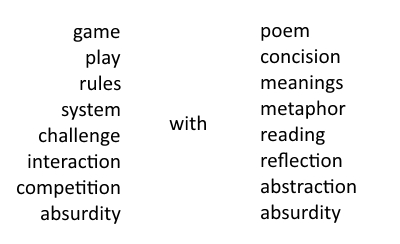
No one of these pairs is necessary or sufficient to make a gamepoem, but they all might be. These columns can be extended, disputed, and swapped, and this definition is descriptive and not prescriptive. Gamepoems are indeterminate. Gamepoems are about playing with and making poetic interpretations of what we think games and poems are. They’re about writing concise sets of rules that summon impossible worlds. They’re about crafting tiny experiences that mean a lot to people. They’re about laughing at the way we act, and acting in ways that make us laugh. Here are some of the gamepoems we’ve been making. They’re all different:
George Buckenham: Monogamy, a game for lovers
George Buckenham: a game for walking home
Adam Dixon: Long Games for Two Players
Adam Dixon: Games for Grimsby
Adam Dixon: Games for Inanimate Objects
HJ Giles: I’ll Check My Diary
HJ Giles: Trashmonsters
Holly Gramazio: 21 Games
Holly Gramazio: A Beekeeper’s Guide to Game Design
Hannah Nicklin: The Ashes Game
Jonathan Whiting: Burn While Reading
Jonathan Whiting: My Dream Game
Now make your own. Now change what the words mean.
image by Louis Vest, licensed under Creative Commons BY-NC 2.0
BLANK the money and BLANK
Uncategorized
I.
It’s funny that the less money artists have the less we’re willing to take. Running alongside the dismantling of the welfare state in the UK is the dismantling of its system of arts funding. There is less state money available, and it’s less widely distributed, and arts organisations are being carrot-and-sticked into pursuing the corporate buck. But increasingly the response to this isn’t to scrape and scrounge and take whatever money we can get, but to question where the money’s coming from and what the money can do.
The most high profile campaign on corporate funding is the attack on oil sponsorship of the arts. A coalition of organisations like Liberate Tate, Art Not Oil, and Platform are regularly raising hell by making great art about the oil industry’s artwash of its murderous and racist expansions. The targets are both major British institutions like the Tate, the Royal Shakespeare Company, and the British Museum, and the general public, in a campaign to remove the oil industry’s social license to operate. The work is in solidarity with indigenous activists and climate campaigners as part of a broad attack on big energy.
And as these questions are being asked, arts organisations are being pushed further into corporate sponsorship. ACE’s Catalyst fund supports and trains organisations in seeking funding from beyond state sources, and is also funding exploratory work about the question of funding itself. Catalyst money was involved in the recent funding ethics debate at Artsadmin, Take the money and run, and is also indirectly funding me to write this blogpost, as an artist commissioned to work with Artsadmin as a critical contributor to its Catalyst training and research.
The Take the money and run event was packed with artists and arts workers full of angry questions about how the arts is, will be and should be funded. There was wide opposition to the corporatisation of the sector, support for anti-oil action, questions about how to have an ethical fundraising policy, and demands to camapign for better state funding. In a way, it’s not surprising that this is the response of artists to cuts in funding: with money tight, everyone is thinking about money more, is more aware of where money comes from and what it means, is present to the politics of the issue. Artists have an inconvenient habit of searching out painful ideas, and an tricky inability to let go of them, even when they make art work more difficult.
This is a contribution to the conversation, asking (and trying to answer): What are artists supposed to do about money?
II.
There seems to be a widespread misunderstanding of what a boycott is. A boycott is not a private personal action: it is an organised political campaign. It’s named after a British land agent whose evictions of tenant farmers led to social ostracism and an economic blockade. It succeeded because it was organised to the point of being total.
A personal boycott that’s not part of a broader political campaign is that absurdity, ethical consumerism. Ethical consumerism is the most ineffective political movement I’ve ever heard of. The idea that you can end corporate exploitation and abuse by encouraging people to buy different stuff has no basis in economics: all you’re doing is creating a new market for capitalism to expand into. Supermarkets don’t stop selling coffee grown in the worst possible conditions, they just sell the organic version as well. Sometimes consumer choice can be deployed as part of a broader movement, and sometimes the purchase can be part of building alternative economic structures – as is the case with Fairtrade’s support for co-operatives – but mostly, treated as politics, it’s a con.
Nevertheless, I myself mostly buy organic and Fairtrade goods. I’m even a vegan, albeit a very relaxed one. I can’t bring myself to wear sweatshop clothes or eat megacorp bananas, for the same reason as if I eat meat I can’t get the image of a factory-farmed pig out of my head and feel a personal complicity in the planet burning up. I do most of the ethical consumer things out a vague sense of moral duty and the ongoing construction of who I want to be; I just don’t kid myself that it’s politics.
This pursuit of moral purity defines a lot of this sort of bad politics. Ethical consumerism is an attempt to detach oneself from complicity in genocide and ecocide, an attempt to be a good and separate person in a bad and messy world. To me it feels like it belongs to certain religious traditions, in which sins and good works are totted up on a cosmic balance sheet. I prefer to try and accept that we – the we that I represent, the we of the globally privileged in wealthy countries – are unavoidably complicit in horror, inevitably hypocrites. Worrying about which smartphone is ethically better (spoiler: none of them) and whether or not quinoa is OK to buy since that Guardian article is more about your sense of self-worth than it is about changing the world.
In the arts, there’s now a growing trend of working to institute ethical fundraising policies, rules to make sure organisations aren’t complicit in corporate or state criminality. To me, there’s a risk here that this becomes like ethical consumerism – an attempt to buy a clean moral record, rather than a recognition that funding is politics. A good example is the Tricycle’s failed boycott of Israeli state funding. The Tricycle attempted to claim ethical neutrality – it just wasn’t accepting money from either political actor in a controversial conflict – but opponents easily pointed out the hypocrisy of the position. There was an honourable political approach – joining the major international Boycott, Divestment and Sanctions campaign called for by and in solidarity with Palestinian activists – but by claiming unmaintainable ethical neutrality rather than political commitment, the Tricycle’s attempt failed.
Ethics in arts funding isn’t about you. It isn’t about your personal values. It’s about leveraging cultural power to change something. I join a campaign against oil sponsorship of arts institutions I love not because I feel dirty being associated with oil (I need to accept that I’m morally complicit), but because I think that campaign might be a major wound to an industry that’s killing us. We each come to our own compromise the the world, our own ethical lines that help us to live in a terrifyingly oppressive system – but beyond that, we can campaign, and boycott is one of the tools available to us. When that boycott is called for by those constituencies most affected by the target, it truly isn’t about you: your moral sense is outraged, but your political self must act.

III.
Something which came up repeatedly at Take the money and run was how special art is. How art liberates us, how art takes us to a better place, how art helps us imagine different worlds. These are all things I’d love to be true, and I think that they succeed in being true sometimes, but I’m sceptical about how the argument is often used: that art is special, and we can’t allow commerce to debase it.
Only recently has art become anything other than a plaything of the ruling classes. The culture that the majority of people enjoyed – folk music, say, or street games, or storytelling, or craft – were considered mere entertainment, or mere artisanry, while the arts – opera, ballet, literature – were bought and paid for as ways for the powerful to feel special. Artists were special creatures too, paid for by patrons, while artisans and entertainers had a lower status as workers or, in worse cases, drop-outs. Art as we understand it is a ruling class creation. What’s happened now is that we’ve opened up the category of art in terms of both participants – we want more people to be artists – and audiences – we want access to great art for everyone.
The result is an arts industry that has contradictions at its heart, that combines vaguely liberal ideologies of mass participation with elitist historical roots. Its artists want to be paid properly as workers, but also want to feel like they float about the drudgery of employment. It tries to make art accessible, but remains vaguely attached to the idea that artworks are a special sort of thing and not what everyone enjoys. It wants funding, but doesn’t want to lower itself into the mire of commerce.
We need to avoid assuming that commerce is an inherently bad thing to let into art, and instead ask about the power relations that are involved in different forms of funding. When a sponsor, patron, trust or funding body gives us money, what power are they giving and what power are they taking? What do they get from us, and what do we forget we are giving them? What creative control are they asking for? What social license do they walk away with? How does the art they fund reinforce their power? How might the art they fund undermine their power without them realising it?
A corporate sponsor might artwash, gaining social acceptability through its sponsorship of major institutions, as is the case with BP. A corporate sponsor might ask for creative input on the artwork, turning the art itself into a large scale advert. An arts culture built entirely on corporate sponsorship means that the only art that will get paid for is the art preferred by the rich. But a corporate sponsor might, just sometimes, might be a hands-off source of money, and a corporate sponsor might, just sometimes, not be paying enough attention to what you’re actually doing with their cash.
The goal of seeking funding is to get more great art made; ethical arts funding needs to be about making sure that art doesn’t end up giving more power to those who would destroy us. But there are also some deeper questions that considering where our money comes from gets us to: if we have ambitions for art to be something other than rich people’s toys, how might we make it differently? And what kind of funding might that need to make it happen? Sometimes I think we might be better off destroying the category of art entirely.
IV.
Despite the speed with which artists criticise corporate funding, we’re oddly at ease with state funding. And I’m writing in the British context, about a state built on empire, genocide and slavery, a state which continues to be complicit in financial colonialism and aggressively exploitative globalisation. In terms of the ethical record of funders, you can’t get much worse than the British state: every pound I take from it is a deeply compromised pound.
One difference between state and corporate funding is the chimera of democracy: the idea that when we take money from the state, we’re taking money from an instution we’re supposed to have some kind of democratic control of. The idea, the ideal, is that state funding makes great art happen that couldn’t happen otherwise, ensures that art gets made for and with diverse populations rather than just to the preferences of the rich, and is distributed in some way according to popular will. This ideal bears very little relationship to reality.
As an example, the Arts Council of England spends 15 times as much money per head on London organisations as it does outside the capital, and invests disproportionately huge sums in particular in national opera, ballet and literary theatre. Arts funding, even as it is being cut, shores up the institutions of power. Meanwhile, as the UK’s apathy vote rises, its major parties refuse to adopt the most popular possible policies in favour of cronyism, and its two party system begins to collapse, it’s hardly possible to say that the British state feels particularly good at offering democratic control of resources.
Just as corporate funding has obvious risks, state funding needs to be criticised and problematised. It’s not just in totalitarian regimes that state-funded art props up power: we have to ask to what degree the ruling classes decide where the money is spent, and how much control arts councils give them over distribution. In the UK, as the more independent arts councils are cut, government culture department funding increasingly supports national ideologies – it won’t be long, I’m sure, before DCMS requires funded organisations to disseminate “British values”. Campaigns for ethical funding need to also be campaigns for better state funding – not just more money, but money better distributed, with more democratic control over the distribution.
But then again, these campaigns for ethical funding both tend to imagine that states and corporations can be reformed into perfection; that with enough political pressure, we’ll get a state capitalist system we can all be happy with. Personally, I think that’s nonsense. Personally, I think that the ruling classes can only support ethical funding campaigns as long as the foundation of their power is threatened, and that such campaigns are worth very little, and that more powerful and honest campaigns will bring us into conflicts with the very systems of power we seek to reform. But that said, I’m happy for now to form liberal alliances for transitional reforms – if nothing else, because I refuse to fetishise poverty, and I need to get paid too.

V.
So what can you do? If all money is dirty, if all artists are hypocrites, and if all funding is ethically compromised, what actions are available to you? I’d argue that accepting the brokenness of everything is a great place to start from if you want to make real and radical changes. I’d also argue that refusing the cling to the purity of any given action opens up a wide portfolio of strategies: rather than trying to hold our ethical ground, we can fight a guerilla war, adopting different tactics as needed to win the world we want. Here are four possibilities:
Take the Money and Run. Artists need to get paid, and the system we need to get paid by is inherently oppressive, exploitative and abusive. You’re going to have to accept you’re complicit, and you’re going to have to learn to hold your nose. Or rather, you’re going to have to learn when, for what and for whom it’s worth holding your nose, right to hold your nose. Remember that you’re own survival is important, and that the work you’re doing is important, and decide to make the kind of compromises you can live with. Accept that you’re a hypocrite, and make art that matters. Make your life strong so that you can fight back.
Steal the Money and Smash. Sometimes, they’re not paying attention, and sometimes taking money from a dubious organisation is an excellent way in to cause them some damage. I heard a story once about an artist who took some money from Vodafone’s World of Difference fund at a time when the mobile giant was the target of a major pay-your-tax campaign. The artist used the money to work for a local radical social centre, and leaked passwords to the Vodafone Foundations’ blogging platform to activists, enabling some troublemakers to plaster the company’s website with propaganda for a couple of days and grab some headlines. This story makes it seem possible to cause more damage to a funder than the benefit they gain by artwashing you. Stay alert for opportunities to use their money against them!
Hate the Money and Shout. But sometimes we need the boycott tactic. Sometimes we need to be able to state clearly that a given funder is not acceptable, and make a paraiah of the national institutions lending their reputation to corporate abusers. This is especially the case when the campaign is called for and organised with those on the receiving end of oppression: boycott must always be more about solidarity with those struggling than individual moral worth. When you boycott, organise with others, and turn it into an extraordinary event. You’ll always need to have arguments ready to turn away the easy charge of hypocrisy, but boycott can be one of the biggest ways to shift public perception.
Fuck the Money and Build. The only people who we can really trust, who really need to be able to trust, are each other. Artists, activists and all the people struggling in oppressive systems need to be able to build their own systems of support and mutual aid. A sector of atomised artists each struggling over numbing funding applications and neurotic sponsorship bids is no good for anyone, or for art. We need independently-funded arts and social centres. We need workers co-ops. We need to be honest with each other about money. We need more radical unions. We need to make money off cheap tickets, cheap drinks, cheap food and use it to pay each other. We need to learn how to build autonomous systems of support. We need to look after each other.
*
This article was written as part of a commission with Artsadmin to explore arts funding through attending events, critical thought, writing and a new artwork. All opinions, however, are purely my own and not necessarily those of anyone in the organisation. It was originally published at http://www.artsadmin.co.uk/artsonline/
Images: “where are we now / no money no art”, from Flickr user aestheticsofcrisis, “money is destroying art and culture”, from Flickr user acb, both licensed under Creative Commons Attribution-NonCommercial-ShareAlike 2.0 Generic license, and still from “The K-Foundation Burn a Million Quid” from http://en.wikipedia.org/wiki/File:The_K-Foundation_Burn_a_Million_Quid.jpg for licensing.
 Harry Josephine Giles
