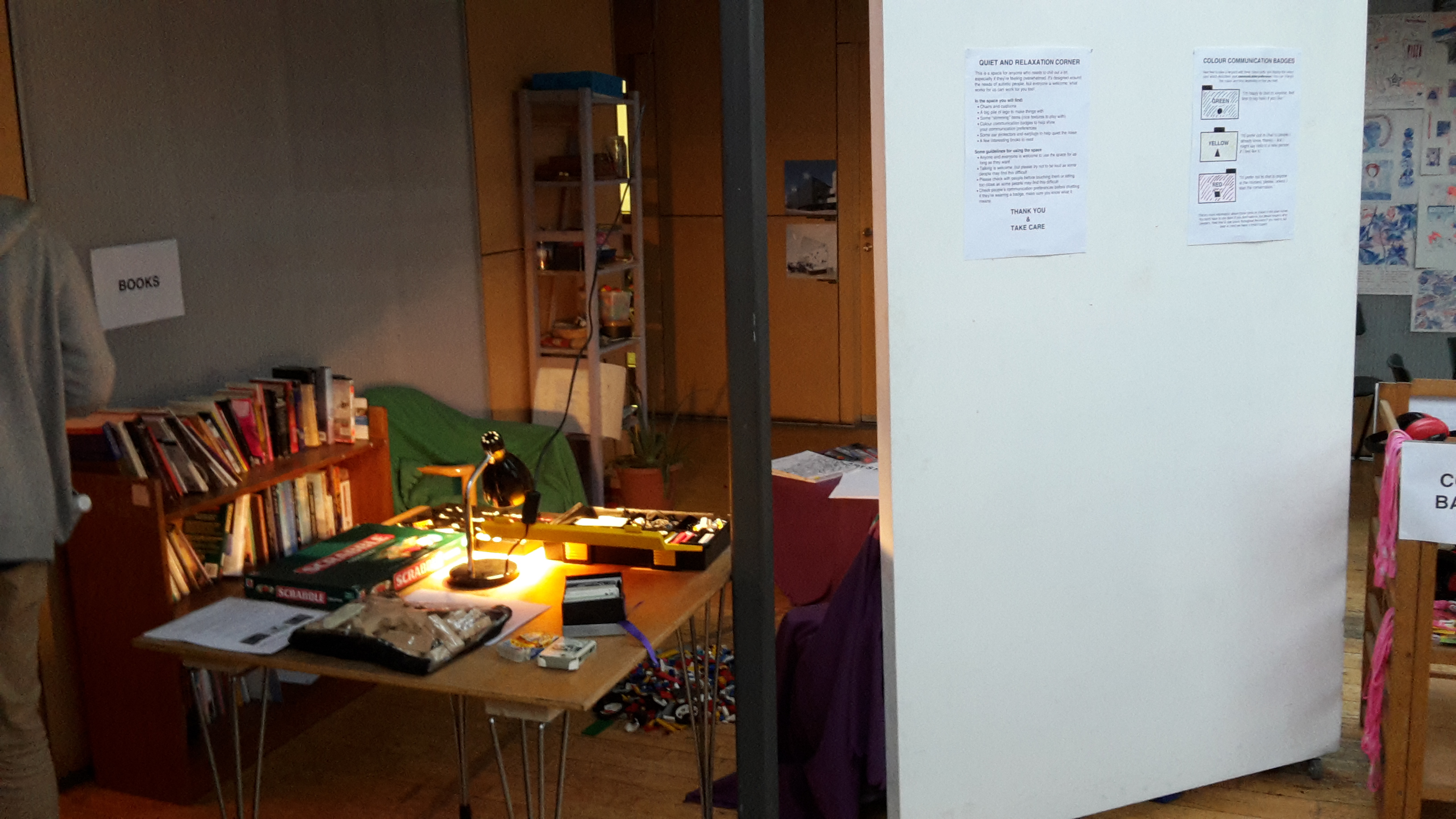
Chill Out Corner is a project creating alternative forms of socialisation for arts events. It uses autism-centred design principles to create a space that can used not just by autistic people but by anyone who feels the need to get some quiet, escape, deal with stress, relax, or otherwise chill out in a noisy and hypersocial context.
The idea for the Corner has been brewing for a long time, after reflecting on the prevalence of big, noisy, social events in the art world. The arts have a long history of celebration, great parties, networking events, hedonism and debauchery — forms of rambunctious sociality are often central to the making and sharing of art. Economically, being professionally social (or socially professional) is a form of advantage in the art world. But equally, many artists are reclusive, shy, awkward, anxious, uncertain, or neurodiverse. How can the art world provide social space to many different kinds of people, together?
Autism is a spectrum condition, and its various characteristics (sensory sensitivity, different styles of communication, propensity to panic/meltdown in response to stress, highly specialised interests, not perceiving received social norms and conventions, high coincidence with conditions like dyspraxia and anxiety) come at very different levels in different people. Many people might have some autistic characteristics to some degree, and the boundary between autism and social awkwardness or social anxiety is fuzzy and porous. So the techniques and ideas which autistic self-advocates have developed for their own events and needs can work well for a much wider range of people.
From the start, the Corner was conceived not as a separate space but as an adjacent space: something that is a visibly alternative form of sociality and presence alongside dominant social patterns, that asserts difference as positive and essential. It’s not a Quiet Room (another great thing to have!) but a Chill Out Corner.
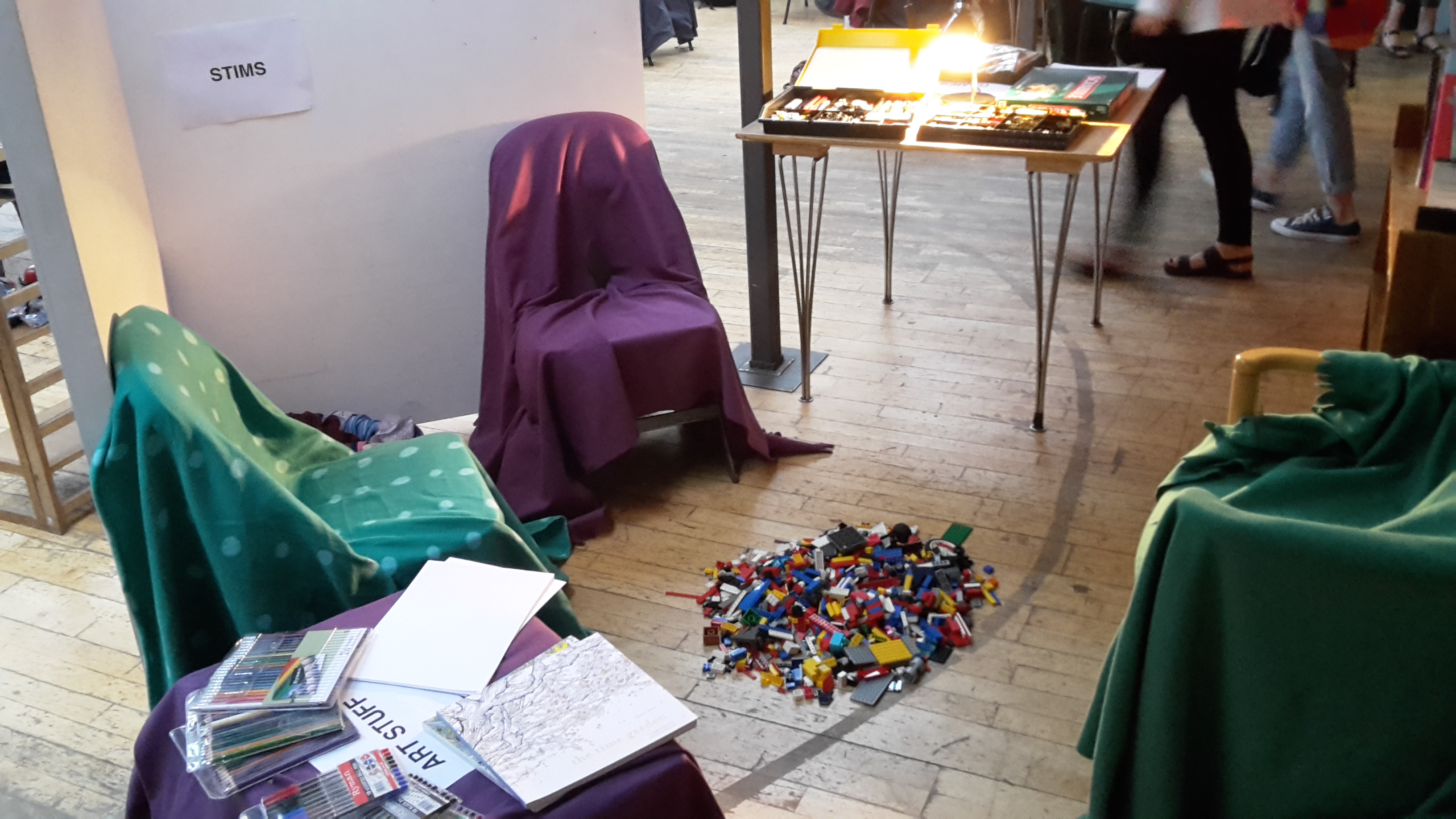
The first Chill Out Corner was run at Forest Fringe, August 2016, for their Reunion Party at the Out of the Blue Drill Hall. At the event there was a main stage with noisy acts, cabaret-style seating, drinking, party-style socialising, incidental performance, and, in one section of the room, a defined space with soft seating, quiet toys and games, books, and autism-centred design materials. People came and went, coloured in and played Scrabble, chatted quietly or sat in sociable silence. It was lovely. I’ve since co-ordinated similar spaces for Arika and other organisations. If you want to hire me to run a Chill Out Corner at your event, get in touch at hj@harryjosephine.com.
To run a Chill Out Corner, the following things are essential:
- To have at least one autistic/Asperger’s person central in the design team
- A generous amount of space for people to sit together without being crammed (the space I created at Forest Fringe was a little too small), and a way of defining that space as separate but open and connected, such as a free-standing screen.
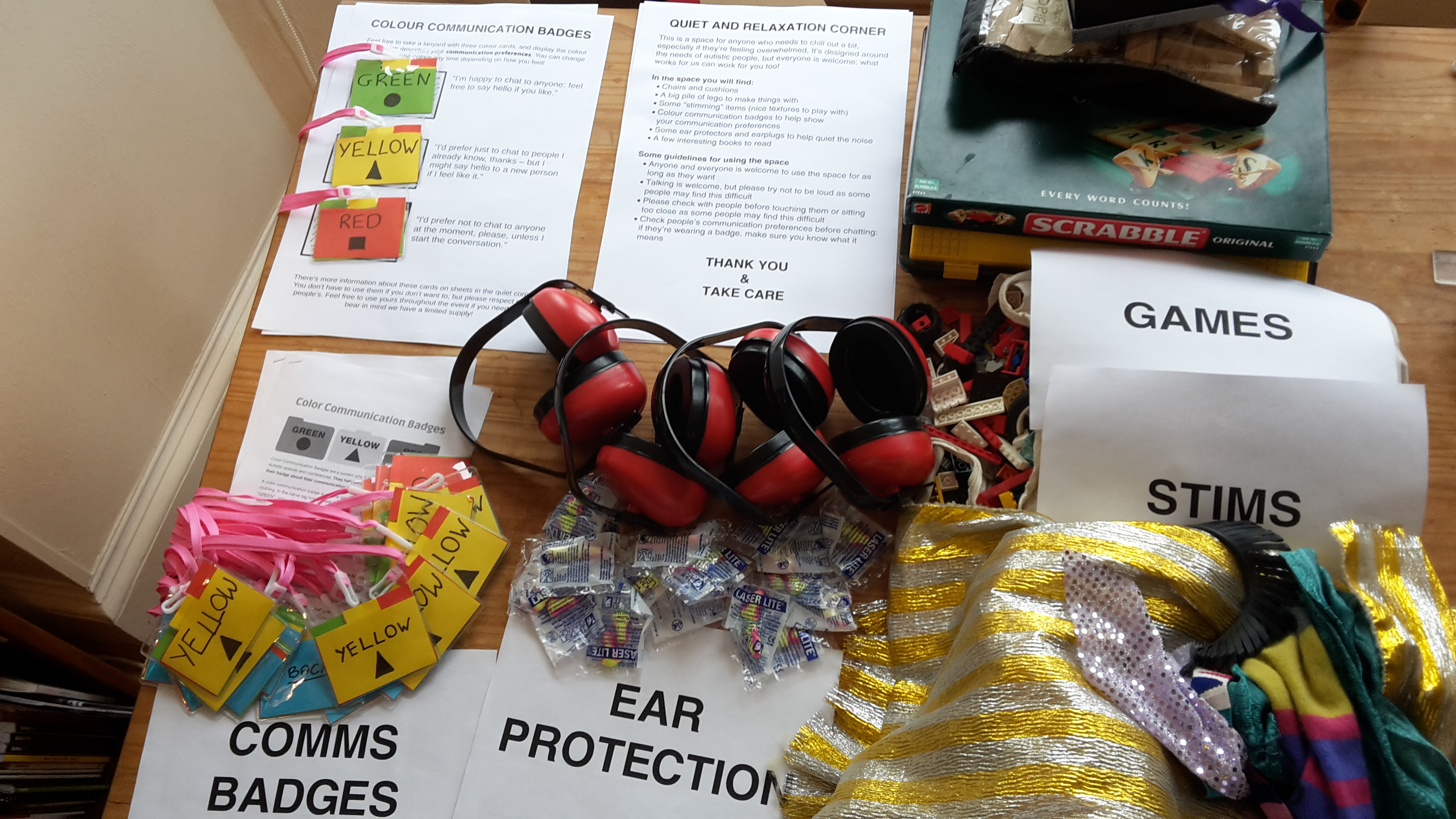
- At least two forms of ear protection, such as noise-cancelling headphones and soft earplugs. (This is because people on the autistic spectrum often have serious sensory sensitivities, and being able to reduce noise reduces the risk of panic/stress/meltdown.)
- Medium-level lighting. (See above.)
- Comfortable seating, with a mix of chairs and floor seating.
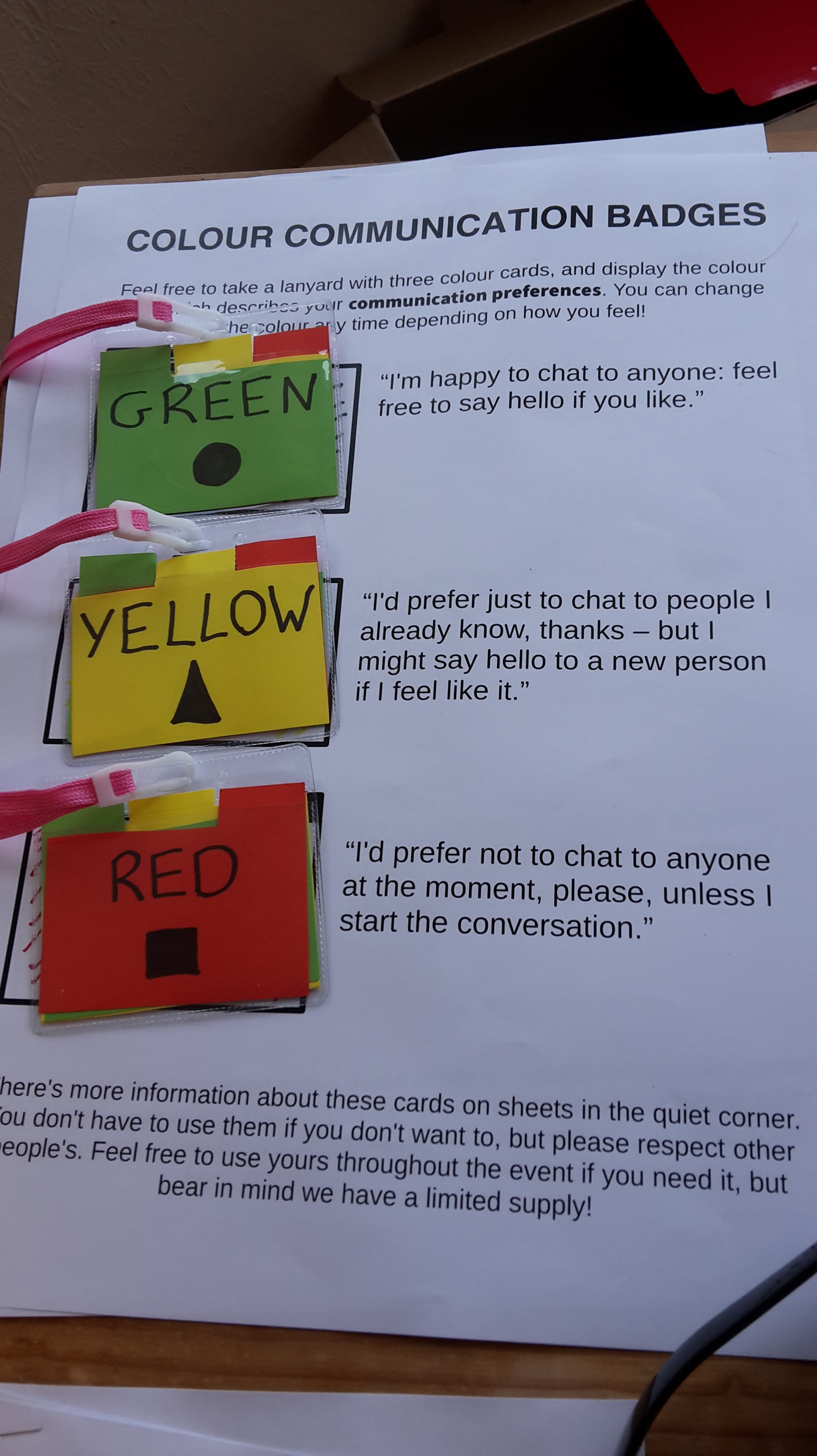
- Colour Communication Badges. See my photos and this poster as an example, and ASAN for more resources. (This is because people on the autistic spectrum often have significant communication needs, and being able to define social boundaries reduces the risk of panic/stress/meltdown.)
- Some quiet things to do, especially visual/tactile things. (Alongside finding sensory over-stimulation stressful, many autistic people find certain kinds of sensory activity calming and comforting.)
- Signage explaining the guidelines of the space. See this poster as an example, which you’re free to use. (Many autistic people struggle to understand social rules and norms, and also have specific social needs, so clear explanations are very helpful.)
Some examples of activities which it can be good to have in the space are:
- A pile of lego
- A box of interestingly-textured materials
- Colouring books and art materials
- Accessible board games
- Structured social games
- A range of books
Two useful posters I made which you can use are:
 Harry Josephine Giles