August: Some Things To Come To

Events, Poetry, Theatre

I live in Edinburgh, and every year as August is approaching I tell people, nah, I’m not really planning to do anything much in the festivals, not really, just a little something. And every year I end up with a diary full of strange and beautiful performances and things I’m delighted to be part of and so much to do that when September comes I want to be out of mobile phone and WiFi range for at least a week. This year, I’m curating a live art programme, performing in Forest Fringe, and doing poetry gigs in between:

What We Owe @ Forest Fringe, Out of the Blue
What-We-Owe-web

What We Owe
One-on-one performance
20 – 22 August, 11am-1pm & 4pm-5.20pm
23 August, 11am-1pm only
Out of the Blue Drill Hall, 30-38 Dalmeny St

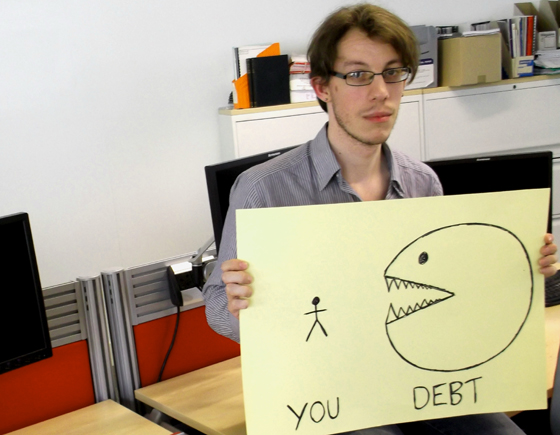
Trapped in a maze of final demands from which you may never escape? Pestered by obligations to friends, family and the television? Cowering under the weight of your debts? What We Owe is the highly unqualified debt counselling service FOR YOU.

We’ll lead you through the journey of what you owe – not just financially, but also emotionally, socially, ecologically, and more. Together we’ll create an absurd (but often effective) Personal Debt Audit, covering everything from the meals you ought to cook your parents to the trees you need to plant, then begin the journey up your personal mountain of debt with a Debt Action Plan. In just 20 minutes, we promise to leave you lighter and happier – or at least with a colour-coded spreadsheet.

Vanquish your debt monsters! Burn your student loan statements! Ignore your friends! In an economy driven by huge financial debts, What We Owe is a tragicomic look at what we mean by debt, and how we might struggle to even begin to cope with it.

www.forestfringe.co.uk

Peep Anatomy @ George Square Gardens

peepfront

ANATOMY is tickled pink, purple, blue, and every other rainbow colour to announce the line-up for our Edinburgh Fringe début, in collaboration with the extraordinary PEEP venue from Natural Shocks.

PEEP is a brave new space — a small box of wonders with a full programme of theatre, dance, cabaret, sound installation and live art. The audience are seated in private booths peeping on the unfolding show – but the artists can’t see them. It’s a peepshow, but definitely “not for the raincoat brigade” (The Guardian).

Through Keyholes of Flesh is an intimate and unique series of live art installations created bespoke for the PEEP venue. The strange, the wonderful, the grotesque and the eerie mundane. £2 a look – for as little or as long as you want.

Full programme at anatomynight.wordpress.com.

Poetry All Over the Place
37518_1524939652428_1502741355_31319175_2216712_n

ANTISLAM
Saturday 10th August, 7.30pm, Banshee Labyrinth

Worst poet wins! We don’t mean bad: we mean hilariously terrible, laugh-out-loud embarrassing, entertainingly cringe-worthy poetry so bad it transcends quality, becoming genius. Featuring top names from Fringe spoken word: with poets this good, being this bad, it’ll be awesome. Hosted by Paula Varjack and Dan Simpson.

http://edinburghfestival.list.co.uk/event/360643-the-anti-slam/

BBC Edinburgh Fringe Slam
Wednesay 14th August, 8pm, Potterow

For the third year in a row, we’ve invited 24 of the best performance poets in the UK, 12 women and 12 men, to compete for our Poetry Slam title. We have UK National Champions, Scottish National Champions, two former BBC Slam Champions and the Scottish Makar.  Hosted by former Scottish Slam Champion, Young Dawkins, the 2013 Slam takes place over five nights – four heats followed by a Grand Final.

https://www.facebook.com/events/472330412861636/


25 Ways for Artists to Think About Economics

Poetry, Politics, Rambles, Theatre

I wrote this brain-dump for Andy Field, who was asked to prepare a presentation on “how artists can think about new financial models for themselves and for audiences”. He collected 150 bits of advice, sold them for £1 each, and used the proceeds to pay a violinist to play music for the length of the presentation: hurrah for the meeting of form and content! I keep attempting to write something long and thoughtful on art and money and how it all fits together, or maybe organise a conference about it, or a piece of action-research, or… well, none of that has happened yet. Maybe it will. In the mean time, two very nice people recently reminded me that I’d written this, so I reread it, and it turns out I’d already said most of the things I’ve been thinking about. So here it is. it’s a start, anyway.

“New financial model” does not mean “working for free”. If someone asks you to work for free and gives you nothing in return and pretends it’s a new financial model, tell them to fuck off.

Next time a venue says it will pay you in experience and exposure, ask them if you can buy tickets to their shows with that.

Go read about the Industrial Workers of the World. Start a union.

Read everything that Radical Routes have on the subject of co-ops. Start a co-op.

Go to an organisation in the UK Social Centre Network and ask them how they organise and fund themselves. Work out how this can be apply to an arts organisation. (Many of them are already arts organisations.)

If you’re doing self-promotion well, you’ll probably feel like an arsehole. Ask other people if you are being an arsehole. If they say you aren’t, you’re doing OK.

Raffles are FANTASTIC. Ask someone who grew up in a rural area how to do them well. This is technically an old financial model. Sorry.

If you are working for free for an organisation or event and other people in the organisation or event are getting paid, something may be fucked up. Exploiting labour is one of the oldest financial models there is.

Take assertiveness, confidence, public speaking, or call centre training, and apply everything you’ve learned to negotiations with venues and producers. Don’t worry about your embarrassment, shyness, awkwardness or shame. It is OK to feel these things, but don’t let them stop you. Asking to get paid is part of building a new financial model for the whole arts sector.

Whenever you work with another organisation, ask them if you can have a look at their budget for the project. While reading it, ask yourself if you would spend the money differently. When you’re in their shoes, make sure you do.

Every new financial model has to interact with a lot of really crappy old financial models. A new financial model is not a new world: it is a laboratory in an old world. It is OK if something goes wrong. It is OK if something explodes. This is how we learn.

Start a reading group for Marx’s Capital. Start a reading group for Smith’s Wealth of Nations. Start a reading group for Kropotkin’s Mutual Aid. Have a party.

If you pay less for a Pay-What-You-Can show than for a set price show, why are you paying that much for the set price show?

Experiment with shoplifting. You will learn a lot about how property works.

Next time you throw a house party, ask the guests to pay. Prepare your arguments.

View the writing of economic impact reports as a radical act. Make it so.

Why do you need to make money from your art? Seriously. Make a list of the answers. Think of ways you could meet all those needs without money. Make it so.

Is your labour the same sort of labour as the labour of someone who works in a call centre? Write a list of the reasons it is. Write a list of the reasons it isn’t. Now make it better for both of you. You might already be the same person.

Poetry publishing is subsidised by pay-to-enter poetry competitions. What the fuck is that all about?

There is very little stigma attached to a musician self-publishing their first EP. There is massive stigma attached to a poet self-publishing their first pamphlet. Discuss.

Financial models are the same thing as power models. How money is distributed is determined by how decisions get made. You can’t have a new financial model without also inventing a new decision-making process.

When you pay for art, what are you paying for? (a) The experience; (b) The object; (c) To support the artist; (d) To support the producer; (e) Because you have to; (f) Because you never thought not to; (g) Other (please state).

Here are some things an artist might be: (a) Labourer; (b) Entrepeneur; (c) Community bard; (d) Amateur or hobbyist; (e) Commodity; (f) Self-facilitating media node (arsehole); (g) Social Worker; (h) Scrounger. Which of these do you want to be? Make it so.

If you give money to buskers, do you actually stop to listen?

When somebody brings a bottle of wine to your dinner party, do you feel obligated to pay them, or to bring a bottle of wine when you go round to their house? What does this mean for the way we do art?

Aye But @ National Collective

Poetry, Politics

I’ve a wee thing up now at National Collective, the artists’ faction of the Scottish independence campaign. It’s taken me a long time to get my thoughts properly together on independence, and the only conclusion I could reach was that it wasn’t possible to reach one coherent conclusion. The piece (it might be a poem) is one long plea for a wider, more important debate about what Scotland is and what it’s for.

Aye, but hit’s no as if Scotland wis a nation foondit on onything ither than imperialism n conquest.
Aye, but hit’s no as if gin ye stamp oot the thistles onything ither will growe in thair steid.
Aye, but hit’s no as if aw this wurds n leids for “Scotland” are orbitin onything ither than a gapin black hole, n the anely thing gaun for that singularity is that hit haesna spewit oot as muckle sharn as “Britain” yet.
Aye, but Yes Scotland have gat a haund haudin a bonsai tree on thair website n that gies me the teemin bowk.
Aye, but a resistans foondit on nationalism is an alienatit resistans (cheers Tom).
Aye, but nationalism is empie.
Aye, but patriotism is for scoundrels.
Aye, but fer aw that n aw that (facepaum) votin for a different state daesna equal votin for self-determination
Aye but independens is no the reid peel.

Read the full piece here.