Ten Scenes from a Protest

Politics, Rambles

I

There’s a group of benefits claimants and activists protesting outside the A4e office, holding a banner in front of the doors.

A young policewoman pops out. “Would you mind moving a bit to the side so that people can get through?”
“That,” I say, “would be missing the point a bit, wouldn’t it?”

II

The protest is a little unsure and dispirited. There’s a rumble in the distance. A huge crowd of students is coming down the hill to join us. Far more than we’d expected. Shall we address them? Maybe we could occupy these offices together?

They stop in front of our picket, and everyone cheers. They chant:

“Students! and Workers! Unite and Fight!”

One of our number attempts to talk through the megaphone, tell them while we’re here. But someone starts moving and the crowd falls forwards, marches onwards.

We shrug, and get into line behind them.

III

We reach the target, and everyone … sits down.

All the anarchists, together and individually, let out a peculiar noise, somewhere between a disgusted groan and a resigned sigh.

They lurk at the back of the crowd, standing, cynically commenting, being watched by the FIT, laughing, pretending to plot.

Now a sequence of indistinguishable white men are making unintelligible speeches through the megaphone.

IV

“Typical. I don’t go to London, and they have a riot and smash up the Tory headquarters. In Edinburgh I come along and they just sit down in a protest cage.”

That speaker shambled off to the pub later, disgruntled. Then the students occupied their university and another team superglue-blockaded the LibDem headquarters.

Typical.

V

I’m bored. I put on my balaclava of evil and my bulky army jacket, and decide to have some fun.

I climb over the protest cage and force the cops to satirise themselves: four tough police officers manhandle me back over the fence. They’re pushing and shouting at a protestor clearly labelled EVIL. I deliberately trip over my own feet, pretend to get stuck on the fence, kick my feet in the air, fall on the ground, jump up like a cat and pretend nothing has happened, mime a whistle. Then I do it all again.

VI

Later, marching again, I walk like a mock guerilla/gorilla behind a crowd-chaperone policeman. I’ve been doing this for a while. He turns around and bits in my face:

“Did you get bullied at school or something?”

Well, yes. And so, probably, did he.

VII

The occupation happened by accident. They’d attempted to sit in the Registry office, but the police quickly got in the way. Keeping the peace. As uncertain about what’s happening and what to do as we are. An authoritative male turned up and the stand-off and suggested we all get together to talk about what to do next.

Some with anger and frustration, some with tiredness and resignation, we assemble in the lecture theatre to talk about our plans. And then understand that, without the cops realising what we’ve done, and without us realising what we’ve done, 200 people have just successfully occupied the building. I don’t think that’s what the people who suggested this assembly meant to happen. But it happened anyway.

VIII

I go outside to check how many police are out there, recce the area, while the assembly takes place. But they’ve figured out I’m not a student. As I try to get back in, five yellow-jackets block my way. I’m shut out.

I wasn’t going to stay at this occupation until they tried to keep me out of it.

I spent forty minutes ignoring the two cops minding me, refusing to negotiate, refusing to give up on my determination to get back inside. Never negotiate with the cops: you always lose something. I stop everyone who enters or leaves the building, say:

“Scuse me? Hey, I’m not arrested or in trouble or anything. They just won’t let me in the building, so I wondered if I could ask you a favour. Or if you could just talk to me for a while? I’m a bit cold and lonely.”

About half the passers-by ignore me, or stop for a moment and then shrug guiltily before leaving. But the other half at least hear me out, though I can’t get any to get someone from inside to come and help me get back in.

Eventually, two friendly Germans tell me that there’s a back entrance to the building. I can’t believe it. And yes, there are no cops there. I re-enter.

My one regret of the whole occupation was that I wasn’t able to show the cops who’d locked me out that I’d just gone round the back. They must have left thinking I’d given up, thinking they’d won.

IX

I accidentally became the social media ninja for the protest. Within an hour I’d set up a website, started tweeting every few minutes, e-mailing across the world. Throughout the long meetings I’d work on communications. I spent nine hours a day glued to TweetDeck and WordPress, blogging the revolution. Soon, blogs and Twitters started sprouting for the 20 occupations across the country. Everyone started following suit. This is the most tweeted revolt in British history. Our hashtag is #solidarity.

X

There’s an occupation of activists downstairs, while upstairs the geeks are working the night-shift: it’s the Informatics building, and they’ve been locked in there all semester. They set up a parody blog and Twitter; the occupation is the best procrastination tool they’ve had all year. Our photos are of snow, curry, and naive revolutionaries; their photos are drab grey shots of window-blinds and a 16k resistor. Solidarity forever.
Dreaming of Joe Hill: A Story, A Song, A Poem

Music, Poetry, Politics, Rambles

I talk about Joe Hill a lot. He’s a huge inspiration, politically and artistically, for people across the world over the last century, and I’m glad to be one of them. He was killed 95 years ago today, murdered by government firing squad for a crime he didn’t commit. But he never died. I wanted to write a post for Joe Hill, to remember him, to explain for those who don’t know the story why he’s so important, and to keep him alive. The story should be told again and again, so while you can find it in many places online, I don’t mind telling it again here. I’ve recorded a song — not by him but for him — and a simple poem came to me too.

Joe Hill was born Joel Emmanuel Hägglund in Sweden, October 7, 1879. He emigrated to America in 1902, working as a migrant laborer all across the country. Like many immigrants and migrant laborers in the 1900s, he became involved in radical labor organisation, joining the Industrial Workers of the World, the Wobblies, in 1910. At the time workers across the country were being betrayed wholesale by the American Federation of Labor, a so-called union that collaborated to suppress the struggle for vital workers’ rights. While the AFL would exclude immigrants, non-whites, women and poorer laborers, the IWW was open to all, struggling for all together. In the early years of the 20th Century, the IWW was crucial in winning many of the rights Americans take for granted today — and spread across the world, too.

Well, Joe Hill wasn’t just an organiser but a poet and songwriter, and that’s what he’s remembered for most now. Between 1910 and 1915 Joe Hill wrote dozens of radical songs which grew immensely popular throughout labor struggles. They were often based on hymn tunes — simple, memorable, and often bitingly funny. You might know The Preacher and the Slave (where the phrase “pie in the sky” comes from), Rebel Girl, or There is Power in the Union. Hill’s songs, because they were so easy to learn, so fun to sing, and condensed vital messages so skillfully, spread across the country, sung by crowds of workers regularly at strikes and protests. They became important for the movement: a way of keeping spirits high, of reminding everybody where they stood and with whom, and of spreading the word.

But Joe Hill made some enemies this way too. Chief among them was Amalgamated Copper ( later known as Anaconda Copper) who were involved in several of the toughest struggles, and of course the state authorities wherever he happened to be. So in January 1914, when in Salt Lake City former police officer John Morrison and his son were killed, he was shadily framed by the authorities for the murder. The evidence was as slim as slim could be: Joe Hill, in the city at the time, had suffered a gunshot wound the same night (as had four other people in the city), and had a red bandana (unsurprisingly for a labor organiser) as did, reportedly, the murderer. But, while strongly denying his involvement, throughout the case Joe Hill resolutely refused to reveal his alibi, even though it might mean his death. The story goes something like the folk ballad Long Black Veil: that Joe Hill had been with a married woman that night, was shot by her husband, and refused to testify in order not to disgrace them. Whether or not that’s true, who knows, but that’s how the story goes.

Joe Hill stayed in jail for well over a year, and people across the world — including Helen Keller and president Woodrow Wilson, of all people — demanded his release. There were vigils everywhere, and often the people gathered would sing Joe Hill songs — songs which he kept writing all the while. But the Utah authorities wouldn’t relent, and he was sentenced to death. Shortly before facing the firing squad, Joe Hill wrote his last will and testament in the style he’d always written:

My will is easy to decide,
For there is nothing to divide.
My kin don’t need to fuss and moan;
“Moss does not cling to a rolling stone.”

My body? Oh, if I could choose
I would to ashes it reduce
And let the merry breezes blow
My dust to where some flowers grow.

Perhaps some fading flower then
Would come to life and bloom again.
This is my Last and final Will.
Good Luck to All of you,
Joe Hill

Joe Hill was taken out into the yard, blindfolded, with a paper heart pinned to his chest. His last spoken word on this world was “Fire!”

But the story doesn’t end there, and Joe Hill never died. His body was sent to Chicago for cremation: he’d said to his friends that he “didn’t want to be seen dead in Utah”. There was a public funeral, and thousands gathered in the street, where they sang his songs together well into the night. Packets of his ashes were sent to every IWW local (except those in Utah) and to supporters across the world. And his songs continued to be sung, and the struggles he took part in continued, and the victories he helped win continued to inspire people. His life and work continued to be an inspiration to political songwriters from Woody Guthrie to Pete Seeger and Phil Ochs to Billy Bragg and Utah Phillips. And that’s why we say he never died. That, and the song, in a very humble rendition by me, which was written in his memory around 1930 by Alfred Hayes and set to music by Earl Robinson:

And the story doesn’t even end there. Here’s my favourite postscript (and long may the postscripts continue). In 1988 it was discovered that an envelope had been seized by the United States Postal Service in 1917 because of its “subversive potential”. The envelope, with a photo affixed, was captioned, “Joe Hill murdered by the capitalist class, Nov. 19, 1915”. The Chicago IWW laid claim to the envelope, scattered some at sites of struggle, but also followed up a suggestion by Yippie activist Abbie Hoffman: portions were given  modern day Joe Hills Billy Bragg and Michelle Shocked to be eaten. Billy Bragg did indeed eat his, and still carries Michelle Shocked’s packet wherever he plays. So Joe Hill is there, too.

I care about Joe Hill because of his significance, and because it’s a good story, and because remembering him helps us to remember all the many labour martyrs whose names and stories we don’t know, but also because of what his approach to music means. Joe Hill wrote songs for people to sing and for a political purpose: he wrote simply, directly and vitally. He wasn’t afraid of sincerity or of satire: he just sung what he thought, and what needed to be sung. Would that I, or any of the artists of all media around now who claim to be political, had the courage and skill to be so honest and direct. So I make no apologies for the corniness of the following poem, which I’ll leave you with (though I do apologise for its other weaknesses). It’s not a very artful poem, and it’s not for print but for performance, and not for performing anywhere but just where it’ll help us in our struggles. I’ve performed poems on blockades and on top of a siege tower; I like the way they can keep our spirits high. This poem is for the moments when a protest or strike has just been broken, when we’re feeling exhausted and dispirited and desperate, when it seems we will never win. It’s just for me, really, because Joe Hill helps me stand up again.

Joe

A singer I never knew
shakes my shaking hand,
reminds me where I stand
with whom.

They shot his paper heart
and crumple mine with news
of broken fights. We lose,
we start

again, we make a plan
to strike once more the spark,
to howl into the dark
demands.

A singer I never knew
shakes my shaking hand,
reminds me where I stand:
with you.

Solidarity forever!

Protest Violence Cliché Bingo

Politics

I wasn’t there. But as soon as I’d finished work for the day, I glued myself to my laptop, obsessively refreshing news websites, trying to follow the ticker-tape madness of the #demo2010 and #Millbank Twitter feeds, watching the reactions pile up on political blogs. I don’t often fully embrace or participate in the social media commentariat, feeling generally pretty sceptical of its significance and self-obsession, but this time I was right there buzzing alongside every other laptop-shackled numpty. Because this time how the protest was portrayed, how the public(s) reacted, how the news reported — these things seemed more significant. The British public(s) are starting to fully digest the meaning of the coalition government’s programme of ideologically-motivated, economically insane and destructive cuts — and starting to get angry. We’re well behind continental Europe and its movement to resist austerity measures, but I don’t want it to be true that Britain is just going to keep calm and carry on: I want us to struggle. And Wednesday’s protest gave me some hope that we will.

So the reporting and reaction was important to me, because I want to see the public discourse turning, I want to see a wider understanding of the need for anger and resistance, I want to see more support for protesters, even when their direct action can seem frightening to many. And, by and large, I did see the first glimmers of a change in the discourse, at least in the centre-left press. But, as always, inevitably, that hope was buried beneath a mountain of garbage, of clichéd and misleading and irresponsible and editorialising journalism — journalism that failed its duty to enhance public understanding, that, by resorting to hackneyed narratives and obfuscating clichés, actively sought to confuse, prejudice and disempower the general public.

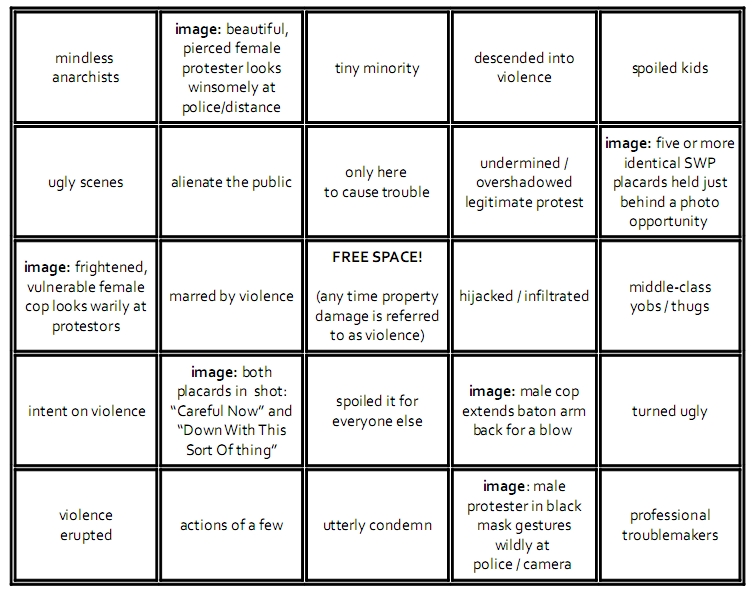
This is nothing new (although the damning ubiquity of one photo was a particularly horrible example of lazy journalism). And in fact there was, as linked above, some better reporting than usual. But I am so tired of this. I used to want to be a journalist, and my first job was on the local paper, but the venal charlatanry of the British media drained every such desire from me. I don’t feel there’s much I can do about this but howl into the void. So I decided to make a game instead, so that at least next time I would have something to do.

The Bingo Card

click to expand

Download a ready-to-print bingo card, with detailed commentary: Front Card and Back Card

The Rules

1. Whenever a major protest occurs, a new game begins;

2. To tick off a square, you must find an example of the cliché in the print, broadcast or online media (blogs, youtube and social networks not included);

3. The first person to score a BINGO (five squares in any direction, including diagonal) and e-mail the sources to harry DOT lodestone AT gmail DOT com wins a prize. The reason for the sourcing is not just so that the adjudicator can check your card, but so that we can also e-mail the media outlet or comment on the article to let them know they’ve been bingod;

4. Some variations in language may be allowed, at the adjudicator’s discretion, but may lose out in the event of a tie-break;

    5. Bonus points may be awarded in a tie-break (see overleaf, or for particularly excellent submissions), entirely at the whim of the adjudicator.

    Download a ready-to-print bingo card, with detailed commentary: Front Card and Back Card

    Creative Commons Licence
    Protest Violence Cliché Bingo by Harry Giles is licensed under a Creative Commons Attribution-NonCommercial-ShareAlike 3.0 Unported License.

    Some Notes

    This has been released under a Creative Commons License not because I’m particularly fussed about my ownership of the piece (I mean, it’s bingo) but because I want to actively encourage people to share this bingo card far and wide. I’d love it if a good few people were playing this game every protest, especially if we were able to embarrass media outlets with it.

    On that note: I am neither an illustrator nor a graphic designer, so the .pdf of the card is currently quite spartan. I would love it if anyone who does have those talents would like to make a new version of the card that looks nicer. If you need a copy of the original texts, e-mail me.

    Finally, because this blog also functions as a semi-professional website, and because potential employers may look at it, I’m going to have to be absolutely, pedantically clear on my position. a) I fundamentally support everyone’s right to protest, and believe that direct action and civil disobedience have historically been and are now important protest tactics, even though they often entail breaking laws; b) I do not believe that property damage is violence, and I certainly will not condemn people who damage property for political aims, but nor do I believe it is always a beneficial tactic to use; c) I do not think that actions like throwing light missiles at police are particularly violent or dangerous, but again I do not think it is always beneficial, and can sometimes greatly damage a protest; d) Personal assault (including dropping a fire extinguisher from a great height)  is, obviously, violence, and will very rarely help a protest, particularly in affluent societies, but I don’t feel the need to condemn or condone it, because to think that social change will always happen peacefully for all people is naive and culturally imperialist; e) Any employer who has a problem with their employees holding particular political views is not an employer I would want to work for anyway.

    I declare the first round of Protest Violence Cliché Bingo, for the 10/11/10 UK student protests, officially open!